
Spill containment in Singapore is both a regulatory and physical challenge. New rules, heavier rainfall and denser industrial sites all raise the risk that a small chemical leak or flood event turns into a serious incident. For facility managers and EHS officers in chemical plants, logistics hubs and warehouses, the real question is no longer whether to upgrade spill containment, but which combination of systems gives reliable protection in everyday operation and in emergencies.
This guide explains
- Singapore’s regulatory framework
- a simple five-layer containment model
- the role of spill containment pallets
- how Spillbarrier’s automatic chemical and flood barrier systems protect high?risk openings that pallets and static bunds cannot cover on their own
Key Takeaways
- Spill containment in Singapore requires more than one layer of protection.
- Spill containment pallets protect the storage point, while automatic barriers protect doors, ramps, and loading docks.
- Secondary containment is typically sized to 110% of the largest container or 25% of total stored volume.
- Chemical Spill Barriers activate automatically when liquid reaches the opening.
- Fire Spill Barriers are used where fire resistance is the main requirement.
- The best setup combines pallets, threshold protection, and clear emergency response procedures.
Table of Contents
Why Spill Containment Singapore Is a Tier?One Industrial Risk
Key facts at a glance
- About 30% of Singapore lies below 5 m above mean sea level.
- Mean annual rainfall has increased by roughly 78 mm per decade since 1980.
- Jurong Island hosts over 100 energy and chemical companies in a compact coastal zone.
Singapore’s Flood and Spill Risk Profile
Singapore’s chemical industry handles large volumes of hazardous liquids each year. Jurong Island alone brings together more than 100 energy and chemical companies in one coastal cluster. The combination of dense operations and limited land means that a spill or flood in one area can quickly affect neighbouring assets.
Physically, the island is highly exposed. Around 30% of Singapore’s land sits below 5 metres above mean sea level, and mean annual rainfall has been climbing by about 78.1 mm per decade since 1980. According to Singapore’s Third National Climate Change Study (V3), published by the Centre for Climate Research Singapore in January 2024, mean sea level around Singapore is projected to rise by 0.23 m to 1.15 m by the end of the century.
JTC Corporation has already invested in flood?resilience infrastructure on Jurong Island, including a nature?based retention pond that can hold 125,000 m³ of rainwater to reduce climate?driven flooding risk.
JTC Corporation is Singapore’s lead government agency for developing and managing industrial land and infrastructure. It oversees major estates including Jurong Island, Tuas, and the JTC Chemicals Hub, and is responsible for long-term flood-resilience planning across Singapore’s industrial zones.
Source: JTC Corporation — jtc.gov.sg
Industrial Site Vulnerabilities
On the regulatory side, NEA’s new mandatory chemical reporting framework requires all Hazardous Substances Licence and Permit holders to screen and report chemicals that meet certain hazard criteria at every licence renewal. Storage areas must be bunded or kerbed all around, equipped with fire protection and safety facilities and supported by an up?to?date emergency action plan. Non?compliance can lead to licence suspension, remediation orders and financial penalties.
For operators, this means that secondary containment and spill control are now central to business continuity. A single uncontained release can hurt safety performance, trigger regulatory action and interrupt production or logistics flows. Understanding how climate change and industrial growth together are reshaping flood and spill risk is the starting point for any serious containment review.
Singapore’s Regulatory Framework for Spill Containment
Three bodies set the rules for chemical storage, secondary containment and spill response in Singapore. Each one has a different focus, but all three apply to most industrial facilities that handle hazardous liquids.
1. NEA — National Environment Agency (EPMA)
The National Environment Agency (NEA) enforces the Environmental Protection and Management Act (EPMA). This law controls how hazardous substances are imported, stored, used and transported in Singapore.
Under EPMA, any facility that handles designated hazardous substances must hold a Hazardous Substances Licence. To get and keep that licence, the facility must meet specific storage conditions:
- Storage areas must be bunded or kerbed all around to prevent spills from spreading.
- Fire protection equipment and safety facilities must be in place.
- Where toxic gases are stored, leak detection and warning devices are required.
- Licence holders must keep up-to-date stock records and a current emergency action plan.
From 2026 onward, NEA also requires licence holders to report specific hazardous chemicals — those that meet GHS criteria for toxicity, persistence or bioaccumulation — at every licence renewal. This adds a new layer of documentation to what is already a detailed compliance process.
2. MOM — Ministry of Manpower (WSH Act)
The Ministry of Manpower (MOM) administers the Workplace Safety and Health Act (WSH Act) and its subsidiary regulations. Where NEA focuses on environmental protection, MOM focuses on worker safety.
WSH regulations require facilities that handle hazardous chemicals to run a Management of Hazardous Chemicals Programme. Part of that programme covers how secondary containment must be sized. The practical rule applied in Singapore is:
The containment system must hold 110% of the largest single container in the zone, or 25% of the total stored volume, whichever is greater.
In practice: one 1,000 L IBC requires at least 1,100 L of sump capacity. Four 200 L drums require at least 220 L — not 200 L. Always calculate both figures and use the larger one.
3. Major Hazard Installations (MHIs)
Some large industrial sites are classified as Major Hazard Installations (MHIs) under Singapore law. These are typically sites that store or process hazardous substances above certain quantity thresholds — such as large chemical plants and petrochemical facilities on Jurong Island.
MHI operators must go beyond standard licences and WSH programmes. They are required to prepare and maintain a Safety Case — a structured set of documents that demonstrates, with evidence, that all major accident risks have been identified, assessed and reduced to as low as reasonably practicable.
For spill and flood containment, this means that passive or manual systems are often not enough on their own. Automatic containment systems that activate without human intervention are directly relevant here, because they reduce risk even when staff are not present at the time of an incident.
How the three frameworks relate
| Framework | Who enforces it | What it primarily protects |
|---|---|---|
| NEA — EPMA | National Environment Agency | The environment and public safety |
| MOM — WSH Act | Ministry of Manpower | Workers in the facility |
| MHI Safety Case requirement | Ministry of Manpower / NEA jointly | Communities and assets near large hazard sites |
In most Singapore chemical plants and warehouses, all three frameworks apply at the same time. A compliant facility needs to satisfy NEA’s storage and reporting rules, MOM’s containment sizing and programme requirements, and — if it meets MHI thresholds — the Safety Case standard as well.
The Five?Layer Spill Containment Model
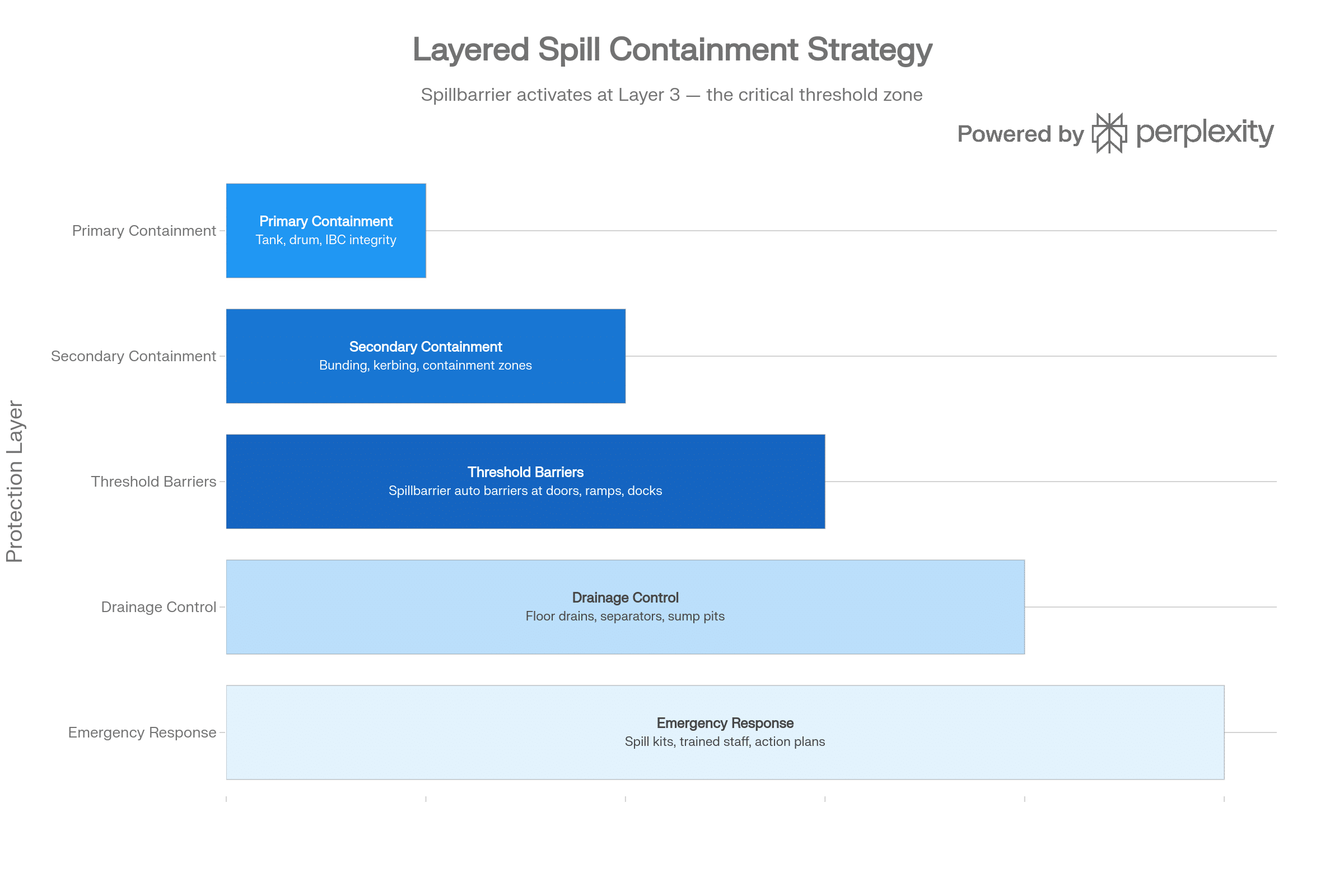
No single product can handle every spill or flood scenario. A practical way to design protection is to think in five layers, from the container itself out to emergency response.
- Primary containment: Tanks, drums and IBCs in good condition — seals, valves and connections checked regularly.
- Secondary containment: Bunds, kerbs, containment zones and spill pallets that catch leaks at the storage point.
- Threshold and opening protection: Automatic barriers at doors, ramps and loading docks that stop liquid leaving the area.
- Drainage control: Floor drains, sump pits and oil?water separators that manage any liquid reaching the drainage system.
- Emergency response: Spill kits, trained staff, clear plans and fast communication when a release occurs.
Many Singapore facilities have good bunds and spill pallets, and reasonable emergency response. The missing layer is often layer 3: protection at doors and ramps where liquid can escape the storage zone.
Spill Containment Pallets: What They Are and Where They Fit
Spill containment pallets are Layer 2 tools. They capture leaks under drums or IBCs so liquid does not reach the floor. They are widely used in chemical plants, warehouses and workshops across Singapore, and form part of a compliant secondary containment plan. But they cannot stop liquid that has already left the storage point from flowing through doors, ramps or drains.
What Are Spill Containment Pallets and How Do They Work?
A spill containment pallet is a low platform with an integrated sump. Drums or IBCs sit on a deck or grating above the sump. If liquid escapes through a loose bung, damaged valve or overfill, it falls through the grating and collects in the basin below. The liquid stays there until trained staff clean it up and dispose of it safely.
By keeping liquid inside the sump, pallets reduce slip hazards, protect concrete floors from chemical attack and help keep spills away from floor drains. For flammable liquids, confining a leak to a small sump also reduces the fire load and vapour?forming surface area compared with a wide, spreading puddle on the floor.
Key Design Elements of Spill Pallets
| Element | Description | Why it matters |
|---|---|---|
| Load capacity | Maximum weight the pallet can support, including containers and contents. | Prevent collapse or structural damage under full load. |
| Sump volume | Total capacity of the integrated basin beneath the deck. | Must match the 110% / 25% rule to comply with secondary containment requirements. |
| Chemical compatibility | Material (HDPE, steel, stainless steel) and its resistance to the stored liquids. | Prevents corrosion, swelling or cracking that could cause loss of containment. |
| Deck and grating | Removable surface that supports containers and lets liquid drain into the sump. | Makes inspection and cleaning easier and ensures leaks flow into the basin. |
| Drainage features | Drain plugs or sloped bases for removing collected liquid. | Allows safe, controlled emptying of the sump after a spill. |
| Handling | Forklift pockets or handholds for moving pallets. | Supports flexible layouts and easier housekeeping. |
Spill Pallet Types and Configurations
Different pallet sizes and layouts serve different storage needs.
| Type | Container capacity | Typical sump volume | Typical use |
|---|---|---|---|
| 1-drum pallet | 1 × 205 L drum | Approx. 110–220 L | Workshops and small decanting stations. |
| 2-drum pallet | 2 × 205 L drums | Approx. 110–220 L | Compact chemical storage or staging. |
| 4-drum pallet | 4 × 205 L drums | 220–440 L minimum | Heavy-duty setups and bulk drum storage. |
| IBC pallet | 1–2 × 1,000 L IBCs | ? 1,100 L for a single IBC | Large-volume storage in chemical plants and terminals. |
In practice, the 4?drum pallet is the standard for heavy?duty drum storage. For IBCs, a single?tank pallet must offer at least 1,100 L sump capacity to satisfy the 110% requirement.
Where Spill Pallets Reach Their Limits
Spill pallets only protect the small area directly under the containers.
They cannot stop liquid flowing:
- across open floors
- through doors
- along ramps.
In compact Singapore estates with connected drains and open loading areas, this is a real limitation. Chemical booms, drain covers and temporary storage containers can support emergency response, but they all rely on people being present and acting fast.
Important limitation
Even with good spill pallets, a spill that happens during transfer or that exceeds sump capacity can still escape through doors, ramps and drains unless there is an automatic barrier at the threshold.
Automatic Chemical Spill Barrier: How Spillbarrier Works
The Chemical Spill Barrier from Spillbarrier is a Layer 3 solution. It is installed flush in the floor at doors, ramps, loading docks and corridors. When liquid reaches the trigger mechanism, a float body lifts the barrier automatically. No power, no hydraulics and no manual deployment are needed.
The barrier rises, seals the opening and holds the liquid inside the room or zone where the release started. Once the incident is under control and clean?up is complete, the barrier can be lowered back into its floor recess and normal traffic can resume.
Because Activation depends on the liquid itself, this kind of automatic spill containment is particularly valuable in 24/7 or low?staffed areas. It works even if a spill happens at night, during a shift change or when no one is near the doorway.
Technical Specifications — Chemical Spill Barrier
| Specification | Value |
|---|---|
| Certification | TÜV NORD + DMT (RW?TÜV 9.1.1. LÖWR1/99), §62 AwSV |
| Leak?tightness | 72 hours absolutely leak?free (RW?TÜV and DMT approved) |
| Fire resistance | 730 °C (1,346 °F) for 35 minutes (DMT?tested) |
| Material | AISI 304 stainless steel with PTFE seals |
| Width range | 0.7 m – 45 m |
| Seal height range | 0.3 m – 2.40 m |
| Rolling load | 3.5 t / 200,000 load cycles (DIN 1055, TÜV NORD) |
| Impact test | FM?2501: 358 kg, Ø43 cm, 2 m drop, 2.1 m/s (~70°) |
| Activation | 100% mechanical — float?based, no power required |
| Options | SmartBarrier #getnotified, ATEX?rated versions |
How the Chemical Spill Barrier Compares to Bunds and Manual Systems
At thresholds, you usually compare three options: fixed bunds, removable flood boards and an automatic Chemical Spill Barrier. Each has strengths and gaps.
| Criterion | Static bund / kerb | Manual flood board | Chemical Spill Barrier |
|---|---|---|---|
| Activation | Permanent, passive | Manual – staff must install | Automatic – liquid?triggered |
| Power needed | No | No | No |
| Works without staff present | Yes, if correctly designed | No | Yes |
| Forklift / vehicle passable | Limited (step or ramp needed) | No, must be removed | Yes, flush with floor |
| Typical opening width | Fixed, often narrow | Limited by board length | 0.5 m – 50 m |
| Fire resistance | Depends on construction | Usually none | 730 °C / 35 min (tested) |
| Leak?tightness certification | Rare | Rare | 72?hour certification |
| Maintenance effort | Low | Training, storage, periodic checks | Annual inspection |
The biggest difference is dependency on people. Manual boards only work if someone is present, trained and fast. A Chemical Spill Barrier works even if the area is empty when the spill happens.
For deeper product?level detail, see the Spillbarrier guide on chemical spill barriers for aggressive liquids.
Key Applications in Singapore Facilities
Chemical Plant Doorways and Corridors
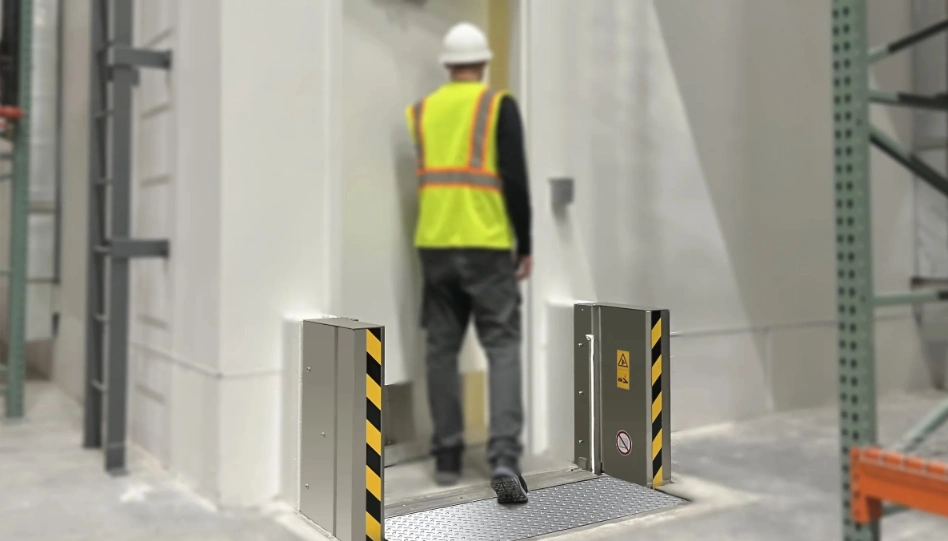
In chemical plants, corridors connecting storage rooms to process or packing areas are a common “escape route” for spills. Installing a Chemical Spill Barrier at the doorway between a chemical store and a corridor keeps spills inside the room, while still allowing free movement during normal operation.
Loading Docks and Ramps
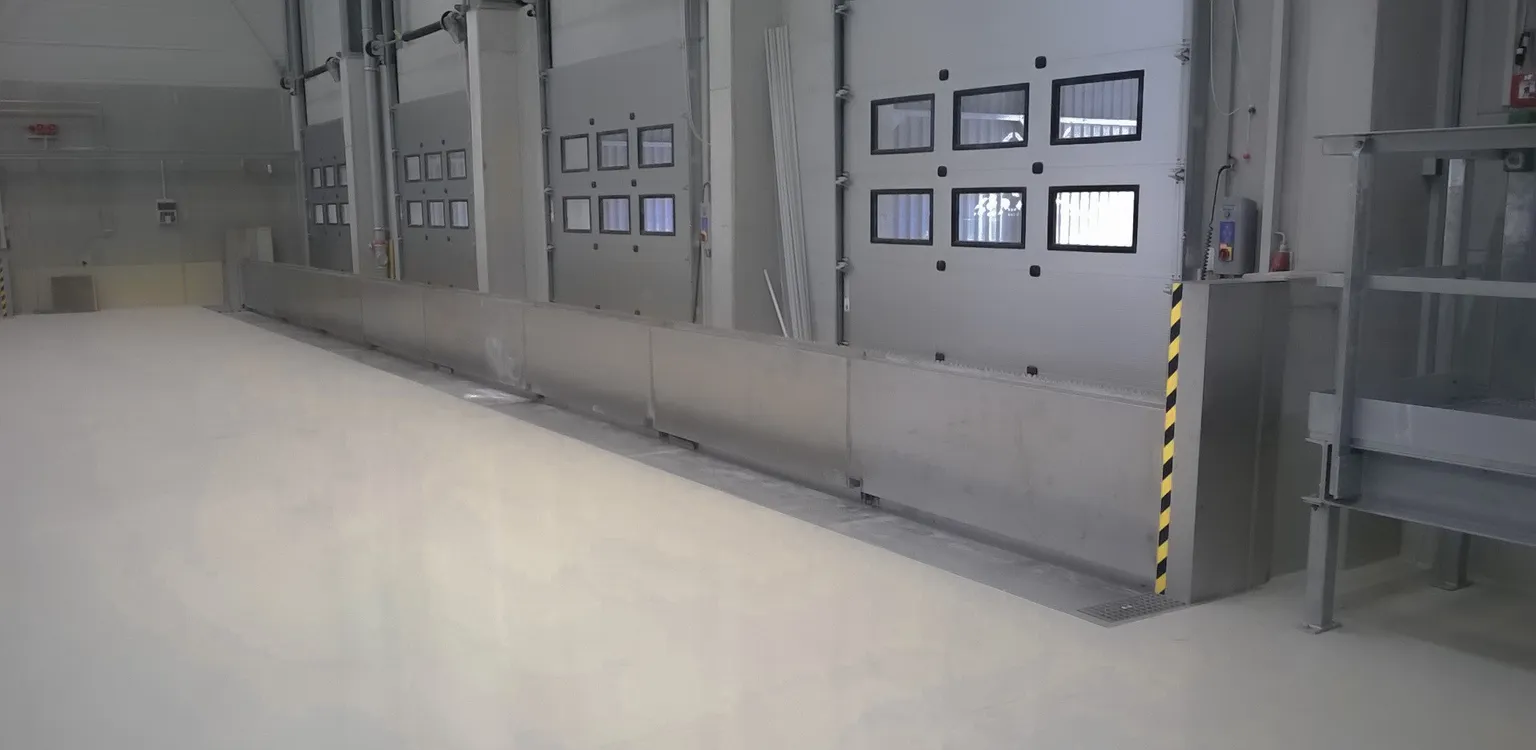
Loading docks are open, busy and often connected directly to external paving and drains. A spill from a drum or IBC during loading can run straight outside unless there is a barrier at the threshold. Because the Chemical Spill Barrier is flush with the floor and takes 3.25?tonne rolling loads, forklifts and pallet trucks can cross it without noticing it during normal work.
Warehouse Bays and Logistics Hubs
Logistics hubs handle many different products, including chemicals, in high volumes. Open?plan layouts and frequent transfers between vehicles and storage zones increase the chance that a spill travels beyond its original bay. Automatic barriers at bay entries contain liquid without waiting for manual action. Where fire is also a concern, the barrier’s fire?tested performance is an extra safety margin.
Typical risk factors in logistics hubs
- High throughput of drums and IBCs.
- Shared bays for different products.
- Shift work and varying staffing levels.
- Direct connection to external yard and drains.
Basement Plant Rooms and Substations
Basement rooms — such as switch rooms, substations and mechanical plant areas — are exposed to both chemical spills and external water ingress. A Chemical Spill Barrier at the entrance can protect against liquid from inside the room and water from outside, depending on which product version you select. This is especially relevant in buildings where basements connect to underground car parks or external ramps.
ATEX Zones and Explosive Atmospheres
In areas with flammable liquids and vapours, where explosive atmospheres are possible, ATEX?rated versions of the Chemical Spill Barrier are available. These provide automatic containment that is compatible with Zone 1 and Zone 2 requirements, so you do not have to compromise between safety and zone compliance.
Fire Safety and Spill Containment: Two Sides of the Same Problem
Spill containment is not only about environmental protection and regulatory compliance. In many chemical facilities it is also a core fire safety control. A flammable spill that spreads out over a wide floor area creates a much larger fire load and vapour cloud than the same spill held in a small volume.
When a barrier rises and seals an opening as soon as liquid reaches it, the spill stays in one zone. The area of exposed liquid stays small, which helps limit vapour formation and possible ignition points. The tested fire resistance of the Anhamm Chemical Spill Barrier means it continues to provide this function even when exposed to high temperatures.
Fire Spill Barrier for High?Fire?Load Openings
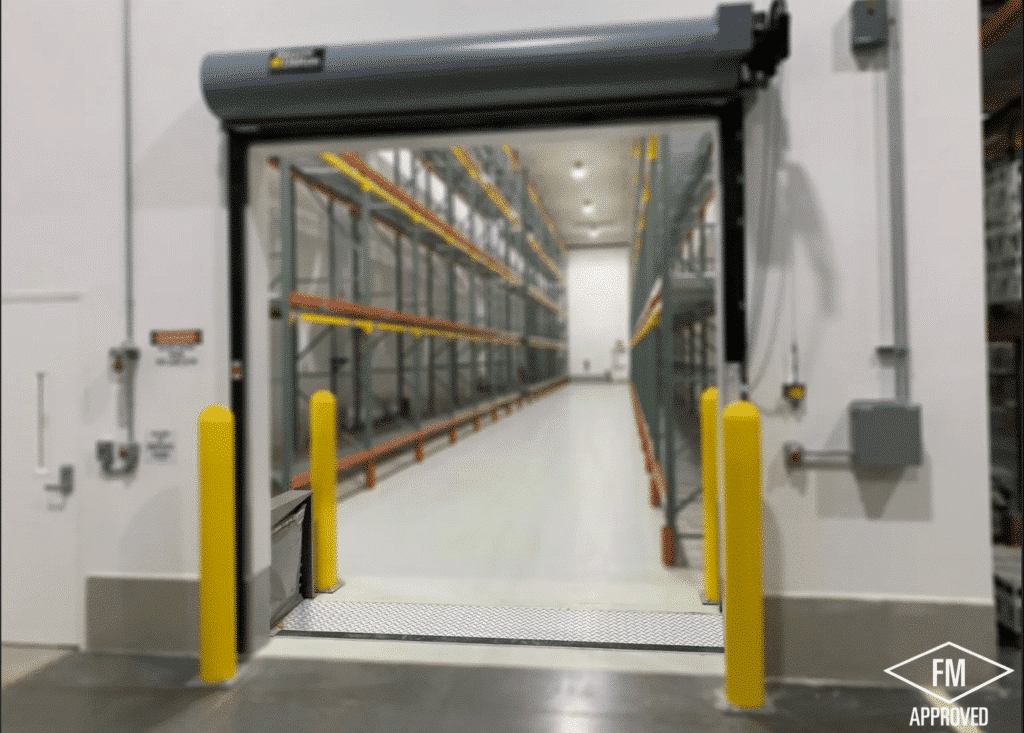
For openings where fire is the main concern, Spillbarrier offers a dedicated Fire Spill Barrier. This product is certified to FM Approval Standard 4985 and was the first in its class to receive this approval. It is designed to stay leak?tight even after exposure to intense fire, and is used at openings where flammable liquids and fire are likely to coincide – such as fuel storage rooms or high?hazard process areas.
SmartBarrier: Remote Monitoring for 24/7 Operations
Many Singapore facilities run multiple shifts or operate around the clock. For these sites, fast awareness of any barrier activation is essential. The SmartBarrier option adds monitoring and notifications to the core mechanical system.
When a Chemical Spill Barrier or Fire Spill Barrier activates, a switch in the system sends a signal via the building management system (GLT) to a control room or alarm panel. This gives operations and EHS teams real?time information that a containment event has occurred, even if no one is at the doorway.
What SmartBarrier adds
- Immediate notification when a barrier activates.
- Integration with existing GLT / building management systems.
- Better incident documentation and follow?up.
- Extra assurance for NEA and WSH emergency planning requirements.
Frequently Asked Questions: Spill Containment Singapore
What is the minimum sump capacity required for secondary containment in Singapore?
Singapore’s safety standards mandate that secondary containment must hold either 110% of the largest single container’s volume or 25% of the total stored volume in the zone — whichever is greater. For a single 1,000 L IBC, that means at least 1,100 L of sump capacity. For four 200 L drums, you need at least 220 L. Always calculate both figures and use the larger result.
Does the Chemical Spill Barrier need power to activate?
No. Activation is fully mechanical. The barrier lifts when liquid fills the float body chamber — no electricity, pneumatics or hydraulics are involved. Power is only used if you connect the optional SmartBarrier monitoring circuit, and even then the barrier itself activates without any electrical supply.
What chemicals is the Chemical Spill Barrier compatible with?
The barrier uses AISI 304 stainless steel and PTFE seals, which are suitable for most acids, alkalis, solvents, petroleum products and other industrial liquids. For extremely aggressive chemicals, AISI 316L (V4A/1.4404) can be specified on request. Always confirm compatibility against the Safety Data Sheet (SDS) for each substance before installation.
Can forklifts and heavy trucks drive over an installed Chemical Spill Barrier?
Yes. When inactive, the barrier sits flush with the floor and is rated for a rolling load of 3.5 tonnes per axle over 200,000 load cycles, tested and certified to DIN 1055 and TÜV NORD standards. Normal forklift and pallet truck operations continue without any modification or obstruction.
What is the difference between a spill containment pallet and an automatic spill barrier?
Spill containment pallets are Layer 2 devices — they capture leaks directly under drums and IBCs at the storage point, before liquid reaches the open floor. Automatic Chemical Spill Barriers are Layer 3 devices — they protect doorways, ramps and loading docks from liquid that has already escaped the storage zone. Both serve different roles and work best together: pallets at storage points, barriers at thresholds and openings.
Can the Chemical Spill Barrier be retrofitted into an existing facility?
Yes. The system is designed for retrofits. An installer cuts a recess in the floor at the doorway or ramp, sets the factory-built barrier unit into place, and commissions the activation mechanism. Work is limited to the immediate threshold and typically takes a few days per barrier. No structural modification to the wider facility is required.
Next Steps for Singapore Facility Managers
If you are responsible for chemical storage or process safety in Singapore, a good next step is to map your facility against the five?layer model. Identify:
- Where primary and secondary containment are already strong (tanks, drums, pallets, bunds).
- Where spills could travel through doors, ramps or drains without any barrier.
- Which openings handle flammable liquids and might need Fire Spill Barriers.
The Spillbarrier gallery shows real installations in similar environments worldwide. To discuss a project or request a technical proposal, you can contact the Spillbarrier team and share your floor plans, chemical inventory and NEA licence requirements.
Anhamm Liquid Barrier Products GmbH — Franz?Haniel?Strasse 47, D?47443 Moers, Germany. All technical details in this article are based on Anhamm documentation as of May 2026. Spillbarrier is the international brand at spillbarrier.com.

