Fire Resistant Barriers: Automatic Protection for Flammable Liquids

Key takeaways
- Automatic fire resistant barriers sit flush in the floor at doorways and loading gates; liquid entering the tray triggers them, and springs raise the barrier to seal the opening.
- They work mechanically, without power supply, sensors or control electronics, so a power outage during a fire does not affect activation.
- In the US, NFPA 30, OSHA 29 CFR 1910.106 and the EPA SPCC Rule (40 CFR 112) frame flammable liquid storage and secondary containment.
- Retention volume must cover the largest container plus the expected firefighting water (flow rate × duration); drains inside the area need their own solution.
- Barrier height, placement and egress must be coordinated early with the local Authority Having Jurisdiction (AHJ), including NFPA 101 life safety requirements.
Fire resistant barriers for flammable liquids are automatic containment barriers installed flush in the floor at doorways and loading gates. When a flammable liquid or contaminated firefighting water reaches them, the liquid itself triggers the barrier, which rises and seals the opening - with no manual intervention and no power supply. The Fire Spillbarrier works on this principle and was tested according to FM Approval Standard 4985 in a 50 MW fire. Anhamm has been building automatic containment barriers for over 30 years.
The uncontrolled spread of flammable liquids is among the most critical risks in industrial operations. When solvents, chemicals, or contaminated firewater flow through ground-level openings, they endanger human lives, the environment, and entire facilities. Facility managers, HSE officers, and engineers in chemical, production, and logistics facilities face the challenge of meeting NFPA 30 standards and legal requirements for containment systems - without disrupting ongoing operations.
Automatic barriers like Spillbarrier activate on liquid contact and remove the need for manual deployment. Anhamm barriers are delivered to 40 countries, in chemical warehouses, logistics centers and production facilities. Learn more about fire protection in hazardous materials warehouses in our comprehensive guide.
Safety Notice
Installation of fire resistant barriers must be performed by certified contractors. Employers must comply with OSHA 29 CFR 1910.106 and with the locally adopted fire code, which is often based on NFPA 30 or the International Fire Code.
In this comprehensive guide, you will learn:
- How automatic fire resistant barriers work and which materials are used
- Which standards and regulations (NFPA 30, OSHA 29 CFR 1910.106, EPA SPCC 40 CFR 112) apply to your facility
- Where barriers should be installed in warehouses and at loading docks, and how drains are handled
- How to correctly size systems and retrofit them into existing buildings
- What challenges arise with aggressive chemicals and firewater retention
What Are Flammable Liquids and What Hazards Do They Pose?

Flammable liquids pose a significant risk of fire, explosion, and extensive property damage in industrial operations. These substances are characterized by a low flashpoint and can form ignitable vapors at room temperature that mix with air to create dangerous conditions. Even small quantities - improperly stored or handled - can cause massive damage to buildings, equipment, and the environment during a fire event. Modern chemical spill barrier systems provide decisive protection against these scenarios.
The safe storage of flammable liquids is therefore a central topic in industrial fire safety. Specialized fire-rated safety cabinets compliant with NFPA 30 and code-compliant storage rooms are essential to minimize the risk of uncontrolled spread. These systems prevent hazardous substances from migrating into adjacent areas during a spill or fire, where they could trigger additional ignition and explosion events.
Low Flashpoint
OSHA defines a flammable liquid as any liquid with a flash point at or below 199.4°F (93°C); the most hazardous categories have flash points below 73.4°F (23°C) (29 CFR 1910.106).
Vapor Formation
Volatile substances generate dangerous vapor clouds that can rapidly spread through facilities and drainage systems, creating invisible hazards.
Rapid Spread
Liquids flow through openings, drains, and thresholds within seconds, escalating localized incidents into facility-wide emergencies.
Compliance with OSHA and NFPA Regulatory Requirements
OSHA 29 CFR 1910.106 (Flammable Liquids) defines binding requirements for the storage of flammable liquids in US industrial facilities:
- Classification into Categories 1-4 based on flash point and boiling point (NFPA 30 uses Classes IA-IIIB)
- Inside storage rooms built with fire-resistance ratings appropriate to the quantities stored
- Limits on the quantities kept in work areas outside approved storage
- Control of ignition sources in storage and handling areas
Beyond technical equipment, proper handling procedures are critical. Under OSHA HazCom (29 CFR 1910.1200), employers must train employees on the hazardous chemicals in their work area at initial assignment and whenever a new chemical hazard is introduced. Our overview of safety measures for chemicals and fire hazards provides practical, actionable recommendations for facility managers. Portable fire extinguishers are inspected and maintained per NFPA 10, sprinklers per NFPA 25 and fire alarm systems per NFPA 72.
Compliance with legal requirements and industry-specific standards is not merely an obligation - it protects human life, property assets, and the environment. The Spillbarrier Fire Protection System integrates into existing fire safety plans and is designed to meet NFPA 30 and EPA SPCC requirements. Organizations that invest in proactive fire protection minimize the risk of fire damage, production downtime, and long-term liability exposure - while ensuring a safe working environment for all personnel.
Fundamentals of Fire Resistant Barriers: What Are Automatic Containment Systems?
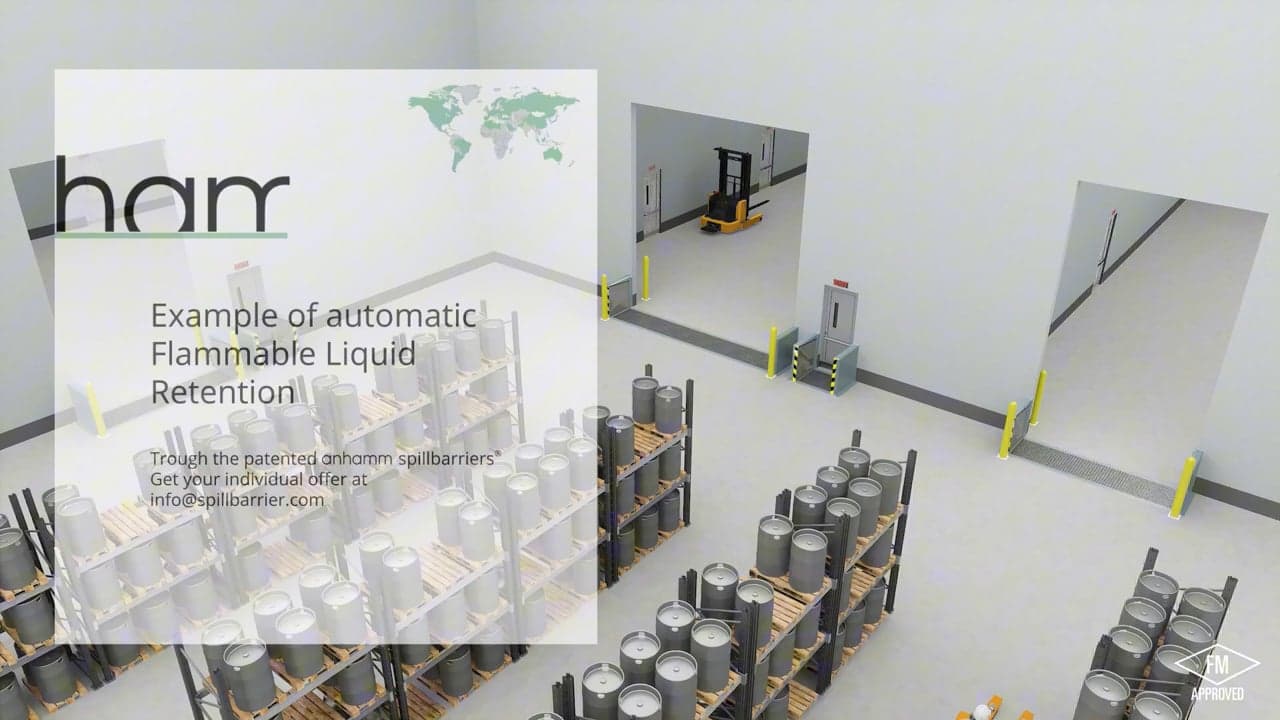
Playing loads the video from Vimeo.
Fire resistant barriers are specialized containment systems that combine passive fire protection principles with automatic liquid retention. The term “fire resistant barrier” describes mechanical protective systems that activate autonomously upon liquid contact and seal openings to prevent the spread of flammable substances, chemicals, or contaminated firewater into adjacent fire compartments. They form a critical protective layer between hazard zones and neighboring areas of a facility. For more detail on liquid barriers for aggressive chemicals, see our specialist guide.
In addition to fire resistant barriers, secondary containment structures such as drip pans and spill berms play a central role in the safe storage and leakage protection of flammable liquids in industrial settings. The fire behavior of building components is typically rated per UL 263 (equivalent to ASTM E119), the US standard for fire resistance ratings of building components and assemblies.
Key Difference: Fixed Curbs vs. Automatic Barriers
Passive systems like fixed concrete curbs are permanently visible and impede forklift and vehicle traffic. Automatic barriers like Spillbarrier are flush-mounted in the floor and allow normal traffic flow with forklifts and vehicles. Only upon liquid contact do they activate independently.
This makes them a practical solution for facilities that need to combine workplace safety with operational efficiency.
Fire alarm systems and detection devices such as smoke detectors and heat sensors complement passive barriers by identifying fire events early, enabling faster emergency response. The control of flames and smoke is critical in industrial fires, as smoke can often be more dangerous than the flames themselves - requiring dedicated protective measures such as smoke exhaust systems and fire resistant barriers working in coordination.
How Does an Automatic Fire Resistant Barrier Work? Technology and Activation
The float mechanism is the core of the automatic barrier. Liquid - whether a flammable substance, a chemical or firefighting water - flows into the openings of the barrier tray set into the floor. As it collects, it floats the mechanism up and releases the barrier; springs then fold the barrier into an upright, sealed position at the sealing height specified for the project.
Activation Sequence of a Spillbarrier System
- Fluid intake: Flammable substances, chemicals or contaminated firewater enter the barrier tray
- Automatic triggering: The collected liquid floats the mechanism up and releases the barrier
- Sealing and retention: Springs fold the barrier into an upright, fully sealed position
Key technical features:
- Energy-free activation: No power supply, no sensors, no control electronics required
- Materials: AISI 304 stainless steel with PTFE seals
- Independent of power: A power outage during a fire does not affect activation, unlike electrically operated doors and gates
The Fire Spillbarrier has been tested according to FM Approval Standard 4985 in a 50 MW fire test.
The barrier can also be combined with fire alarm systems and detection devices such as smoke detectors, sprinkler systems, and automatic suppression systems to ensure early fire detection and rapid coordination with local emergency services. Fire alarm systems, including their monitoring and the transmission of alarms to the fire department where required, are covered by NFPA 72.
What Types of Fire Protection Barriers Are There?
Different barrier types are deployed depending on the installation location and protection objective. Selection depends on building structure, the substances being stored, and the applicable standards and code requirements.
| Barrier Type | Installation Location | Typical Application | Retention Volume |
|---|---|---|---|
| Threshold Barriers | Doorways, loading gates | Loading docks, bay doors, storage rooms | Confirmed per project |
| Compound Barriers | Multiple openings | Complex fire compartments, multi-zone facilities | Confirmed per project |
1. Threshold Barriers: Protection at Gates and Doorways
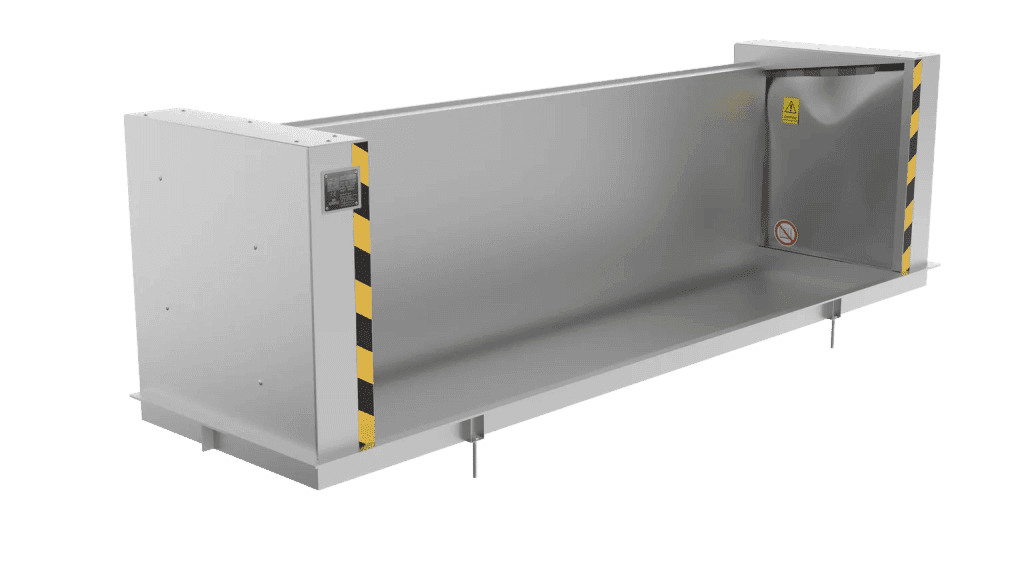
Threshold barriers are low-profile systems flush-mounted in the floor in front of gates, doors, or loading docks. In their resting state, they allow unrestricted movement of forklifts, trucks, and personnel. As soon as liquid reaches the threshold, a stainless steel plate automatically rises, sealing the opening completely.
What does this look like in practice? Picture a rectangular stainless steel cassette running the full width of a bay door opening - similar to a door threshold, but with an integrated float mechanism. The cassette is made to measure for the opening width. When liquid enters, a solid plate rises from the cassette and forms a watertight barrier.
Typical installation locations:
- Loading docks: Preventing solvent release during tanker unloading accidents or delivery spills
- Bay doors: Separating flammable liquid storage areas from the rest of the production hall
- Chemical storage room entries: Containment during tank or vessel leakage incidents
- Workshop doors: Retaining oils, hydraulic fluids, or coolants from machinery
The Spillbarrier Fire Protection System is an example of this barrier type. It is particularly well-suited for areas that require frequent forklift access during normal operations but must be sealed as soon as a spill occurs.
Illustrative Example: Loading Dock at a Chemical Plant
A bay door opening is protected by a flush-mounted Spillbarrier threshold. During normal operations, forklifts drive over the low-profile threshold without restriction. During a spill at a tanker unloading station, the barrier activates automatically and keeps the spilled liquid inside the dock area until the fire department arrives on-site.
2. Floor Drains and Drainage Systems
Floor openings matter as much as doorways: a drain inside a containment area can carry spilled liquid or contaminated firefighting water out of the building. Drains in these areas therefore need their own solution - for example omitting them, connecting them to a dedicated containment system or fitting shut-off arrangements. FM Global Data Sheet 7-83, Drainage and Containment Systems for Ignitable Liquids, addresses the design of such systems. Which closure is suitable for a given drain is clarified during project planning.
Compliance Note
Under the EPA SPCC Rule, facilities that store oil above threshold quantities must provide secondary containment; for bulk storage tanks this means the entire capacity of the largest single container plus sufficient freeboard for precipitation (40 CFR 112.8(c)(2)). State environmental rules can add requirements for other hazardous liquids.
3. Compound Barriers: Protecting Complex Fire Compartments
Compound barriers are not a standalone barrier type - they are a coordinated combination of several threshold barriers, together with measures for drains, that form an integrated protection system. Picture a large storage facility with multiple bay doors, access points, and drainage locations: a compound system protects all openings simultaneously and in a coordinated manner.
What does this look like in practice? For example, three bay doors and two connecting corridor doors are equipped with threshold barriers, and the drains inside the area are closed off or connected to a containment system. All systems operate independently of one another but together form a “security perimeter” around the critical area. When an incident occurs, the barriers activate automatically - regardless of which direction the liquids are flowing.
Why are compound barriers necessary? Modern industrial facilities are complex: a chemical warehouse has not just one entry point, but multiple access routes, emergency exits, connecting doors to production halls, and a branching drainage system. A single barrier would only protect one exit point - the liquids would simply flow out through other openings. A compound system covers all potential escape routes and creates comprehensive containment that helps meet NFPA 30 and EPA SPCC requirements.
Typical installation locations:
- Multi-zone chemical warehouses: Protection of adjacent storage areas with different hazmat classifications
- Production facilities with integrated raw material storage: Separation of processing areas, storage rooms, and shipping zones
- Fueling and service station complexes: Coordinated sealing of fueling area, service bays, and storm drain infrastructure
Spillbarrier systems can be combined in modular configurations to precisely match the requirements of your facility. System design is based on facility floor plans, risk assessment documentation, and applicable NFPA and EPA standards - developed by our engineering team.
Planning Tip for Compound Systems
When sizing a compound system, total retention volume is the critical factor: the system must contain not only the stored liquids, but also the expected volume of firefighting water. Multiply the expected suppression water flow by the expected duration of firefighting: for example, 500 liters per minute (about 130 gallons per minute) over 30 minutes already adds 15,000 liters (about 4,000 gallons) that must remain within the fire compartment. Determine the required volume with your fire protection engineer and insurer, using the applicable guidance, such as FM Global Data Sheet 7-83.
Industrial Applications: Where Are Fire Resistant Barriers Used?
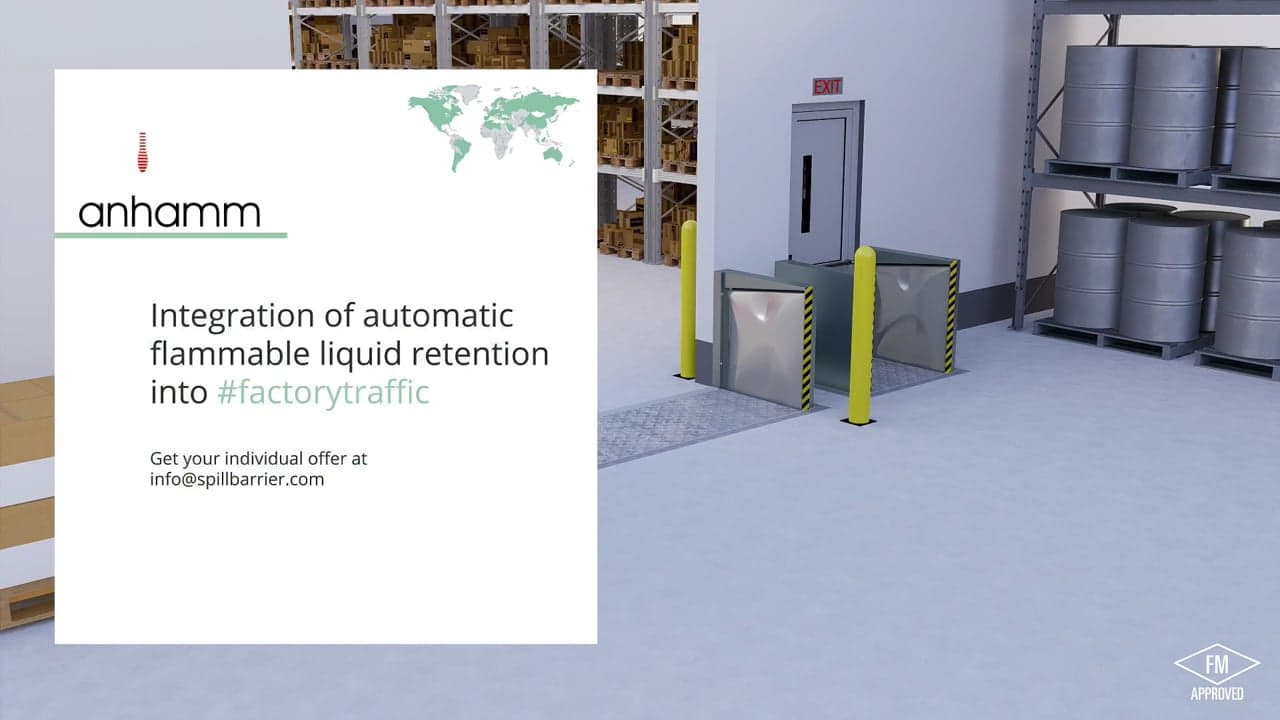
Playing loads the video from Vimeo.
Building on the technical foundations outlined above, it becomes clear that automatic fire resistant barriers are relevant across virtually every industry where flammable liquids are present. Tailored solutions are essential to meet the individual requirements of different sectors and ensure optimal protection against the spread of flammable liquids.
Chemical Warehouses and Production Facilities
Chemical warehouses and fueling areas are the classic installation environments for fire resistant barriers. Large quantities of flammable liquids with low flashpoints are stored here, enabling rapid spread during a fire or spill event. For effective protection, UL-listed or FM-approved secondary containment systems are frequently deployed below storage vessels to capture leakages and prevent fire spread. Our expertise in fire protection for warehouses and logistics centers outlines proven containment strategies for US industrial facilities.
Typical application areas:
- Chemical warehouses: Retention of solvents, paints, and aggressive hazardous substances using Spillbarrier Chemical Spill Protection systems
- Production halls: Protection against spread during machinery leaks or process upsets
- Loading docks: Preventing discharge through bay door areas during transfer operations
- Fueling areas: Containment during vehicle fueling accidents or infrastructure leaks
- Firewater retention: Environmental protection against contaminated suppression water discharge
Which Standards and Regulations Apply to Fire Resistant Barriers?
No single US standard covers automatic containment barriers as such. The requirements come from the rules for flammable liquid storage, spill prevention and drainage below, applied by the local Authority Having Jurisdiction. For complementary regulatory guidance, see our overview of fire protection measures for industrial companies.
| Standard / Regulation | Jurisdiction | Relevance for Containment Barriers |
|---|---|---|
| NFPA 30 | United States | Flammable and Combustible Liquids Code - storage, handling, fire protection requirements |
| OSHA 29 CFR 1910.106 | United States (Federal) | OSHA Flammable Liquids standard - workplace storage and handling requirements |
| EPA SPCC Rule (40 CFR 112) | United States (Federal) | Spill Prevention, Control, and Countermeasure - secondary containment requirements for oil storage |
| FM Global DS 7-83 | United States / International | FM Global Data Sheet on drainage and containment systems for ignitable liquids |
| UL 263 / ASTM E119 | United States | Standard fire resistance tests for building construction and materials |
| NFPA 30 / UL 1275 | United States | Fire-rated flammable materials storage cabinets |
| ICC-ES / UL Listing | United States | Building product evaluation and certification for code compliance |
Compliance Requirement
Coordination with the local Authority Having Jurisdiction (AHJ) and your facility’s fire marshal is required to correctly determine barrier height requirements. Barriers must not obstruct required means of egress, so their height and placement are reviewed against the applicable life safety code, such as NFPA 101.
Spillbarrier System Technology: Technical Specifications
Spillbarrier systems are designed to meet NFPA 30 requirements. Anhamm has been building automatic containment systems for over 30 years; its barriers are delivered to 40 countries, with more than 2,000 projects.
Technical specifications:
- Material: AISI 304 stainless steel with PTFE seals
- Activation: 100% mechanical, triggered by the liquid itself; no external power
- Width: Made to measure for the opening width
- Sealing height and retention volume: Confirmed per project
- Chemical resistance: Confirmed per application against the substance list
- Drive-over capability: Tested under RW-TÜV supervision (DIN 1055); the load rating for your traffic is confirmed during project planning
- Fire test: Fire Spillbarrier tested according to FM Approval Standard 4985 (50 MW fire), leak-proof afterwards
- Options: SmartBarrier notifications, audible and visual signals
Installation is possible in both new construction and existing facilities. The barrier is supplied as a complete, factory-adjusted unit and suits both new builds and retrofits; unlike raised curbs, it leaves the floor passable. The Fire Spillbarrier requires no electrical connection and requires minimal maintenance. Full technical specifications are available in the technical datasheet (PDF).
Planning and Installation: How Are Containment Systems Sized?
The practical implementation of automatic liquid containment systems requires a systematic design process based on risk assessment, regulatory requirements, and existing building conditions. From the planning phase onward, coordination with the local Authority Having Jurisdiction (AHJ) and your fire marshal is a central component - particularly regarding barrier heights, egress path compliance, and NFPA 101 life safety requirements. Facility managers should identify critical installation points early and verify chemical compatibility.
When Is a Barrier Design Assessment Required?
Whenever flammable liquids are stored, processed, or transferred in a facility and the potential exists for those liquids to spread through ground-level openings to other areas or the environment.
The Design Process in Four Steps
1. Conduct Risk Analysis and Hazard Assessment
Identify all areas with fire or spill risk from flammable liquids. NFPA 30 and OSHA 29 CFR 1910.106 provide classification guidance, while the building and fire codes define fire separation requirements. Facilities subject to the EPA SPCC Rule (40 CFR 112) must also prepare an SPCC Plan.
2. Calculate Required Retention Volume per EPA SPCC / NFPA 30
Required volume is determined by the quantity stored, the flashpoint classification of the substances, and the requirements of the EPA SPCC Rule (40 CFR 112) and NFPA 30. A practical starting point is the capacity of the largest container (plus freeboard for precipitation outdoors, as 40 CFR 112.8(c)(2) requires for bulk storage tanks) plus the expected firefighting water: flow rate × expected duration.
3. Define Installation Points
Doors, bay gates, floor drains, and drainage systems are the critical locations. Evaluate every point where liquids could migrate into adjacent fire compartments or reach the environment - including storm drains that fall under EPA jurisdiction.
4. Determine Chemical Compatibility
Material compatibility must be verified for the specific substances stored, including the seals.
Planning Tip
Engage your local Authority Having Jurisdiction (AHJ) and fire marshal early in the planning process. Coordination on barrier heights and egress path compliance is critical for permit approval and NFPA 101 life safety code adherence.
Comparing Barrier Technologies: Which System Fits Your Facility?
Selecting the right technology depends on required response time, maintenance burden, and certification requirements. The table below helps facility managers and HSE officers make the right decision for their specific operational context.
| Criterion | Automatic Spillbarrier System | Mobile Spill Berms | Permanent Raised Curbs |
|---|---|---|---|
| Response Time | Automatic on liquid contact | Minutes (manual deployment) | Permanently active |
| Maintenance Burden | Minimal (periodic inspection) | Regular inspection required | Minimal |
| Certification | supervised by RW-TÜV and tested by DMT | Variable | Usually none |
| Forklift / Vehicle Access | Yes (flush-mounted in floor) | No (requires setup/teardown) | Restricted |
| Personnel Risk | Low (no manual deployment) | High (manual deployment in hazard zone) | None |
| Installation Cost | Confirmed per project | Low | Construction work required |
| Long-Term Reliability | Confirmed per project | Depends on storage conditions | Very high |
Decision guide: Automatic Spillbarrier systems are a good fit when fast response without personnel risk is required and the area must remain passable during normal operations. Mobile spill berms serve as a useful supplement for temporary or emergency-response scenarios. Permanent raised curbs are appropriate only where an area can be permanently segregated and vehicle access is not required.
Common Challenges and Solutions
Recurring implementation challenges arise across industries when installing automatic liquid containment systems. Delivering effective spill protection requires tailored solutions precisely matched to each facility’s specific operational requirements. The following solutions are based on experience from more than 2,000 projects across diverse industrial sectors in the US and internationally.
Retrofitting Existing Buildings
Retrofitting fire resistant barriers into existing buildings is achievable without major construction work. The low-profile design of the Spillbarrier system allows integration into existing floor structures with minimal disruption. Similar retrofit principles apply to automatic barriers for property perimeters in flood protection applications.
The Spillbarrier solution for retrofit installation:
- Complete unit: Supplied as a complete, factory-adjusted unit
- Made to measure: Built for the width of the opening
- Integration into existing fire compartments: No change to structural building elements around the opening
- Phased installation: Openings can be equipped one after another to keep operations running
Chemical Resistance for Aggressive Substances
Material compatibility must be verified case-by-case, as aggressive hazardous substances place specific demands on containment systems. AISI 304 stainless steel resists many industrial liquids, but not all: chlorides and some strong acids attack it. That is why compatibility, including that of the PTFE seals, is checked against the actual substance list. For detailed guidance, refer to our specialist resource on liquid containment barriers for aggressive chemicals.
Key factors to assess for chemical compatibility:
- pH range of stored substances
- Liquid temperature range
- Concentration levels and duration of liquid contact
- Potential chemical mixtures or reactions between co-stored substances
- Organic solvents and petroleum-based hydrocarbons
- Oxidizing substances, strong mineral acids, and caustic alkalis
Safety Notice
Spillbarrier recommends a case-by-case chemical compatibility review for each new application environment. Contact our technical team with your specific substance list for a compatibility assessment prior to system specification.
Integration with Automatic Sprinkler and Suppression Systems
Where firefighting water may be contaminated, its retention is part of the overall fire protection design. Automatic Spillbarrier systems operate seamlessly alongside fire alarm systems, smoke detection devices, NFPA 13-compliant sprinkler systems, and automatic suppression systems - ensuring coordinated emergency response from the moment a spill is detected through full fire department engagement.
Emergency coordination in a fire event:
- Barrier activates independently of fire alarm panel upon direct liquid contact
- Contaminated firewater is retained within the building perimeter
- Hazardous substances are kept out of drains and waterways
- Defined retention zones support fire department operations with predictable containment boundaries, enabling faster suppression and safer access
Active fire protection systems detect fires early and trigger immediate alarms, enabling rapid suppression response. Regular inspection and testing of all integrated systems - per NFPA 25 (Inspection, Testing, and Maintenance of Water-Based Fire Protection Systems) - is essential to ensure long-term operational reliability across the complete fire protection system.
Conclusion and Next Steps
Automatic Spillbarrier systems provide an automatic solution for the retention of flammable liquids, hazardous chemicals, and contaminated firewater. They are triggered by the liquid itself, need no power and no manual deployment during a fire emergency.
Investing in automatic fire resistant barriers protects lives, minimizes property losses, and reduces long-term environmental liability - the three pillars of a defensible industrial fire safety program.
Actionable next steps for your facility:
- Conduct a hazard assessment for all areas storing or handling flammable liquids per NFPA 30 and OSHA 29 CFR 1910.106
- Identify all critical openings (bay doors, floor drains, threshold crossings, connecting corridors)
- Verify chemical compatibility for the specific substances handled in each area
- Coordinate required retention volume calculations with your AHJ, fire marshal, and EPA SPCC consultant
- Review NFPA 30, EPA SPCC (40 CFR 112), and applicable state fire and environmental codes for current compliance status
Plan Your Project with Spillbarrier
Protect your facility, your workforce, and the environment with automatic containment systems designed to meet NFPA 30 and EPA SPCC requirements. Our team offers a free, no-obligation consultation by phone, email or on site.
Full technical specifications, installation requirements, and certification documentation are available in the technical datasheet (PDF).
Frequently Asked Questions (FAQ)
How does an automatic barrier work without power?
The mechanism is entirely mechanical. Liquid flowing into the barrier tray floats the mechanism up and releases the barrier, and springs fold it into an upright, sealed position. No sensors, no electronics and no external power source are required, so a power outage during a fire does not affect activation. Anhamm barriers are delivered to 40 countries, with more than 2,000 projects.
What standards apply to firewater retention systems in the United States?
In the US, the EPA Spill Prevention, Control, and Countermeasure (SPCC) Rule under 40 CFR 112 establishes secondary containment requirements for facilities storing oil above threshold quantities. NFPA 30 (Flammable and Combustible Liquids Code) governs storage and containment design. FM Global Data Sheet 7-83 provides additional guidance on drainage and containment systems for ignitable liquids. OSHA 29 CFR 1910.106 addresses workplace requirements for flammable liquid storage. Coordination with the local Authority Having Jurisdiction (AHJ) and your fire marshal is required for correct system sizing and permit approval.
Can Spillbarrier systems contain aggressive chemicals?
Often, but chemical compatibility must be verified for each application. AISI 304 stainless steel and PTFE seals resist many industrial liquids, but not every substance. For specialty hazardous substances, chemical mixtures, or elevated temperature applications, we recommend a case-by-case compatibility review by our technical team. Contact us with your substance data sheet (SDS) list for a pre-specification assessment.
Where should barriers be installed in warehouses?
Barriers should be installed at every floor-level opening through which flammable liquids could migrate into adjacent fire compartments or reach the environment. Typical locations include:
- Bay doors and loading dock thresholds
- Loading and unloading areas
- Transition points between storage rooms and production areas
- Connecting corridor doors
Drains inside the protected area need their own solution. A hazard assessment per NFPA 30 and OSHA 29 CFR 1910.106 identifies the critical locations, and our team can review your layout during a consultation.
Do automatic barriers replace secondary containment?
No. A barrier closes floor-level openings so that a room or hall can hold back spilled liquid and firefighting water, but the containment as a whole still has to be designed: the required volume, liquid-tight floors and walls, and the handling of drains. Barriers complement bunds, diked areas and containment pits; they do not replace the volume calculation.
What maintenance do automatic containment systems require?
Requirements are minimal because the barrier works mechanically, with no electrical components. Seals should be inspected periodically, especially where aggressive chemicals are handled. Inspection intervals and procedures are set out in the manufacturer’s documentation, and optional service contracts with customized intervals are available.
Are Spillbarrier systems NFPA- and FM-approved?
The Fire Spillbarrier has been tested according to FM Approval Standard 4985 in a 50 MW fire test, and Spillbarrier systems are designed to meet NFPA 30 requirements. For specific compliance documentation, UL listing status, or FM approval inquiries, contact our technical team.
Spillbarrier Fire Safety Editorial Team
The Spillbarrier Fire Safety Editorial Team consists of fire protection engineers, technical writers, and specialists in passive fire containment systems. Our focus:
- Development of low-maintenance, code-compliant automatic liquid containment systems by Anhamm Spillbarrier
- Clear, practical guidance on US fire protection regulations (NFPA, OSHA, EPA) for industrial facility managers
- Honest technical information without exaggerated claims - grounded in real-world installation experience
- Support for facility managers through hazard assessments, retrofit planning, and compliance documentation
Disclaimer: This article does not substitute for professional engineering design by a licensed fire protection engineer. For project-specific guidance, consult a qualified fire protection contractor or registered engineer. All installations must comply with applicable local fire codes, building codes, and environmental regulations. Referenced standards and regulations are subject to revision - verify current versions with the issuing authority (NFPA, OSHA, EPA) before implementation.