Fire protection in hazardous materials warehouses: Protection against flammable liquids
Key takeaways
- Fire protection for flammable liquid storage combines approved containers and cabinets, spill control and drainage, firewater containment and suppression designed for liquid fires.
- OSHA 29 CFR 1910.106 defines flammable liquids as liquids with a flash point at or below 199.4 °F (93 °C), divided into four categories.
- OSHA requires openings of inside storage rooms to have liquid-tight sills or ramps at least 4 inches high, a recessed floor or an open-grated trench draining to a safe location.
- Containment must hold the leaked liquid and the contaminated sprinkler and hose water; doors, docks and forklift routes are the usual weak points.
- CO2 total flooding is lethal at its minimum design concentration of 34 percent (US EPA), so it suits only enclosed spaces that people can be kept out of.
Fire protection in a hazardous materials warehouse comes down to three things: storing flammable liquids in approved containers, cabinets and rooms within the quantity limits of the code; stopping a leak, and the burning liquid and contaminated firefighting water that follow it, from spreading beyond the storage area; and installing suppression designed for liquid fires. In the United States the main documents are NFPA 30, OSHA 29 CFR 1910.106 and the International Fire Code (IFC), in the editions your state or city has adopted.
This guide explains how those rules fit together, why doors and loading docks are the weak points of most containment concepts, and which fire protection measures are worth comparing. For sprinkler design and fire safety in general-purpose warehouses, see our warehouse fire protection guide.
Why flammable liquid storage needs its own fire protection concept
In an ordinary warehouse a fire tends to stay where the fuel is. A flammable liquid behaves differently. Once a container leaks, or fails in the heat, the liquid runs across the floor, under doors and into drains, and a pool fire spreads with it. Most flammable liquids do not mix with water and are lighter than it, so when sprinklers or hose streams operate, burning liquid can be carried on the water surface into areas that were not yet involved.
That is why the codes treat container storage, spill control, drainage and automatic fire protection as one system. A sprinkler design for a liquid storage room assumes the liquid stays within a known area. An opening without a sill, or containment that is too small, undermines that assumption.
Which liquids count as flammable?
OSHA defines a flammable liquid as any liquid with a flash point at or below 199.4 °F (93 °C) and divides flammable liquids into four categories (29 CFR 1910.106(a)(19)):
| OSHA category | Flash point | Initial boiling point |
|---|---|---|
| Category 1 | Below 73.4 °F (23 °C) | At or below 95 °F (35 °C) |
| Category 2 | Below 73.4 °F (23 °C) | Above 95 °F (35 °C) |
| Category 3 | 73.4 °F to 140 °F (23 °C to 60 °C) | Not a criterion |
| Category 4 | Above 140 °F up to 199.4 °F (60 °C to 93 °C) | Not a criterion |
NFPA 30 and the IFC use their own classes (Class I, II and III liquids, with subclasses such as IA or IIIB), also based on flash point and boiling point. The two systems are similar but not identical, so check which one the applicable rule uses before comparing quantity limits. Section 9 of the safety data sheet gives the flash point and boiling point you need.
US regulations for flammable liquid storage
NFPA 30: Flammable and Combustible Liquids Code
NFPA 30 is the US code for the storage, handling and use of flammable and combustible liquids. For container storage it regulates quantities and storage arrangements in storage rooms and warehouses and ties them to automatic fire protection. In the 2024 edition, Chapter 16 is titled “Automatic Fire Protection for Control Areas, Liquid Storage Rooms, and Liquid Warehouses”. It does not apply to Class IA liquids, because no full-scale fire tests exist for them (Viking Group, 2024). The same article notes that full drainage and containment systems are often impractical in liquid warehouses that are leased or have no room to expand, which is one reason to plan containment at openings early.
NFPA 30 has no legal force on its own. It applies through the building and fire codes your jurisdiction has adopted, sometimes in an older edition, and insurers may ask for more.
OSHA 29 CFR 1910.106
OSHA’s flammable liquids standard sets minimum workplace requirements. For container storage it includes (29 CFR 1910.106(d)):
- Storage cabinets: not more than 60 gallons of Category 1, 2 or 3 liquids, or 120 gallons of Category 4 liquids, per cabinet. In a 10-minute fire test using the standard time-temperature curve, the cabinet must keep its internal temperature at or below 325 °F, with joints tight and doors closed.
- Inside storage rooms: openings to other rooms or buildings need noncombustible, liquid-tight raised sills or ramps at least 4 inches high, or the storage floor must be at least 4 inches below the surrounding floor. An open-grated trench inside the room that drains to a safe location is a permitted alternative. The room must be liquid-tight where the walls meet the floor.
- Leaking containers: they must be moved to a storage room or a safe location outside and their contents transferred to an undamaged container.
International Fire Code, Chapter 57
Most US jurisdictions regulate flammable liquid storage through the IFC. Chapter 57 covers flammable and combustible liquids and refers to the general hazardous materials provisions of Chapter 50. An ICC technical article on the 2015 edition explains that spill control and secondary containment under Section 5004.2 apply once the maximum allowable quantity (MAQ) per control area is exceeded, and that Class IIIB combustible liquids have no mandatory spill control or secondary containment (ICC Building Safety Journal). How fire protection water has to be included in the containment volume is a point to settle with the fire code official.
| Document | Type | Most relevant for warehouses |
|---|---|---|
| NFPA 30 | Consensus code, applies where adopted | Storage arrangements, liquid storage rooms and warehouses, automatic fire protection |
| OSHA 29 CFR 1910.106 | Federal workplace regulation | Liquid categories, cabinets, storage room sills, ramps and trenches |
| IFC Chapters 57 and 50 | Model fire code, applies where adopted | MAQ per control area, spill control and secondary containment |
Spill control and firewater containment: why doors and docks matter
Containment for a flammable liquid store has to hold more than the leaked product. When sprinklers, foam-water systems or fire department hose lines operate, they add large volumes of water that mix with it. That water is contaminated. If it reaches storm drains, a sewer or open ground, a warehouse fire becomes an environmental incident, and burning liquid floating on the water can carry the fire into neighbouring areas.
How much has to be retained depends on the suppression design (flow rate and duration), the area that can be involved, the quantity of liquid stored and the drainage paths. Those figures come from your fire protection engineer and the authority having jurisdiction (AHJ). Insurers often have their own criteria; FM Global, for example, publishes a property loss prevention data sheet on drainage and containment systems for ignitable liquids (DS 7-83).
Openings are the weak point
Walls and a sealed floor are relatively easy to make liquid-tight. Openings are harder: personnel doors, fire doors to the main warehouse, rolling doors, loading docks and forklift routes. A fire door stops flames and smoke, but it is not designed to hold back liquid flowing underneath it. For inside storage rooms, OSHA’s answer is a 4-inch liquid-tight sill or ramp, a recessed floor or an open-grated trench draining to a safe location.
On a busy traffic route each option has a cost. Fixed sills and ramps slow forklifts, can unsettle loads and create trip hazards. Trench drains need a safe destination with enough capacity and regular cleaning. Recessed floors are realistic mainly in new construction.
Questions to check at every opening of a flammable liquid storage area:
- Which openings would a spill reach first, given the floor slope and the drain locations?
- Is there a sill, ramp, trench or barrier, and is it liquid-tight across its full width, including the joints with the walls?
- Does the containment height multiplied by the floor area give the required volume, after allowing for the space taken up by racks and stored goods?
- Where does sprinkler and hose water go with the doors closed, and where with the doors open?
- Are floor drains inside the area sealed or routed to a containment tank rather than the storm sewer?
Storage measures that reduce the fire risk
- Approved containers and cabinets. Keep liquids in closed, approved containers, and use flammable liquid storage cabinets for small quantities in work areas.
- Quantity limits and separation. Respect the MAQ per control area and separate liquid storage from other areas with fire-rated construction where the code requires it.
- Segregation. Keep incompatible substances, such as oxidizers, away from flammable liquids, following the safety data sheets.
- Ignition sources. Control hot work, use electrical equipment suited to the hazardous location, and bond and ground containers during transfer.
- Ventilation. Ventilate storage rooms to prevent vapor build-up, especially where containers are opened or liquids are dispensed.
- Inspection and housekeeping. Check containers for leaks, keep aisles and exits clear, and keep absorbents and spill kits within reach.
Fire suppression for flammable liquid storage
Sprinklers and foam-water systems
Automatic sprinklers designed to NFPA 30 Chapter 16, together with NFPA 13, are the usual protection for liquid storage rooms and liquid warehouses. The required design depends on the liquid class, the container type and size, the storage height and the arrangement. Some combinations call for foam-water or in-rack protection, and for some there is no tested protection scheme at all. The design also fixes the water flow that the containment has to handle.
CO2 extinguishing systems
Carbon dioxide extinguishes a fire by displacing oxygen, leaves no residue and does not conduct electricity. It is not a general solution for a warehouse where people work. The US EPA points out that the minimum design concentration for total flooding is 34 percent, which is lethal, and that concentrations above 17 percent can cause unconsciousness and death within one minute; most of the incidents it reviewed occurred during maintenance (US EPA). NFPA 12 calls for safeguards such as a supervised lock-out, pre-discharge alarms and time delays. CO2 is best limited to enclosed spaces that people can be kept out of during a discharge.
Oxygen reduction
Oxygen reduction systems feed nitrogen into a closed building to keep the oxygen level permanently below the level at which the stored materials can ignite. They are used in some high-bay and cold-storage warehouses. For flammable liquids the required oxygen level depends on the substances, a reduced-oxygen atmosphere puts conditions on staff access, and the system only works in a tight building envelope. It needs a specialist assessment and does not replace spill containment.
Where an automatic spill barrier fits
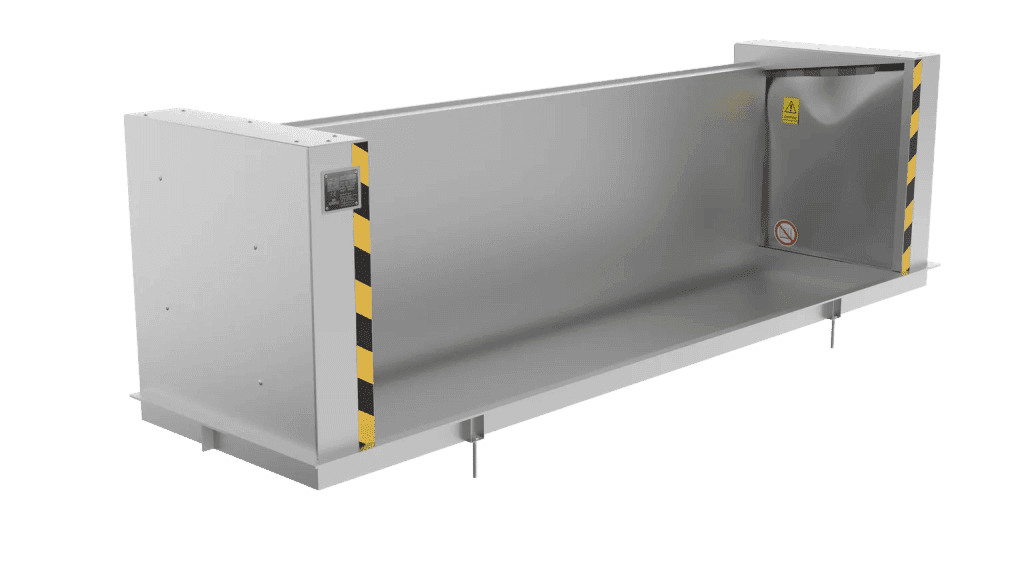
An automatic barrier closes an opening only when liquid arrives, so the doorway stays flat and open to forklift traffic in normal operation. The Anhamm Fire Spillbarrier works this way, without electrical, pneumatic or hydraulic power:
- Liquid that reaches the opening flows into the barrier’s collection tray.
- The collected liquid makes the barrier float up and triggers it.
- Springs fold the barrier into an upright, fully sealed position.
The Fire Spillbarrier was tested according to FM Approval Standard 4985 with a 50 MW fire and was leak-proof afterwards. It is built from AISI 304 stainless steel with PTFE seals and made to measure for the opening width. Its drive-over capability was tested under RW-TÜV supervision (DIN 1055); the load rating for your traffic is confirmed during project planning. Audible and visual signals and SmartBarrier notifications are available as options.
A barrier is one part of a containment concept, not a substitute for it. The retained volume, the drainage routes and the acceptance of the solution have to be agreed with your fire protection engineer, insurer and AHJ. Our guide to fire resistant barriers for flammable liquids looks at barrier selection in more detail, and the article on chemical protection barrier systems covers corrosive and other non-flammable chemicals. To discuss a specific opening, contact our team.
Emergency planning
Containment that depends on valves, gates or drain covers only works if someone closes them in time. Put these steps in the emergency plan, train staff on them and walk through the plan with the local fire department: where the liquids are stored, where firewater will collect, which drains must be shut and where responders should not drive or stand. Our article on causes of fires in the chemical industry covers ignition prevention in more depth.
Frequently asked questions
What does OSHA require at the doors of a flammable liquid storage room?
Under 29 CFR 1910.106(d)(4), openings from an inside storage room to other rooms or buildings need noncombustible, liquid-tight raised sills or ramps at least 4 inches high, or the room floor must be at least 4 inches below the surrounding floor. An open-grated trench inside the room that drains to a safe location is a permitted alternative (OSHA).
How much flammable liquid can be stored in a safety cabinet?
OSHA allows not more than 60 gallons of Category 1, 2 or 3 flammable liquids, or 120 gallons of Category 4 liquids, per cabinet. The fire code adopted in your jurisdiction may add further limits.
Why does firefighting water have to be contained?
Water from sprinklers and hose lines mixes with the stored product and becomes contaminated. Without containment it can pollute drains, sewers and soil, and burning liquid floating on it can spread the fire to other areas. The containment volume therefore has to account for the suppression water as well as the leaked liquid.
Can an automatic barrier replace a fixed sill or curb?
An automatic barrier can be proposed where a fixed sill is impractical because of forklift traffic, since it stays flush with the floor until liquid arrives. Whether it is accepted as equivalent depends on the authority having jurisdiction and your insurer, and the containment volume behind it still has to be verified.
Is a CO2 extinguishing system suitable for a flammable liquid warehouse?
CO2 can extinguish liquid fires, but total flooding concentrations are lethal: the US EPA cites a minimum design concentration of 34 percent (US EPA). It is used for enclosed spaces where people can be kept out during discharge, with lock-outs and pre-discharge alarms, not for warehouses with regular staff presence.