
Flood protection for doors and windows is one of the fastest ways to reduce flood damage. Doors and windows are often the first places water gets in, so the right flood protection for openings can make a major difference during a storm. This guide explains the most effective options for flood protection doors and windows, how to choose between permanent and temporary systems, and where each solution works best.
For a bigger-picture view of your property, see our guide on how to determine your home’s flood risk and the 5?step framework in flood protection for your home.
Key takeaways
- Doors and windows are the most common entry points for floodwater.
- Permanent flood doors and flood windows are best for repeated or high?risk exposure.
- Removable and automatic barriers are practical when flood risk is occasional or when you need rapid deployment.
- The right solution depends on the opening type, expected water depth, and how quickly water can rise.
Table of Contents
Why doors and windows fail first in floods
Floodwater usually enters through the lowest and weakest points of a building envelope: thresholds, worn gaskets, frame gaps, basement window wells, and side panels around doors and windows.
In many homes, a few millimetres of misalignment at a door threshold or an old window seal is enough for water to start seeping in. A good flood protection plan starts with a walk?around to identify those weaknesses before you choose any product.
Official resources like FEMA’s homeowner guidance and local flood?risk maps are useful references when you evaluate how much pressure your doors and windows might face.
Permanent vs temporary flood protection
Permanent systems (like flood doors, flood windows, or automatic spill barriers) are built into the opening and designed to stay in place all year. They are ideal for properties that face repeated flooding, have critical operations, or where there is little time to deploy manual barriers.
Temporary systems (such as demountable barriers, panel systems, or water?activated barriers) are installed only when needed. They make sense when flood risk is occasional, when you cannot replace the existing doors and windows, or when you want a reusable solution for multiple openings.
| System type | Best for | Main advantage | Main trade?off |
|---|---|---|---|
| Flood doors | Repeated flooding, high?risk properties | Always ready, integrated appearance | Higher installation cost and commitment |
| Flood windows / certified glazing | Basement windows, lower floors | Designed for water pressure and impact | Requires professional fitting |
| Demountable door/window barriers | Occasional flooding, front doors, patio doors | Flexible, reusable, protects existing joinery | Must be deployed before water arrives |
| Automatic barriers (e.g. Spillbarrier) | Fast?rising flood risk, critical access points | Deploys without power or manual action | More specialized design and planning |
| Water?activated barriers / sandbags | Short?notice protection for thresholds | Low?tech, can supplement other systems | Labour?intensive, limited lifespan |
For a deeper comparison of barrier technologies and when automatic systems make sense, see ultimate flood protection – 24/7 protection and Spillbarrier flood protection.
Flood protection for doors

1. Flood doors (permanent replacement)
Flood doors look similar to standard exterior doors but have internal reinforcement, watertight gaskets, and locking systems designed to create a seal when closed. They are suitable for front doors, back doors, and some commercial entrances where the door is frequently used but must resist floodwater when locked.
They are the best choice when:
- The property faces repeated flooding or sits in a mapped flood zone.
- You do not want to store or manually install barriers before every event.
- The entrance is critical (main access, evacuation route, or business entrance).
2. Demountable door flood barriers
Demountable door flood barriers use side channels fixed to the reveal and aluminium or steel beams that can be slotted in when a warning is issued. They seal against gaskets and create a rigid wall in front of the door leaf without changing the door itself.
They work well when you:
- Want to preserve the existing door appearance.
- Have staff or household members who can deploy barriers in time.
- Need flexible protection for different heights (e.g. one panel for small events, more panels for deep water).
Our post on flood barriers for doors and garages walks through barrier dimensions, sealing details, and installation points.
3. Automatic flood barriers at doors
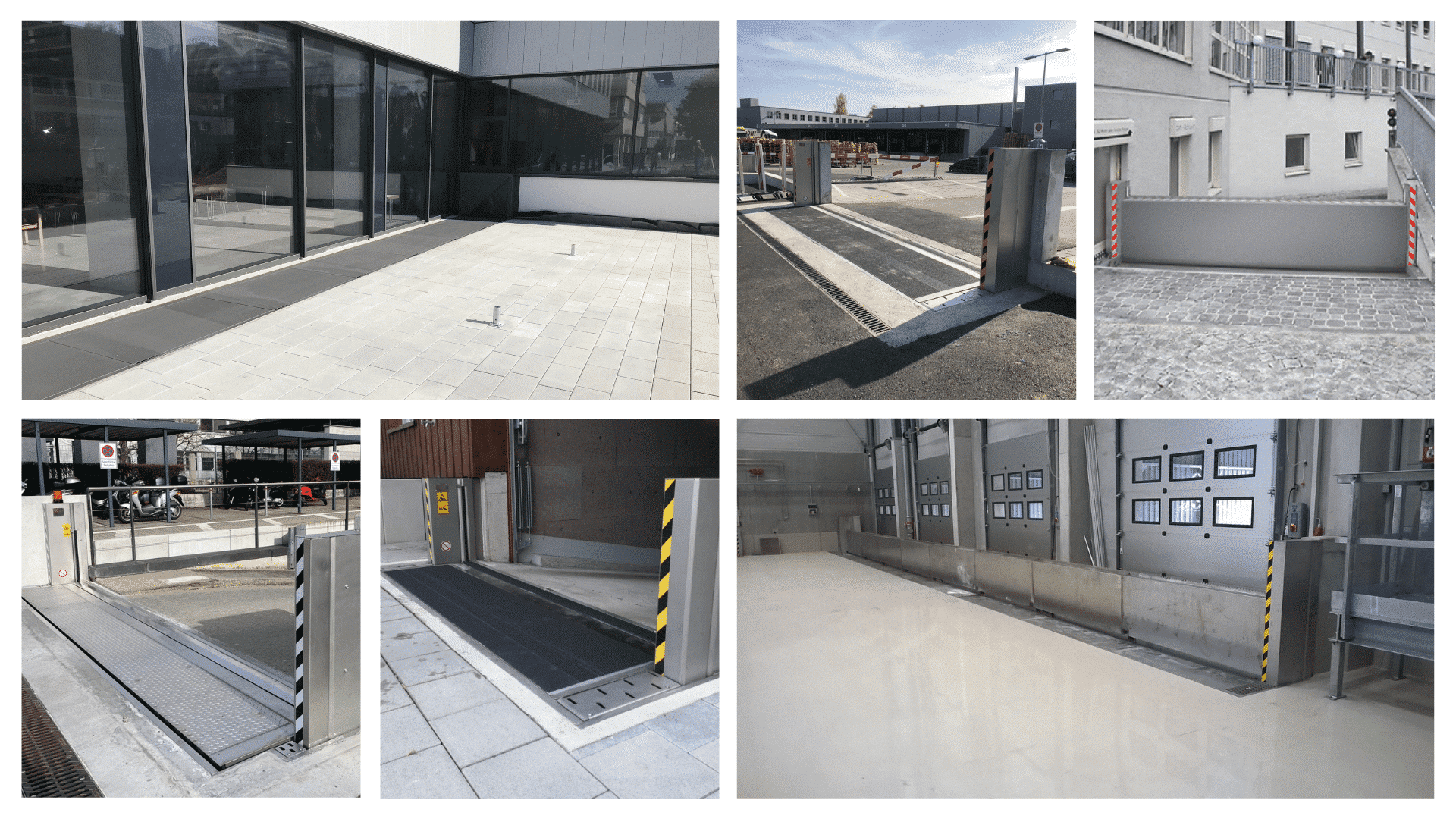
Automatic flood barriers like the Anhamm Spillbarrier are integrated into the floor or threshold and rise automatically when water reaches a certain level. They need no power, no manual deployment, and close even if nobody is on site.
They are particularly useful for:
- Underground garages and loading docks connected to door openings.
- Entrances at industrial or commercial sites where downtime is costly.
- Properties where floodwater can arrive suddenly (flash floods, drainage failures).
4. Threshold seals and door?bottom seals
Threshold seals and door?bottom seals do not replace full flood doors or barriers, but they are important upgrades for minor flooding or wind?driven rain. A well?designed threshold seal can significantly reduce seepage at the lowest point of a door.
5. Water?activated barriers and sandbags at doors
Water?activated barriers and traditional sandbags can be stacked in front of the door to act as a last?minute flood wall. They are useful as a backup, or where budget limits other solutions, but they require labour and are less precise than engineered door systems.
To understand how water?activated barriers perform compared to sandbags, see our detailed guide on water?activated flood barriers.
Flood protection for windows
1. Flood?resistant windows and glazing
Flood?resistant windows use stronger frames, locking systems, and certified flood?tested glazing to withstand water pressure without leaking or shattering. They are especially important for basement and ground?floor windows that sit close to the expected flood level.
When choosing flood windows, look for products that are tested to recognised flood standards and, where relevant, impact resistance if debris is expected in the water.
2. Demountable window panels and barriers
Demountable window barriers use side channels or brackets and infill panels that can be installed before a flood. They act like mini flood walls across the window opening and can be removed afterwards.
This is often the best solution when you:
- Have standard windows you don’t want to replace.
- Need to protect only a few windows in a specific facade.
- Want a barrier that can be reused on other openings of similar size.
3. Window wells, covers, and drainage
Basement windows in wells are particularly vulnerable because water can accumulate in the well and load the glazing suddenly. Window well covers, drains, and small barriers around the well can reduce how much water reaches the glass in the first place.
4. Temporary window protection
In emergencies, window protection can be reinforced with water?activated barriers, plywood, or panel systems fitted to the frame. These options are less elegant than dedicated flood windows or panels but can still buy time and reduce water ingress if deployed properly.
Door and window protection by opening type
Front doors and main entrances
Front doors are high?traffic openings that often face the street. They usually benefit from either a permanent flood door or a high?quality demountable barrier system. Automatic barriers can be justified where flood risk is high and human deployment is uncertain.
Patio doors, French doors, and sliding doors
Patio doors and wide openings need broader barriers. Demountable systems that span the full width, or automatic trench barriers in front of the opening, are often more practical than trying to seal the door leaves themselves.
Basement and lower?ground windows
Basement windows should be treated as high?risk openings because water pressure can be greater below grade. Flood?resistant glazing, demountable panels, and window?well management (covers, drains) are often combined for a more robust solution.
Commercial doors and shopfronts
Store entrances and shopfronts must balance flood protection with accessibility. Many businesses use demountable panel systems or automatic barriers so that everyday access stays normal, but the entrance can be quickly guarded when a flood alert is issued.
Installation and maintenance for flood doors and windows
Installation basics: flood protection for doors and windows
Flood protection products for doors and windows should be installed by experienced contractors or manufacturers’ certified partners wherever possible. Correct frame anchoring, seal compression, and substrate preparation are critical for performance.
Before installation, check:
- Substrate condition (no loose masonry, sound concrete, or framing).
- Correct measuring of the reveal and opening size.
- Compatibility with existing thresholds, cladding, and interior finishes.
Maintenance tasks by flood protection system type
- Flood doors: inspect gaskets and locking hardware at least annually; clean debris from thresholds; confirm the door closes and latches without resistance.
- Flood windows: check sealant joints and frame gaskets, inspect glazing for damage, and verify that drainage paths are not blocked.
- Demountable barriers: store panels dry, check seals for cracking, and perform a “dry run” installation before flood season.
- Automatic barriers: keep channels clear of debris, verify floats and moving parts, and schedule periodic inspections according to manufacturer guidance.
- Water?activated barriers: replace products after their recommended lifecycle and dispose of saturated units according to local regulations.
After any flood event, inspect all door and window systems for hidden damage, including warped frames, worn seals, and fasteners that may have loosened under pressure.
How to prepare flood protection for doors and windows
If flood risk is forecast, the priority is to seal the openings early and make sure each system is ready. Move valuables away from affected doors and windows, clear leaves and debris from thresholds and drains, and confirm that barriers, doors, and windows can close cleanly.
For more structured preparation, combine this article with our wider guides on flood causes and prevention and the 5 essential steps in flood protection for your home.
Official resources such as FEMA and the National Flood Insurance Program (NFIP) also offer checklists and maps to help you understand your risk and insurance options.
FAQ
What is the best flood protection for doors?
There is no single best option for every door. Flood doors are ideal for repeated flood exposure, while demountable barriers are better when you want flexibility and want to keep the existing door.
What is the best flood protection for windows?
Flood-tested windows and glazing systems are the strongest option for high-risk openings, especially in basements and on ground floors. Demountable panels or barriers are a strong alternative if you want to keep the existing windows.
Are temporary flood barriers effective?
Yes, temporary barriers can be effective if they are properly sized, installed before water arrives, and maintained between events. However, they depend on someone being present and ready to deploy them.
Do I need both door and window systems?
Not always, but many properties need different protection levels at different openings. Start with the lowest and most exposed doors and windows, then add protection where mapped flood levels or past events show the biggest risk.
What maintenance do flood doors and windows need?
Flood doors should have their gaskets, thresholds, and locking hardware inspected regularly. Flood windows should be checked for sealant condition, frame alignment, and drainage paths so they continue to perform properly.
About the author
Anhamm / Spillbarrier team
Spillbarrier develops automatic flood protection systems for homes, garages, commercial properties, and critical infrastructure in the US and internationally.
Always verify flood risk and emergency steps with official sources such as FEMA, NFIP, and local emergency agencies.

