

An automatic spill containment barrier is a passive system that seals doorways and openings against hazardous liquids — chemicals, firewater, fuels — without electricity, sensors, or human intervention. It activates on buoyancy alone the moment liquid contacts it, and stays sealed until manually reset. It protects the environment, waterways, and your facility — even when no one is left inside to act.
Some companies are built to make money. Others emerge from an inner necessity — from a deep desire to build something that actually works when it truly matters. Anhamm belongs to the second category. On the occasion of our 30th anniversary, grandson Josef sits down with founder Helmut Anhamm — for an open conversation about origins, setbacks, an invention born from chance, and the values that have carried a family business across three decades.
Anhamm GmbH
Table of Contents
30 Years of Anhamm – A Journey That Sets the Standard
Age 13 – Apprenticeship
Training as a metalworker. A conscious choice — not a compromise.
Age 24 – Master Craftsman
The foundation is laid. A certificate of skill and endurance.
Age 25 – Founded
His own business — against resistance, with conviction.
1973–1980 – Oil Crisis
Seven difficult years. A reputation for reliability carries the company through.
Frankfurt & Düsseldorf
First trade show appearances. “We’ve never seen anything like this.” — The invention finds its audience.
International
Ireland, America, all of Europe — first installations personally overseen by Helmut.
Today – Family Succession
Son and daughter shape the company. Values and passion passed on.
The Roots of Anhamm – Craftsmanship as a Life School
Early Influences
Helmut Anhamm grew up as the son of a farm heir — a man who never really wanted to be a farmer. His father was both dutiful and inventive: he repaired machines others had given up on, improved equipment with whatever was at hand, and always found a way. Not out of passion for agriculture, but out of an innate drive to shape things with his hands. Helmut saw this every day as a boy.
“My father was a farmer — but not by choice. He would have preferred a different trade, but he was the farm heir. Still, he had many ideas. He was gifted with his hands — he’d improve equipment, come up with solutions. And as a boy I took all of that in — how you make things better, how you actually achieve something with your own hands. That shaped me.”
Choosing a Career at 13
At 13, Helmut faced a fork in the road that offered no second chances. No gap year, no lengthy deliberation — three options: carpenter, gardener, or metalworker. He briefly considered gardening. Working outside appealed to him. “But in winter?” He kept gardening as a hobby and became a metalworker. By 24, his Master Craftsman certificate was on the table.
Starting a Business at 25
One year after earning his master’s certificate, Helmut founded his own company. Every step before that — apprenticeship, journeyman years, master’s exam — was defined by practical experience and a refusal to work around problems rather than through them.
First Hurdles
The first obstacle was financing. Little starting capital, economically uncertain times — the Sparkasse said no. The Volksbank took the risk. “And that’s how it started,” says Helmut. It was the first of many moments that established a pattern: whoever refuses to accept no, finds another way.
What Drives Anhamm – Three Principles That Were Never up for Discussion


The identity of a company cannot be read from a mission statement — it reveals itself in concrete decisions under pressure. The following three principles are not a retrospective formulation. They come from experiences Helmut Anhamm lived through, sometimes learned the hard way, and consistently carried forward.
Quality Is Not a Trim Piece
From the very beginning, Helmut chose materials that others considered excessive: stainless steel instead of aluminum, PTFE seals instead of foam. The reasoning was never aesthetic — it was technical.
“If you buy cheap, you buy twice. That’s especially true in technical applications. With Spillbarriers: if you install a system that fails at the first emergency, the price advantage is worth nothing. This isn’t a trim piece — it’s safety equipment.”
That sentence defines Anhamm’s product philosophy more completely than any marketing message ever could.
Your Word Is Your Bond
In the early years, an acquaintance lent Helmut 20,000 Deutsche Marks — no contract, on a handshake. His only request: “Build me a gate for it.” Helmut built it — and repaid the loan with interest, even though no one could have held him to it. “Whatever I do, I do it properly.” Not the letter of a contract counts, but the word given. This attitude is the foundation of every customer relationship today.
From the Field – For the Field
Early in his career, Helmut built improvements into a containment system that benefited the customer — without documenting them in writing. The work went unpaid. “I had nothing in writing. That was educational,” he says without bitterness. That sentence represents a company attitude that shapes everything to this day: every experience — success or failure — feeds directly into the next solution.
“I wanted to know what works. I wanted to see how the product behaves at the customer’s site. That’s the only way you really learn.”
1973 to 1980 – What a Crisis Reveals About Character
The 1973 oil crisis hit the tank construction industry like a hammer blow — and Anhamm was right in the middle of it. Until around 1980, orders collapsed, liquidity became scarce, and many competitors responded with price cuts and quality compromises. Helmut did the opposite.
“I already had a certain reputation. People knew: I’m reliable, hardworking, honest. And that helped me keep going even without large reserves.”
Trust is not a soft currency — it is the hardest. Whoever can rely on their reputation in a crisis survives it. Whoever sold it off beforehand does not. These seven years forged the backbone of a company that could afterwards grow, export, and invent — because the foundation was solid.
The Moment That Changed Everything – Birth of the Spillbarrier
The First Project
It did not begin with a vision — it began with a job. Helmut Anhamm was commissioned to build a liquid containment device to given specifications. He recognized that the existing solution was worse than it needed to be — and built in improvements. Unpaid, but educational. The idea never let him go.
The First Trade Show
Then came the decisive phone call: the Chamber of Crafts invited him to exhibit at a trade fair. Helmut declined at first. “Tank construction? There’s one on every corner.” It was his daughter — Josef’s mother — who wouldn’t let it go: “You have to do this!” And she registered him on the spot. The first show was in Frankfurt, a shared stand. Then came Düsseldorf — with his own stand, a full working model, a live demonstration. The reaction from industry visitors was unambiguous: “We’ve never seen anything like this.”
The Invention
The core of the invention is as simple as it is radical: in an emergency, no one is left inside. During a chemical incident or fire, personnel evacuate immediately. No person can manually activate a containment barrier at that point.
“Where are you going to store four meters of flood boards? Who carries them? That’s not practical. And if you leave them in permanently, the seals eventually fail.”
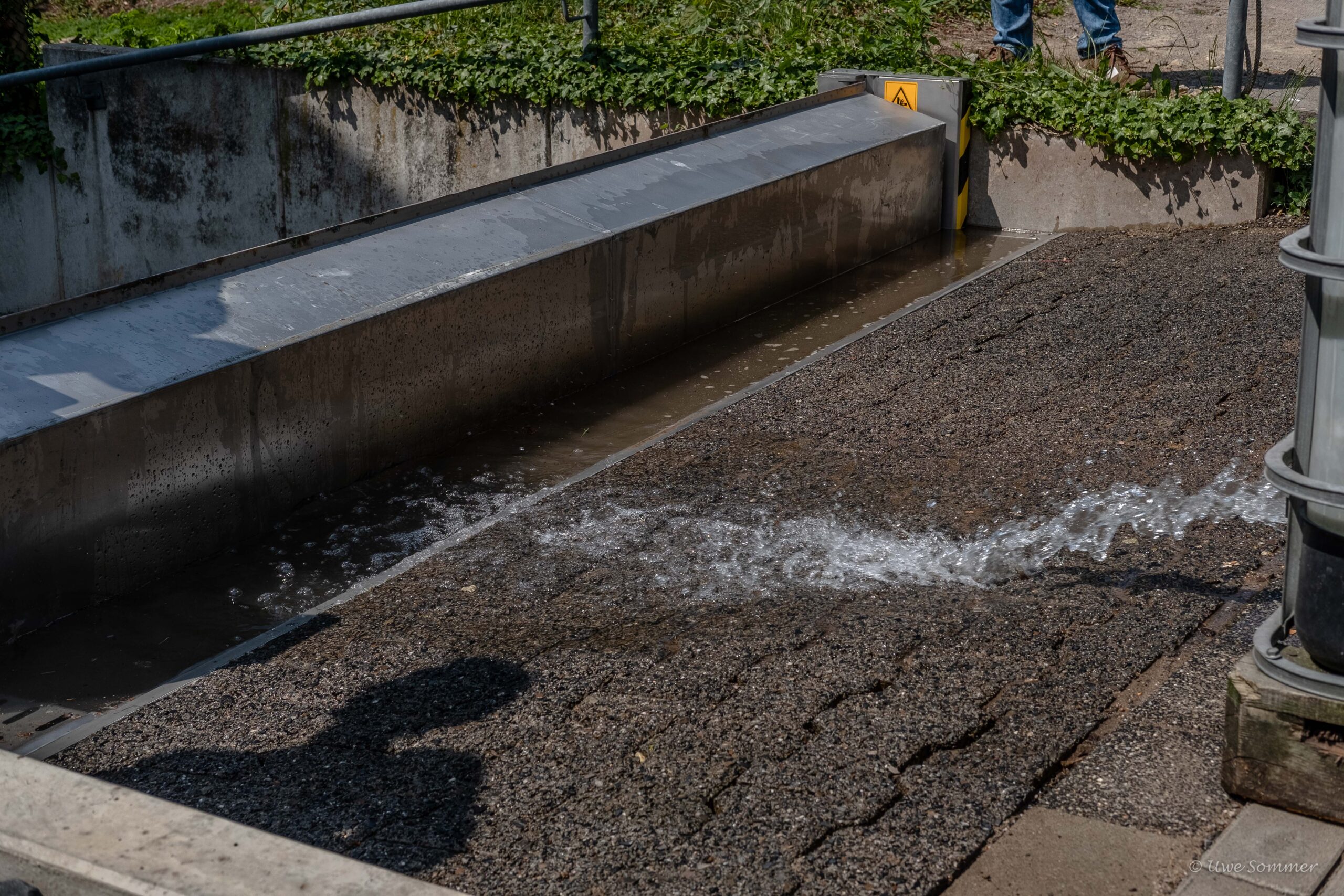
The answer: fully mechanical. The Spillbarrier flips closed through the hydrostatic buoyancy of the incoming liquid — no power, no battery, no control unit. Physics does the work.
Learning from Experience
Every improvement came from real-world experience, never from a laboratory. The first seals were foam — they didn’t last. A chemically knowledgeable employee came back from a trade show with a new material: PTFE. It has been standard ever since. In some installations, these seals have been running for 30 years — without replacement.
The fire protection test also didn’t go smoothly at first: in the initial trial inside a test tunnel, the flap exploded because it had been welded airtight and the hot air expanded inside the rigid foam core. Helmut’s reaction: “That’s when we learned: add a ventilation port!” After that, everything worked. This willingness to learn from failure is the reason the Spillbarrier works today when it truly matters.
Regulatory Framework – Why Automatic Containment Is Required by Law
The development of the Spillbarrier ran in parallel with a growing body of environmental and safety regulations in the United States and internationally. The EPA’s Spill Prevention, Control, and Countermeasure (SPCC) rule (40 CFR Part 112) requires facilities that handle oil and hazardous substances to maintain secondary containment capable of holding 100% of the largest container’s volume — including during power failures and emergency evacuations. NFPA 30 (Flammable and Combustible Liquids Code) establishes spill containment requirements for any facility handling flammable or combustible liquids. Section 311 of the Clean Water Act prohibits the discharge of hazardous substances into US navigable waterways — making functional containment a legal obligation, not an option.
- Prevention of hazardous liquid discharge into soil, groundwater, and navigable waterways
- Full functionality during power outages and complete facility evacuation
- Compliance with EPA SPCC (40 CFR Part 112), NFPA 30, and Clean Water Act Section 311
- Demonstrated effectiveness through independent certification and load testing
A purely mechanical system is not just one option among many under these conditions — it is the most direct answer to what US law actually demands. For further information on fire protection compliance in industrial facilities, see our Complete Guide to Warehouse Fire Protection.
Our Products – Three Barriers for Automatic Liquid Containment


From one invention grew a complete system. The Spillbarrier by Anhamm protects across three core applications — all based on the same mechanical buoyancy principle: automatic, powerless, reliable. Exactly when no one can intervene anymore.
- Protection of environment and people — prevents the release of hazardous liquids during leaks, fires, or flooding
- Regulatory compliance — designed to meet EPA SPCC (40 CFR Part 112), NFPA 30, and Clean Water Act requirements
- Operational safety — functions during power outages and full evacuation without external energy or personnel
- Cost efficiency — low maintenance, long service life, custom-manufactured to exact specification
Fire Barrier
Automatically contains burning liquids and contaminated firewater — tested in a real-conditions fire tunnel. Protects adjacent areas from flame spread and prevents the release of firewater runoff into the environment.
View Fire Barrier › Guide: Fire Resistant Barriers for Industrial Facilities ›Chemical Barrier
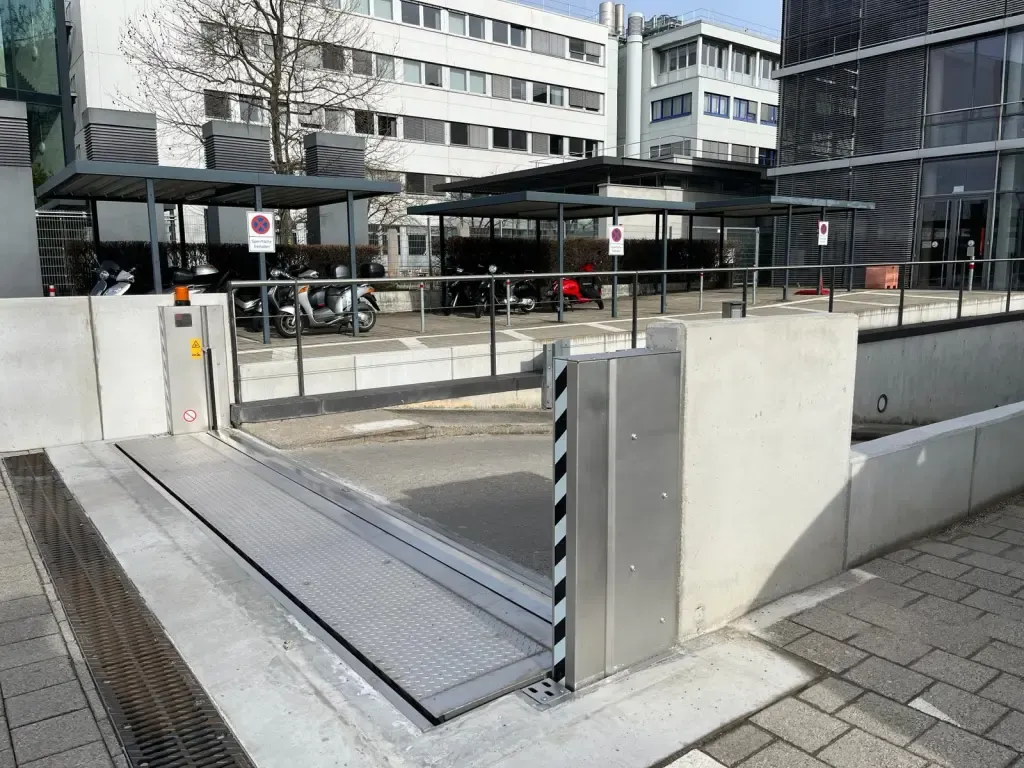
For facilities handling hazardous substances including petroleum products, solvents, and acids. Stainless steel and PTFE seals resist the most aggressive chemicals — permanently, without material fatigue. In some installations, running for 30 years without replacement.
View Chemical Barrier › Guide: Chemical Spill Barriers for Aggressive Liquids ›Flood Barrier
Automatic water containment for industrial gates, driveways, and garage ramps. Seals independently on water ingress — no warning system, no operator, no power. With extreme rainfall events increasing across the US due to climate change, this protection is no longer optional.
View Flood Barrier › Climate Change & Flooding: New Risks for Industrial Facilities ›| Barrier Type | Primary Purpose | Compatible Media | Typical Applications | Key Feature |
|---|---|---|---|---|
| Fire Barrier | Containment of burning liquids & firewater | Firewater runoff, fuels | Industry, warehouses, chemical plants | Tested under real-conditions fire tunnel trial |
| Chemical Barrier | Containment of hazardous liquids | Chemicals, solvents, acids, petroleum | Chemical plants, labs, production facilities | Stainless steel & PTFE — highest chemical resistance |
| Flood Barrier | Containment of floodwater ingress | Water | Industrial gates, garages, driveways | Fully automatic — zero operator action required |
- Activation: Buoyancy-based — 100% mechanical, no power, no sensors, no control unit
- Material: Premium stainless steel, chemically resistant PTFE seals — proven over 30 years
- Load rating: TÜV NORD certified — 200,000 load cycles at 6.5 metric ton axle load (3.25 t / ~7,160 lb wheel load)
- Dimensions: Seal height 300 mm to 2.40 m (approx. 12 in. to 7 ft. 10 in.); widths up to 47 m (154 ft.) — custom-manufactured to specification
- Installation: Any incline, any opening width — no center post, no interrupted driveway width
- Standards: Designed to meet EPA SPCC (40 CFR Part 112) and NFPA 30 secondary containment requirements
Certifications & Guarantees – Trust Through Verified Quality
Reliable containment systems are more than engineering — they are a core element of industrial environmental compliance. For facility operators, regulators, and insurers to trust the effectiveness of these systems, independent certification is essential. US requirements including EPA SPCC, NFPA 30, and the Clean Water Act demand systems that function without exception — including during power failures and emergency evacuations. Only systems that meet these requirements provide genuine protection for people, the environment, and the business.
Anhamm therefore relies on verified quality: drive-over capability of all Spillbarriers has been tested and certified by TÜV NORD at 200,000 load cycles under 6.5 metric tons forklift axle load (equivalent to approximately 7,160 lbs per wheel). All systems are manufactured from certified materials and designed to meet EPA SPCC and NFPA 30 requirements. Every product is custom-manufactured and internally tested before delivery. The result: maximum confidence — through the combination of certified products, clear guarantees, and full compliance with applicable law.
Spillbarrier Made in Germany – Installed Across Europe, the USA, and Ireland
After Frankfurt and Düsseldorf, demand grew faster than expected — first nationally, then across Europe, then across the Atlantic. Spillbarriers by Anhamm were installed in Ireland, in the United States, across the most varied industrial sectors. But no matter how far the project: Helmut Anhamm was on site.
“It was never about cheap production somewhere overseas — it was about quality. We installed the first units ourselves, on location. I wanted to see how they performed in the field.”
This method — learning through accompaniment, improving through observation — explains why the Spillbarrier today stands at a technical level that was developed not in a laboratory, but in the field. Over three decades, in the hardest industrial environments in the world. What that means in practice is illustrated by the Washington Flood Case Study 2025 — a compelling example of what happens when containment measures are absent.
Family Is No Coincidence – The Foundation of the Company
Helmut’s daughter — Josef’s mother — was fully involved in the business at just 14 years old. After school: bookkeeping, writing invoices, organizing, absorbing crises — without making a fuss. It was this same daughter who pushed Helmut to exhibit at the first trade show, without whom the Spillbarrier might never have found an audience. “Without her, the company wouldn’t exist today,” says Helmut without hesitation. His son, a graduate engineer, brought the technical depth that every new product generation required. Neither of them were heirs — they were co-creators.
What keeps this family business together even under pressure is illustrated by a story Helmut tells with a quiet smile. Large corporations regularly tried to push the price down. “Sometimes it was: you’ll get the order if you come in cheaper.” And then the purchasing manager would say, in confidence: “You were already the cheapest anyway.” No concession. No exception. Whoever works with Anhamm doesn’t get a cheap solution — they get something that works. Always.
“The best feedback is when someone calls after 20 years and says: still running. Or: good to see you again, Mr. Anhamm. That tells you that you got it right. It’s not about selling volume. It’s about what you build actually helping someone.”
30 Years of Anhamm – And We’re Just Getting Started
An anniversary is not an endpoint — it is a position fix. Three decades after founding the company, Helmut Anhamm continues developing new variants in his spare time. A small workshop at home. New ideas, new material combinations, new approaches.
“There’s always something that gets in the way — the garden, the yard, something’s always happening. But I stay at it.”
Because entrepreneurship was never a phase for him. It is a way of life.
30 years of Anhamm means 30 years of responsibility toward people who rely on a product in critical moments — moments when no one is left inside the building and the mechanism alone decides. That responsibility was real on the first day of the company. It is just as real today.
Josef, whose interview documents this anniversary, writes in the afterword:
“Helmut Anhamm didn’t just build a company — he lived values that matter more than ever today: reliability, honesty, quality consciousness, and a willingness to take responsibility. He has proven that with groundedness, clear thinking, and craftsmanship, you can build things that endure — that outlast decades, protect people, solve problems. Without grand words, but with all the more substance.”
And Helmut himself:
“Keep developing. Stay honest. Be reliable. And hold to what you promise. Then success comes by itself. Business is a life’s work — but a beautiful one.”
The Complete Interview with Helmut Anhamm: “A Smith Who Forged His Own Fortune”
Frequently Asked Questions – Spillbarrier by Anhamm
What is the Spillbarrier (Klappschott), and what applications is it designed for?
The Spillbarrier — known in German as the Klappschott, literally “flip barrier” — is an automatic spill containment barrier by Anhamm GmbH, manufactured in Germany. It covers three core applications: fire barrier (automatic containment of burning liquids and contaminated firewater runoff), chemical barrier (containment of hazardous substances including petroleum products, solvents, and acids), and flood barrier (automatic sealing of industrial gates, driveways, and garage ramps against floodwater). All three variants operate on the same fully mechanical buoyancy principle — no electricity, no sensors, no control unit. The barrier activates on contact with liquid and stays sealed until manually reset.
Does the Spillbarrier meet EPA SPCC secondary containment requirements?
The Spillbarrier is designed to meet the secondary containment requirements of the EPA’s Spill Prevention, Control, and Countermeasure (SPCC) rule under 40 CFR Part 112, as well as NFPA 30 (Flammable and Combustible Liquids Code). Its fully mechanical trigger activates without power — directly satisfying the requirement that containment systems must function during power outages and emergency evacuations. Contact us for technical documentation to support your compliance process.
Why stainless steel and PTFE — not aluminum or foam?
Stainless steel withstands higher temperatures and more aggressive chemicals than aluminum, and does not corrode under prolonged chemical exposure. PTFE seals are chemically inert against the widest range of industrial substances — including strong acids and solvents — and are structurally permanent, unlike foam which degrades rapidly under chemical contact. In some Anhamm installations, PTFE seals have been in continuous service for over 30 years without replacement. As founder Helmut Anhamm puts it: “This isn’t a trim piece — it’s safety equipment.”
How can the Spillbarrier be driven over by heavy vehicles?
The Spillbarrier sits flush within its housing and transfers vehicle loads directly to the floor structure — no center post, no raised threshold, no interrupted driveway width. Drive-over capability has been independently certified by TÜV NORD at 200,000 load cycles under a 6.5 metric ton forklift axle load (3.25 t per wheel, approximately 7,160 lbs per wheel). Cars, heavy trucks, and industrial forklifts can cross without restriction at any time — whether the barrier is in its resting or activated position.
Are there size limitations for the Spillbarrier?
The minimum seal height is 300 mm (approx. 12 inches); the maximum is 2.40 m (approx. 7 ft. 10 in.). The largest single installation to date spans 47 meters (approximately 154 feet) in width at 1 meter seal height. All Spillbarriers are custom-manufactured to the customer’s exact opening dimensions — including inclined surfaces and garage ramp geometries. There is no standard off-the-shelf size; every system is built to specification.
Can the Spillbarrier be manually lifted, and can an alarm system be integrated?
Yes to both. The Spillbarrier is the only automatic flip barrier that can be raised manually without significant physical effort — pre-tensioned springs substantially reduce the effective weight, requiring no tools or powered equipment. For alarm integration: on request, Anhamm installs an end-switch in the barrier post that a licensed electrician can connect to a warning light, acoustic alarm, or facility management system. The barrier’s mechanical trigger remains fully independent of the alarm circuit at all times.
Helmut Anhamm
Founder & Inventor · Anhamm GmbH · spillbarrier.com
Helmut Anhamm is the founder of Anhamm GmbH and the inventor of the Spillbarrier — the automatic liquid containment barrier known in German as the Klappschott. With over 50 years of experience in precision metalworking and industrial containment engineering, he is one of Europe’s foremost experts in passive barrier technology. His systems protect industrial facilities across Germany, Ireland, the United States, and throughout Europe. The Spillbarrier is manufactured entirely in Germany.

