
Updated: May 2026
Executive Summary
The Bottom Line: Automatic flood barriers are the scientifically superior choice for modern flood protection compared to sandbags or manual gates. They utilize hydrostatic pressure for self-activation, require zero electricity, and deliver a 100% seal effectiveness. A single prevented major flood event is enough to justify the entire investment, making them the most cost-effective solution for long-term asset protection.
Introduction: The Flood Crisis in an Era of Climate Change
In times of increasing extreme weather events, effective flood protection systems are becoming increasingly important for property owners and municipalities worldwide. Climate science confirms this is no longer speculative — extreme rainfall events are intensifying globally due to human-induced climate change. The warmer atmosphere holds more moisture, leading to heavier precipitation events that overwhelm traditional defenses. Even in regions once considered safe, flood risk is escalating: the United Kingdom alone saw flood damage claims increase by 218% over five years, from £3.5 million in 2020 to just over £11 million in 2024.
Property owners and municipalities face a critical dilemma: how to find a flood protection solution that is both reliable and practical in an era of unpredictable, increasingly severe weather. This is where Anhamm Spillbarriers enter the equation — an innovative answer to the challenges of modern flood protection. Unlike passive systems that require manual deployment during emergencies, these systems offer protection that activates automatically when danger arises, operates independently of external power, and is constructed from high-quality stainless steel that blends seamlessly into architectural surroundings.
Imagine a flood barrier that responds within minutes to rising water levels — without human intervention, without electricity, without manual labor. This is not theoretical. The science behind automatic spill barriers is grounded in physics, tested through rigorous engineering standards, and proven in real-world deployments across the globe, including 42 countries worldwide.
The Rising Cost of Flood Damage: Why Prevention Matters
Understanding the Economic Reality
Flooding has become the most common and costly natural disaster affecting residential and commercial properties. The financial impact extends far beyond the initial water damage:
| Property Type | Average Damage Cost | Range | Source |
|---|---|---|---|
| Residential (average) | $15,000–$20,000 | $3,000–$40,000+ | UK Government – Flood costs evidence (2024) US Senate JEC – Flooding economic costs |
| Commercial properties | $50,000–$100,000+ | Variable by industry | Association of British Insurers (ABI) – 2025 claims data NOAA – Billion-dollar disasters (US) |
| Restoration (per incident) | $3,838 nationally (US) | $1,381–$6,350 typical | FEMA FloodSmart – Cost of flooding (US) Congressional Budget Office – Flood damage costs |
A single flood event at a commercial property can cost $50,000 or more — the equivalent of years of flood insurance premiums.
For residential properties, nearly 1 in 4 claims (23%) in the UK exceed £1,000. Yet these figures only capture direct property damage. The true cost includes:
- Business interruption: Manufacturing facilities forced to halt operations for weeks.
- Inventory loss: Retail and warehouse stock destruction.
- Mold remediation: Health hazards requiring specialized removal ($1,200–$3,800).
- Structural repairs: Foundation and framing damage ($500–$2,800+).
- Emotional loss: Irreplaceable items, family heirlooms, and personal memories.
Insurance doesn’t always cover these losses. In the United States, over $1.77 billion in uninsured flood damages were recorded in recent catastrophic events, with property owners absorbing costs directly.

The Climate Acceleration Effect
Climate modeling confirms that flood risk is not stabilizing — it is accelerating. Global warming increases the atmosphere’s moisture-holding capacity by approximately 6–7% per degree Celsius. This translates directly into more intense rainfall:
- Canada: Parts of southern British Columbia, Ontario, and Quebec have already seen increases of 2–3 heavy rainfall days per year on average.
- Northeast United States: An extreme rainfall event now occurring once every 20 years is projected to happen once every 5 years by end of century.
- Global projection: Extreme rainfall event magnitude is expected to increase by 12% on average.
- Coastal areas: Sea-level rise of 0.40–0.65 meters by 2050 will transform occasional flooding into regular occurrences.
The urgency is reinforced by attribution science: researchers have determined that 37% of all inland flood damage in the United States since 1988 — approximately $84 billion out of $230 billion in total losses — can be directly attributed to precipitation changes linked to climate warming.
Types of Flood Barriers: Setting the Stage for Innovation
Flood barriers are specialized, engineered systems designed to block, divert, or control rising water, preventing it from damaging homes, businesses, and infrastructure. Today’s flood protection systems offer a range of solutions, each designed to address different levels of flood risk and property requirements.
Permanent Flood Barriers
Engineered for locations with persistent or high flood risk, providing reliable long-term protection for critical infrastructure and commercial properties. These barriers are installed once and serve as a steadfast defense against repeated flooding.
Removable Flood Barriers
Offer flexibility for municipalities and businesses that need protection only during certain seasons or events. These systems can be quickly installed and removed, allowing normal operations when flood risk is low.
Portable Flood Barriers
For properties where space and rapid response are priorities, portable flood barriers provide a compact, lightweight solution. Designed for quick deployment and easy storage, ideal for emergency situations.
Automatic Spillbarriers
The most innovative solution — combining reliability with efficiency. These systems activate automatically based on hydrostatic pressure, requiring no human intervention, no power, and no advance warning.
Investing in a reliable flood protection system — whether permanent, removable, or portable — can prevent significant flood damage and reduce the risk of business interruption, property loss, and environmental impact. As flooding becomes more frequent and severe, choosing the right barrier system is essential for protecting commercial properties, residential buildings, and municipal infrastructure.
The Mechanism: How Spillbarriers Work
Hydrostatic Pressure Principle
At its core, an Anhamm Spillbarrier operates on a fundamental principle of physics: hydrostatic pressure. When floodwater approaches a protected entrance, water rises and enters a specially designed activation chamber beneath the barrier system. As the water level increases, hydrostatic pressure — the force exerted by the weight of water — builds underneath the barrier panel, turning it into a wall that holds back floodwaters and creates a secure perimeter to prevent water ingress.
This is not electrical activation. It is not sensor-dependent. It is passive, mechanical, and based entirely on the physics of water pressure and buoyancy.
Spillbarrier Step-by-Step Activation
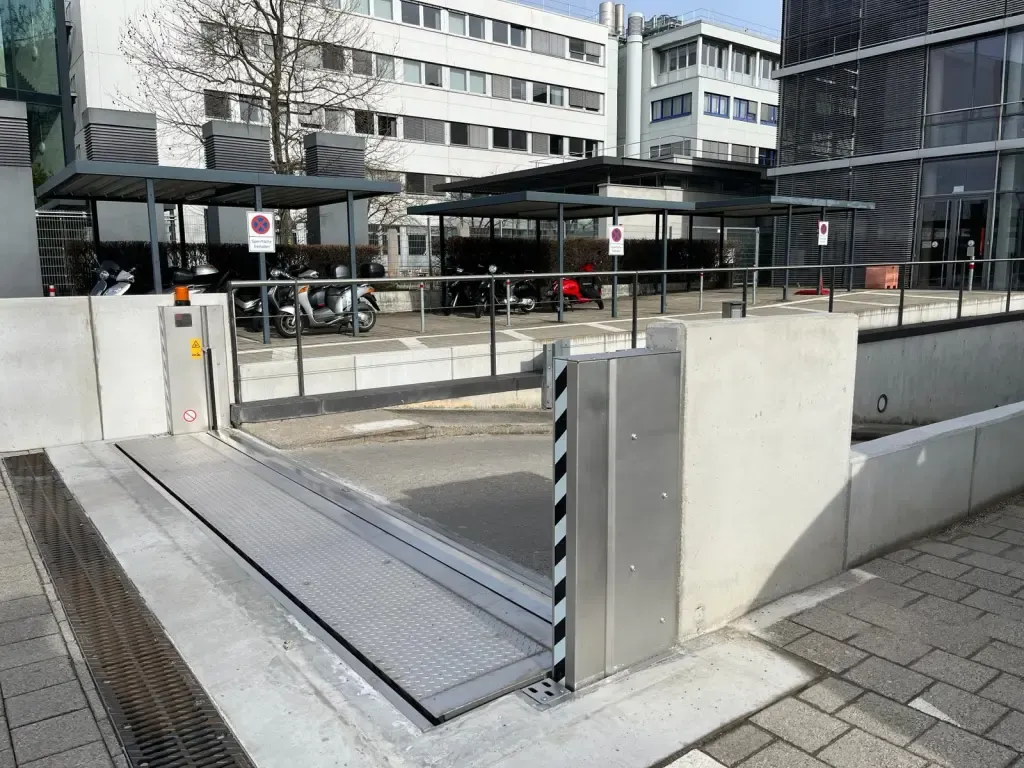
- Resting State: The barrier panel lies horizontally in a recessed pit, flush with the ground. Vehicles, forklifts, and pedestrians pass over it without obstruction. All internal mechanisms remain concealed.
- Water Entry: As rainfall or external flooding occurs, water flows toward the entrance and begins entering the activation chamber through designed inlet ports.
- Pressure Accumulation: More water accumulates in the chamber, creating increasing hydrostatic pressure against the underside of the stainless-steel panel. This pressure is proportional to the height of the water column.
- Automatic Lift: Once the hydrostatic pressure exceeds the activation threshold, the barrier begins to rotate upward around its hinge line — smoothly and systematically, with no human intervention and no electrical power.
- Self-Locking Position: As the panel reaches its fully deployed vertical position, structural lock elements engage. The rising floodwater itself becomes the mechanism that holds the wall closed — the higher the water level, the stronger the pressure forcing the seal.
- Deactivation: After floodwaters recede, the declining water level reduces hydrostatic pressure. The barrier returns automatically to its resting position. No manual action is required.
Spillbarrier Advantages Over Alternatives
This hydrostatic/buoyancy design fundamentally differs from sandbags, temporary barriers requiring setup, or electric gates dependent on power. The critical advantages include:
- No Power Dependency: Works during blackouts, storms, and power outages when protection is most needed.
- Instantaneous Response: Activation occurs within minutes of the water level rising to trigger level.
- Continuous Pressure Seal: The water pressure itself maintains the watertight seal — the harder the flood pushes, the tighter the seal.
- Fail-Safe Design: Mechanical operation means no electronic components to malfunction.
Material Quality and Durability Testing for Flood Barriers
Stainless Steel Construction and Corrosion Resistance
Anhamm Spillbarriers are constructed from high-quality stainless steel, a material engineered to withstand repeated exposure to water, moisture, and saltwater without degradation. Stainless steel resists oxidation and corrosion through a self-healing chromium oxide layer that forms on its surface — a property that makes it ideal for flood protection systems that may be exposed to contaminated water, muddy conditions, and harsh environmental factors.
The barrier components include reinforced rubber seals manufactured to remain flexible across temperature ranges from freezing to high heat, ensuring consistent performance across seasons and climates.
Rigorous Testing and Verification
Research institutions with over 275 years of combined engineering expertise have subjected these systems to testing protocols that simulate real-world flood scenarios:
Watertightness Testing:
- Barriers were exposed to continuous water pressure for 72 hours to replicate extended flood events.
- Sealing performance was verified under hydrostatic pressures equivalent to water depths of 1+ meters.
- Results confirmed watertight performance with minimal seepage.
Structural Load Cycling:
- Test parameters: 200,000 load cycles with simulated wheel loads of 6.5 tons (equivalent to heavy commercial vehicles and forklifts).
- Barriers must maintain structural integrity, sealing function, and activation reliability after stress testing.
- Field installations in logistics facilities and municipal infrastructure have recorded 150,000–200,000+ actual deployment cycles over years of operation.
Impact and Debris Resistance:
- Barriers were subjected to impact tests simulating floating debris striking the deployed barrier.
- Wave action tests replicated conditions during storm surge and flash flood scenarios.
- Performance remained stable under dynamic loading conditions.
Fire Resistance: An Often-Overlooked Safety Feature
One of the most valuable but overlooked advantages of automatic spillbarriers is their fire resistance capability. Industrial and commercial facilities — data centers, manufacturing plants, chemical storage facilities — face dual risks: flooding and fire. Fire protection in warehouses and warehouse fire safety strategies increasingly recognize these dual-threat barriers as essential.
Fire Resistance Classification: Spillbarriers withstand temperatures of up to 730°C for 30 minutes — performance validated through international fire safety standards:
- ISO 834: Standard fire resistance testing conditions. The temperature curve reaches ~730°C after approximately 5 minutes of exposure — a benchmark used globally for structural fire testing.
- EN 13501-1: European fire classification system for construction products, classifying materials from A1/A2 (non-combustible) through F.
- EI30 Classification: Spillbarriers meet EI30 standards (integrity and insulation for 30 minutes), maintaining compartmentation during building evacuation.
This means spillbarriers are designed to maintain structural integrity and remain sealed during the critical 30-minute evacuation window, ensuring that compartmentalization is maintained and seals remain effective even under intense heat. Warehouse fire protection strategies specifically highlight these barriers’ role in preventing both fire spread and flammable liquid runoff during emergencies.
Spillbarriers vs. Traditional Flood Protection Methods: A Scientific Comparison
Sandbags: The Traditional Approach and Its Limitations
Sandbags have been the default flood defense for decades, yet modern engineering research has documented their significant shortcomings. The UK Environment Agency officially acknowledges that sandbags are “ineffective” at mitigating flooding, noting they are only used because they are “cheap, easy to obtain and can provide protection for short periods of time.” Tests conducted at a British Standards Institute accredited test tank found that a standard arrangement of 10 sandbags was breached by water within just 2 minutes. Compare that to water-activated flood barriers that maintain a seal for 72+ hours:
| Factor | Sandbags | Spillbarriers |
|---|---|---|
| Installation time | 4–8 hours (large teams required) | 0 hours (already in place) |
| Watertightness | Acknowledged as ineffective by the UK Environment Agency; breached within minutes in BSI testing | 99%+ effective; hydrostatic self-sealing |
| Setup labor | 6+ people, physically demanding | 0 people (zero intervention) |
| Reusability | Single-use; contaminated after flood | Reusable indefinitely |
| Environmental impact | Contaminated sand disposal hazardous | No waste; no disposal costs |
| Effectiveness during power loss | 100% (no power required) | 100% (no power required) |
| Psychological burden | High (frantic manual preparation) | Zero (automatic peace of mind) |
Modern Alternatives: Portable and Modular Flood Barriers
Modern portable flood barriers offer significant advantages over sandbags and traditional temporary solutions:
- Modular systems require no tools for assembly and use the weight of floodwater itself to secure the barrier to the ground.
- The NOAQ Boxwall can be deployed over 100 times faster than sandbags, holds back floodwaters up to 40 inches deep, and is fully reusable.
- AquaFence provides a modular, reusable flood barrier system with height transitions from 2.5 ft to 9 ft.
- The Dam Easy flood barrier uses a pneumatic seal, installs in under five minutes with no tools required, and is reusable.
Many of these modern barriers are designed for tool-free installation, allowing unskilled personnel to deploy them rapidly. Unlike sandbags, these solutions do not require fill materials, reducing environmental impact and simplifying logistics. Spillbarriers, however, go one step further — they require no human presence at all.
Mobile Flood Barriers and Temporary Solutions
Temporary barriers (inflatable systems, portable gates) have gained popularity, yet research reveals their limitations in real-world deployment:
- Setup time: 30 minutes to 2 hours, depending on system
- Deployment limitations: Less effective in fast-moving flood waters or with debris impact
- Skill requirement: Improper installation compromises effectiveness
- Environmental conditions: Performance varies with temperature, surface irregularities, and water pressure
The fundamental difference: temporary barriers require human decision-making (“Should we deploy now?”), human effort, and human timing. Automatic spillbarriers eliminate all three variables through physics-based operation.
Fixed and Permanent Solutions
Fixed structures like flood walls and seawalls represent large-scale infrastructure designed to withstand significant water pressure and protect entire districts or property perimeters from tidal surges. Most residential barriers, however, are designed for water levels under 3–4 feet; deeper flooding can overtop them.
Leaky Barriers and Natural Flood Management
Research into “leaky barriers” (log-based structures mimicking beaver dams) shows supplementary benefits in stream management: peak flow reduction of 22±6% for multiple barriers across a catchment, and water storage that raises levels behind barriers by 0.8 meters. These cost between £50–£500 per unit and are designed for upstream watershed management, not building protection. Spillbarriers operate in a different category entirely — they are active structural barriers designed for point protection (entrances, driveways, basement openings) and are complementary, not competing, systems.
Spillbarrier Performance Under Real-World Conditions
Case Study: Global Deployment and Climate Resilience
Automatic spillbarriers are deployed across 42 countries worldwide, addressing flooding in diverse climatic zones and infrastructure types:
Europe
UK, Netherlands, Belgium, Germany, Austria, France, Italy, Ireland — Coastal and riverine protection in temperate climate zones with frequent tidal and seasonal flooding.
Asia-Pacific
Japan, Australia, Singapore, Malaysia — Tropical storm and monsoon regions with extreme rainfall events and typhoon surge protection.
North America
United States, Canada — River flooding mitigation and storm surge protection in diverse climatic regions from coastal to inland applications.
Logistics & Infrastructure
International shipping ports, cross-border warehousing, industrial facilities — Critical infrastructure protection requiring zero-downtime flood defense.
Field Performance Data: Proven Track Record
Operational installations have achieved exceptional performance metrics:
- 100% activation success rate in tidal river applications — including Carrick-on-Suir, Ireland, with 150–170 automated activations annually since 2002, representing over 4,000+ documented deployments according to Anhamm operational records.
- Rapid response: Barriers activate and seal within minutes of water level rise, faster than any manual intervention system.
- Zero power outage failures: Systems performed flawlessly during major storms (2000–2015) when electrical infrastructure failed across affected regions.
- Extended service life: Barriers engineered for 50+ year operational life with minimal maintenance requirements.
Customized Solutions: Engineering Protection for Unique Challenges
No two properties face identical flood risks. Flash floods, rapidly rising water levels, and unpredictable storm surges each require tailored engineering solutions. This is where customization becomes essential:
Commercial Floodplain Facilities
A manufacturing facility in a designated floodplain requires large-scale barrier systems that protect valuable machinery, ensure business continuity, and prevent prolonged operational shutdowns. Specialized panels and modular walls are engineered to the exact dimensions of loading docks, roll-up doors, and service entrances.
Residential Property Protection
A home in an urban area with basement flooding risk benefits from compact, lightweight barrier systems designed for specific door and window dimensions. These can be maintained by property owners, providing peace of mind without daily disruption to normal use.
Customization extends beyond sizing. Engineered solutions account for surface irregularities, water diversion on sloped driveways, integration with existing drainage systems, and aesthetic requirements for historic districts. Whether installed in busy urban retail environments or remote residential areas, customized barriers ensure every property receives the protection needed to withstand flooding. Ultimate flood protection solutions now prioritize both safety and aesthetic integration.
Strategic Water Diversion: The Physics Advantage
One of the most powerful — yet often misunderstood — advantages of spillbarriers is their ability to strategically manage the hydrodynamic forces generated by floodwaters. Unlike passive sandbag barriers that simply obstruct water, spillbarrier systems actively utilize hydraulic physics:
- Hydrostatic pressure formation: As floodwater rises, the accumulating weight creates increasing pressure against the barrier. A 1-meter water column generates 9.8 kPa of pressure.
- Passive force utilization: Rather than requiring external power to resist this pressure, spillbarriers use the pressure itself to maintain a self-locking seal.
- Flow diversion in uneven terrain: Spillbarriers are engineered to create comprehensive seals across complex geometries where water can quickly accumulate.
Cost-Benefit Analysis: The Investment That Pays for Itself
Breaking Down the Economics: Single Prevention = Full ROI
The financial case for professional flood protection is remarkably straightforward. A single prevented flood event typically pays for the entire system investment. With residential flood damage averaging $15,000–$20,000 per event (sourced to UK Government flood cost evidence and FEMA FloodSmart), and commercial damages regularly exceeding $50,000–$100,000 (per ABI 2025 claims data and NOAA), the ROI case is undeniable. Additional prevented costs for commercial properties include:
- Business interruption losses per day of downtime
- Inventory loss and product destruction
- Reputation and customer relationship damage
- Regulatory fines and compliance violations
Insurance Premium Reduction: Quantifiable Ongoing Savings
Property owners installing professional flood protection systems frequently qualify for significant insurance premium reductions through FEMA’s flood insurance programs:
- CRS premium discounts range from 5% to 45% for communities participating in FEMA’s Community Rating System, depending on creditable flood mitigation activities. (Source: FEMA CRS Local Officials Guide)
- Enhanced coverage: Reduced deductibles on flood insurance policies in FEMA CRS communities.
- Cumulative impact: Communities investing in structural flood mitigation realized $11.4 billion in cumulative damage reductions between 1998–2020 across all CRS-participating communities. (Source: IOP Science – Federal Incentives for Community-Level Climate Adaptation)
A facility manager implementing flood causes and prevention strategies would identify spillbarriers as a foundational investment alongside drainage improvements and watershed management.
Minimal Ongoing Costs: The Long-Term Advantage
Unlike sandbags, temporary barriers, or electrical flood gate systems, spillbarriers require minimal operational investment. There are no power costs — the system operates entirely mechanically. Seal components are engineered for long service intervals. This stands in sharp contrast to alternative flood protection methods where repeated deployments incur recurring labor, material, and disposal costs year after year.
The mathematical reality is clear: spillbarriers offer the lowest total cost of ownership while providing the highest level of protection over their 50+ year operational life.
Installation and Seamless Integration into Existing Infrastructure
Architectural Invisibility: The Aesthetic Advantage
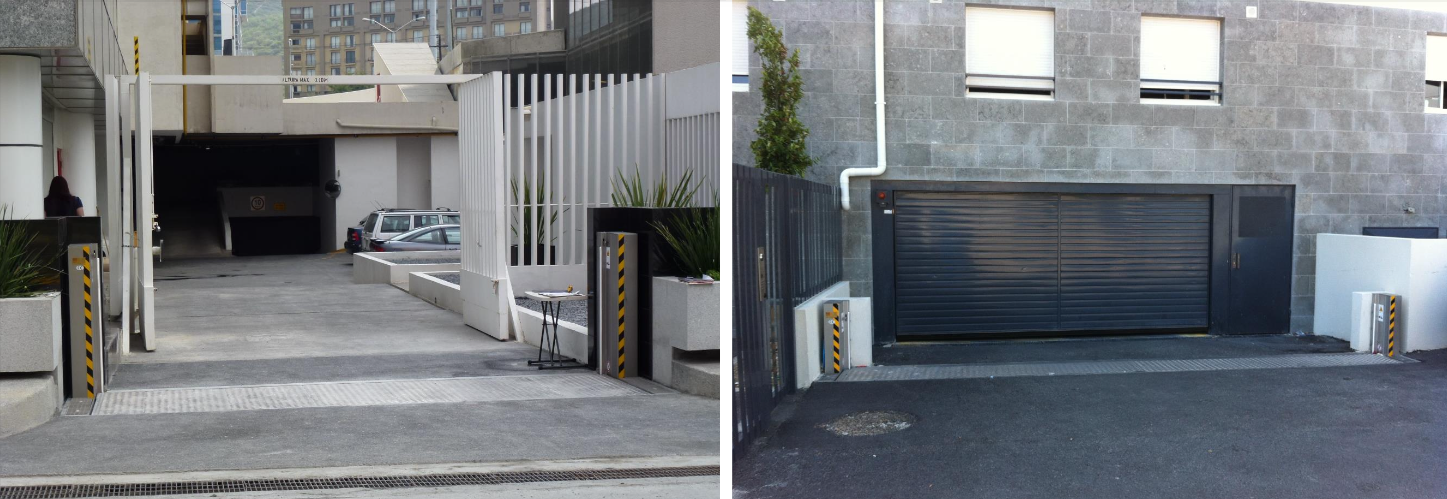
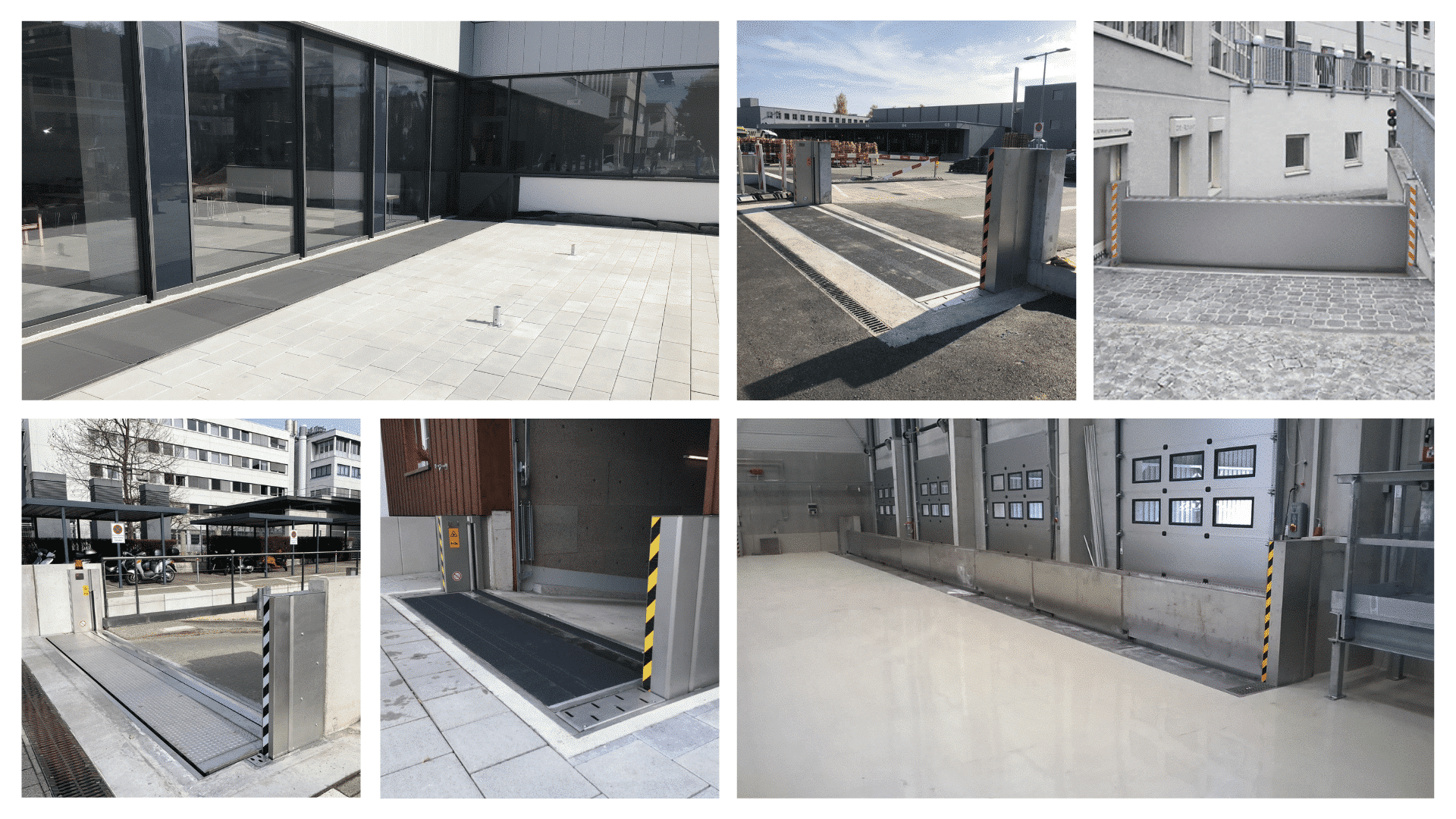
A frequently overlooked advantage of automatic spillbarriers is their complete invisibility during normal operations. Unlike visible flood walls, permanent barriers, or temporary sandbag deployments, these systems remain flush with the ground surface when not in use — vehicles, forklifts, and pedestrians traverse over the recessed panel without obstruction. This architectural integration is particularly valuable for:
Historic Properties & Heritage Buildings
Where visible modifications are prohibited or violate preservation guidelines, spillbarriers provide hidden protection that preserves architectural integrity.
Urban Retail Environments
Storefronts depend on visual appeal and customer access. Spillbarriers activate invisibly without disrupting the customer experience or storefront appearance.
Residential Neighborhoods
Property values in residential areas depend on curb appeal. Spillbarriers maintain neighborhood aesthetics while providing individual home protection.
High-End Commercial Spaces
Premium office buildings, galleries, and upscale venues require flood protection that doesn’t compromise sophisticated interior design or the entrance experience.
Installation Timeline and Process
As fully prefabricated units, spillbarriers are installed with remarkable efficiency and minimal operational disruption:
Site Assessment & Engineering
Professional evaluation determines optimal placement, required barrier dimensions, and opening-specific specifications. Each installation is custom-engineered for doors, garages, loading docks, and other vulnerable entry points.
Duration: 1–3 days
Excavation & Foundation Preparation
The entry area is excavated to install the barrier’s recessed housing. This work is localized to the specific opening, minimizing disruption to adjacent areas.
Duration: 1–2 days (residential)
Barrier Assembly & Installation
Prefabricated barrier components are assembled, aligned, and secured. Mechanical systems, hinges, seals, and locking mechanisms are installed and calibrated.
Duration: 1–2 days
Testing & Commissioning
Comprehensive performance verification under simulated flood conditions. The system is tested for proper activation, seal integrity, and manual override functionality.
Duration: 1 day
Operational Deployment
The system is placed into service and is immediately ready to respond to flooding. Property owners receive comprehensive training on the system’s operation and maintenance requirements.
Duration: Immediate activation
Total installation window: 3–5 days for most applications. For new construction, integration costs are minimal because the spillbarrier system is engineered into the building design from the foundation stage. For retrofitting existing properties, the 3–5 day installation timeline minimizes business interruption and operational disruption.
Global Flood Risk Escalation: Why Adaptation Is Critical Now
Climate Change and Accelerating Flood Projections
Scientific consensus is unequivocal: flood risks are accelerating, not stabilizing. Climate modeling by the IPCC and atmospheric research institutions confirms that warming climate conditions intensify extreme precipitation and increase flood frequency across all regions. Consider these verified projections:
United States (by 2050)
- Louisiana: +147% increase in flood losses
- Florida: +74% increase in flood losses
- South Carolina: +58% increase in flood losses
- Orange County, Texas: +914% increase in average annual flood loss
Canada (mid-century to end of century)
- Annual flood damage: 3–5× increase (to over $5.5 billion)
- By end of century: $13.6 billion annually
- Regions most affected: Southern BC, Ontario, Quebec
Source: Canada Climate Institute
Europe (by 2050)
- Northern regions: Increased extreme precipitation and river flooding
- Southern regions: Storm surge and coastal flooding (sea levels rising 0.40–0.65 m by 2050)
- Current infrastructure: Increasingly inadequate for projected conditions
Source: IPCC Sea Level Rise Report
The Urgency of Immediate Action
Every year of delay increases future costs. Properties built or retrofitted with flood resilience today benefit from 50+ years of protection. Homes and businesses lacking adaptive defenses will face three choices in the near future:
- Expensive retrofitting: Adding flood protection to an existing structure costs significantly more than engineering it into new construction
- Catastrophic losses: Suffering damages and extended recovery periods
- Property abandonment: Becoming uninsurable or unmortgageable as flood risk escalates
Automatic spillbarriers represent one of the highest-return-on-investment climate adaptation measures available to property owners today. Floods account for 48% of all people affected by climate-related hazards globally, and 2025 saw $122+ billion in climate-related disaster costs in just the first half of the year. Properties with flood risk assessment and active protection systems are positioned to maintain insurability, preserve asset value, and ensure business continuity.
Frequently Asked Questions
Can warning systems be attached to the Anhamm Spillbarrier?
Yes. While the system is fully automatic and requires no human intervention, optional sensors can be integrated to send alerts to property managers or emergency personnel when water levels approach activation thresholds. This provides advance notification of flooding conditions while the barrier continues to function independently if alerts are missed.
Why can the Spillbarrier be driven over with heavy loads without problems?
The barrier is engineered with reinforced materials and structural anchor systems capable of withstanding sustained vehicle loads of 6.5 tons (equivalent to heavy commercial trucks, forklifts, and loaded pallets). Rigorous stress testing confirmed structural integrity across 200,000+ load cycles. The barrier is designed to blend seamlessly into driveways, loading docks, and high-traffic service areas.
Are there restrictions on sizes of Anhamm Spillbarriers?
No. Barriers can be custom-engineered to fit virtually any opening dimension — from narrow residential doorways (0.8–1.5 m wide) to expansive industrial entrances (6+ m wide). Modular designs allow scaling for large perimeters and multiple openings. Specifications are determined during the site assessment phase based on your exact requirements.
Are there installation restrictions on slopes (e.g., garage ramps)?
Sloped installations are possible and are engineered case-by-case. The hydrostatic activation mechanism functions on slopes, though design modifications may be required to ensure proper water accumulation and seal engagement. Professional assessment during the site evaluation determines feasibility and optimal configuration.
Can the Spillbarrier be manually raised for cleaning and maintenance?
Yes. The barrier can be easily manually raised to its vertical position, providing full access for cleaning accumulated debris, mud, sediment, or algae buildup. This straightforward maintenance typically requires minimal effort and takes 15–30 minutes annually or after flood events.
What happens if the barrier activation fails?
Spillbarriers employ fail-safe mechanical design. Because activation depends on simple hydrostatic pressure and buoyancy — not electronic sensors or power supplies — failure rates are extremely low. The system has been tested for 200,000+ load cycles with consistent performance. In the extraordinarily rare event of mechanical jamming, the barrier can be manually deployed to protect the opening.
How do I request a site assessment?
Contact our flood protection specialists through the Spillbarrier website or by phone. Our team will conduct a comprehensive site evaluation, assess your specific flood risk, determine optimal barrier sizing and placement, and provide a detailed proposal for your property or facility.
Conclusion: Redefining Flood Protection for the Climate-Changed Era
Flood protection has fundamentally evolved. The sandbag era — requiring desperate preparation hours before predicted flooding — is being replaced by intelligent, physics-based automation that operates 24/7 without human intervention or external power.
Anhamm Spillbarriers represent this transformation. They ground flood defense in engineering science, validate performance through rigorous testing, and prove reliability through global deployment across 42 countries and diverse climatic zones.
The Core Facts
- Climate-driven flood risk accelerates globally — extreme rainfall becoming more intense and frequent, with US flood losses projected to increase 26.4% by 2050
- Flood damage costs are rising sharply — a single event costs $15,000–$100,000+ depending on property type, yet one prevented loss justifies complete system investment
- Automatic activation eliminates human error — protection functions during vacations, power outages, and emergencies when manual defenses fail
- Zero power consumption ensures reliability — activated by water pressure alone, eliminating electrical dependencies during infrastructure failures
- Decades of operational life — engineered for 50+ years with minimal maintenance, the lowest total cost of ownership among all flood protection methods
The strategic question for property owners is no longer whether they need professional flood protection. Climate projections leave no ambiguity. The question is simply timing: Will you invest in protection today when installation is straightforward? Or face forced retrofitting at double the cost when flood risk becomes undeniable?
Take Action Today
Discover why Anhamm Spillbarriers are the choice of property owners and municipalities protecting assets across 42 countries. Explore comprehensive solutions designed for your property type and risk profile.
Research Sources & Data Attribution
This comprehensive analysis integrates evidence from leading scientific institutions, government agencies, and peer-reviewed research:
Climate Science & Flood Projections
- IPCC (Intergovernmental Panel on Climate Change) — Global climate assessments and flood risk projections
- Canada Climate Institute — Canadian flood risk and adaptation analysis
- NOAA — U.S. flood data, extreme weather monitoring
Engineering Standards & Testing
Insurance & Economic Data
- FEMA National Flood Insurance Program — Flood damage costs and coverage
- ASFPM – CRS Resources — Community Rating System effectiveness data
- IOP Science — CRS program evaluation ($11.4B damage reduction)
- Confused.com – 2025 UK flood damage analysis

