
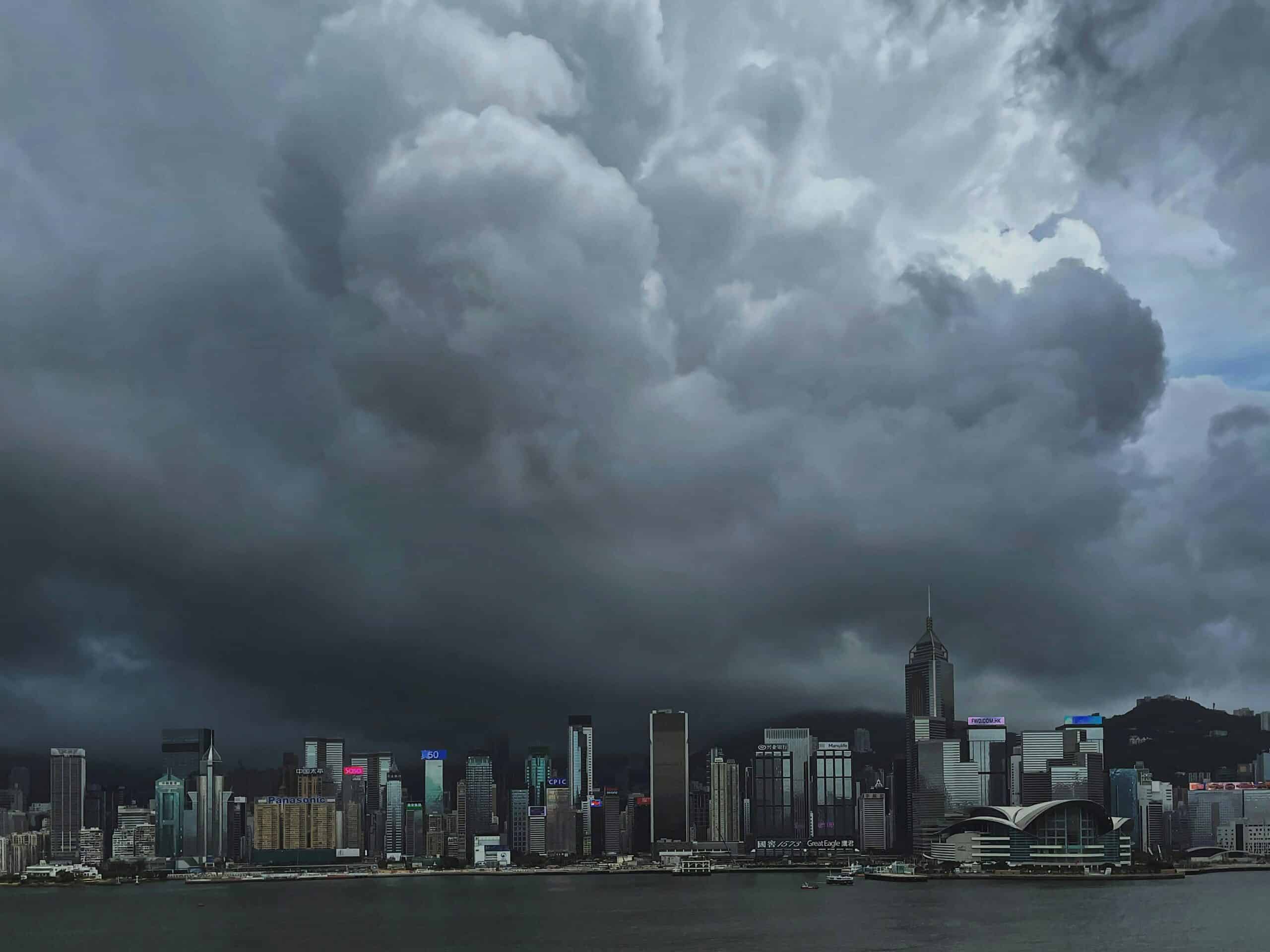
Hong Kong typhoon season runs from May to November, but the real danger window is June through October — and in recent years, the risks that come with it have grown significantly. Typhoons, storm surge, extreme rain, and sea-level rise no longer arrive as separate events. They increasingly combine into one compound flood event, amplifying damage well beyond what any single driver would cause alone. For facility managers and asset owners responsible for basements, logistics sites, data centres, and waterfront towers, the question is no longer whether to invest in flood protection. It is which combination of measures delivers reliable, automatic protection — day and night, in every weather condition, with or without staff on site.
This guide explains:
- Hong Kong’s compound flood risk and what the data shows
- why the typhoon season in Hong Kong is getting more challenging
- why traditional flood control measures fall short for high-risk openings
- how Spillbarrier’s automatic flood barrier protects entrances, ramps, and critical openings that sandbags and manual boards cannot cover reliably
Key Takeaways
- Hong Kong faces increasing compound flood risk from typhoons, storm surge, sea-level rise, and extreme rain. For high-value assets, an automatic flood barrier is now a practical resilience requirement.
- Spillbarrier’s self-activating flood barriers provide power-independent flood protection solutions for entrances, ramps, basements, tunnels, and critical openings.
- Public drainage, sandbags, and demountable boards are no longer sufficient for mission-critical sites in Hong Kong.
- A local weather forecast helps teams prepare. A flood barrier is what stops water at the building line.
- Automatic and passive barriers deploy automatically when water levels rise, sealing off an area without human intervention.
- If your site has below-grade access, critical equipment, or a history of ponding, contact Spillbarrier for a site-specific assessment.
Table of Contents
Hong Kong’s Changing Flood Risk: Climate Highlights and Weather Outlook
Geographic and Urban Flood Risks
Regional Flood Context
The Pearl River Estuary connects Hong Kong to a wider coastal flood system. Storm surge, high tide, and heavy rain can interact across the whole region, not just within one district.
Hong Kong is a steep coastal city. Dense business districts, transport corridors, podium developments, and waterfront assets sit close to Victoria Harbour, the Pearl River Estuary, and narrow coastal inlets — while hillsides rise sharply behind them. That layout creates fast surface runoff and raises the risk of flash floods where water is channelled toward roads, ramps, tunnels, and low-lying entrances.
This is why flood protection cannot be treated as a public-infrastructure issue alone. A drainage system may work well at district scale, yet a single car park ramp, loading bay, plant-room doorway, or tunnel portal can still become the path of least resistance during a serious flooding event.

Recent Climate Data
Recent climate highlight data supports the concern. Peer-reviewed analysis of Hong Kong flood drivers from 1979 to 2022 found that mean sea level has risen by roughly 25 mm per decade, while maximum storm surge levels have also increased. The same research highlights the growing likelihood of compound flooding — where heavy rain, elevated sea level, and storm surge occur together rather than as separate hazards.
The Hong Kong Observatory shows long-term sea-level rise at Victoria Harbour continuing upward over the historical record. For asset owners, this matters because a threshold that stayed dry 20 years ago may now sit closer to regular overtopping or backflow during typhoons. A detailed forecast is essential before any storm — but it cannot change the physics at your ramp entrance.
Typhoon and Rainfall Outlook
For 2026, the Hong Kong Observatory annual outlook expects:
- 4–7 tropical cyclones coming within 500 km of Hong Kong.
- The tropical cyclone season is expected to start in June or later and end by October or before.
- Annual rainfall is forecast to be near normal, but the Observatory warns of significant risk from rainstorms and localised heavy rain.
Teams should monitor the weather forecast throughout June to October and check a detailed forecast before any rainstorm warning signal or typhoon signal is raised. A local weather forecast can tell you what may happen. Engineered flood protection solutions determine whether your building can resist it.
What Recent Weather Events Show Is at Stake

Super Typhoon Ragasa shows why Hong Kong flood risk cannot be judged by local rainfall alone. The storm hit the northern Philippines first, then tracked west toward Hong Kong, where storm surge, high tide, and heavy rain created a serious coastal flood threat.
Typhoon Mangkhut and Ragasa
Super Typhoon Mangkhut in 2018 generated a storm surge of about 2.35 m above astronomical tide at Quarry Bay and North Point. Super Typhoon Ragasa in September 2025 pushed water to 3.4 metres above Chart Datum at Quarry Bay, coinciding with astronomical high tide — one of the highest combined sea levels ever recorded in Victoria Harbour. At least 101 people were injured, 24 flooding incidents were logged, and economists estimated total losses between HK$2 billion and HK$3 billion.
Black Rainstorm Warnings
During 2025, five Black Rainstorm Warnings were issued in just 17 days between late July and mid-August. A Black Rainstorm Warning is triggered when very heavy rain has fallen or is expected to fall generally over Hong Kong, exceeding 70 millimetres in an hour. During such events, hourly rainfall accumulation can overwhelm drains faster than teams can manually deploy any flood defence.
Facility Team Readiness
Facility teams already use meteorological data in daily operations. A practical flood-readiness routine includes:
- Checking nearby weather stations and other meteorological stations for localised rain build-up.
- Reviewing location weather reports for the specific district.
- Tracking hourly rainfall and hour rainfall intensity across the urban catchment.
- Monitoring meteorological data displayed at the Hong Kong Observatory for territory-wide conditions.
Understanding Hong Kong’s Climate Through the Data
Good flood planning starts with the right data. Monthly rainfall data and monthly rainfall data recorded at official stations show that about 80% of annual rainfall in Hong Kong falls between May and September, with June and August typically the wettest months. This is the seasonal window when every unprotected ramp, loading dock, and plant-room door is most exposed.
Hong Kong Rainfall Timeline
Rain falls throughout the year, but Hong Kong is much wetter from May to September. This is the main flood-risk season for ramps, loading docks, and low openings.
June and August are usually the wettest months, and heavy rain is common during this period.
January to April is the driest and safest period for inspections, maintenance, and flood barrier installation before the wet season begins.
The Hong Kong Observatory’s climatological information services provide the full weather picture for Hong Kong, including rainfall, temperature, and monthly climate data.
Hong Kong Temperature Timeline
Coolest period. It is also one of the driest times of the year.
Temperatures rise fast, and conditions begin shifting toward the wet season.
Hot, humid, and unstable. This is the main period for convective thunderstorms and flood risk.
Conditions ease, temperatures fall, and the post-season maintenance window opens again.
Temperature variation across Hong Kong’s districts matters for flood risk because heat drives afternoon convective thunderstorms. Absolute max temp values at urban stations sometimes exceed 36–38°C in the hottest months, while absolute min temp readings in the New Territories can drop below 5°C in winter. Reviewing January Hong Kong climate summaries gives teams a seasonal baseline: January is one of the driest months, with rainfall well below 50 mm. The January-April period represents the lowest-risk window — the ideal time to inspect, maintain, or install flood barrier systems before the wet season.
Hong Kong UV Index Timeline
Lower UV, but outdoor work still needs basic sun protection.
UV rises quickly from March onward.
Highest UV risk of the year, often reaching very high or extreme levels on sunny days.
UV declines, but sun exposure still matters for outdoor crews.
The Observatory’s public meteorological data pages also reference the maximum UV index during summer months, relevant for outdoor maintenance scheduling. During periods of persistently hot weather, the Very Hot Weather Warning is issued and crews should plan outdoor work for early morning. On days when southerly winds prevail, moist air flows in from the South China Sea and raises the probability of intense afternoon rainstorms.
On weather bulletins, you may see references to southern China tomorrow being affected by upper air disturbances or a strengthening monsoon trough — these are the precursors to Hong Kong’s most intense localised rain events. When upper air disturbances departing the region are noted, conditions typically improve, but the window as a disturbance passes through can bring the highest rainfall intensities.
When using HKO’s climatological distribution charts, the user selected location feature lets you pull grey area world weather data for a specific district. Case meteorological data and archived monthly summaries from stations including King’s Park and Quarry Bay are available for historical comparison. Climatological mean dotted lines in these charts mark the long-term average; the solid line shows actual recorded values for comparison.
Source: Hong Kong Observatory Climatological Information Services
Hong Kong Typhoon Season: The Full Risk Picture
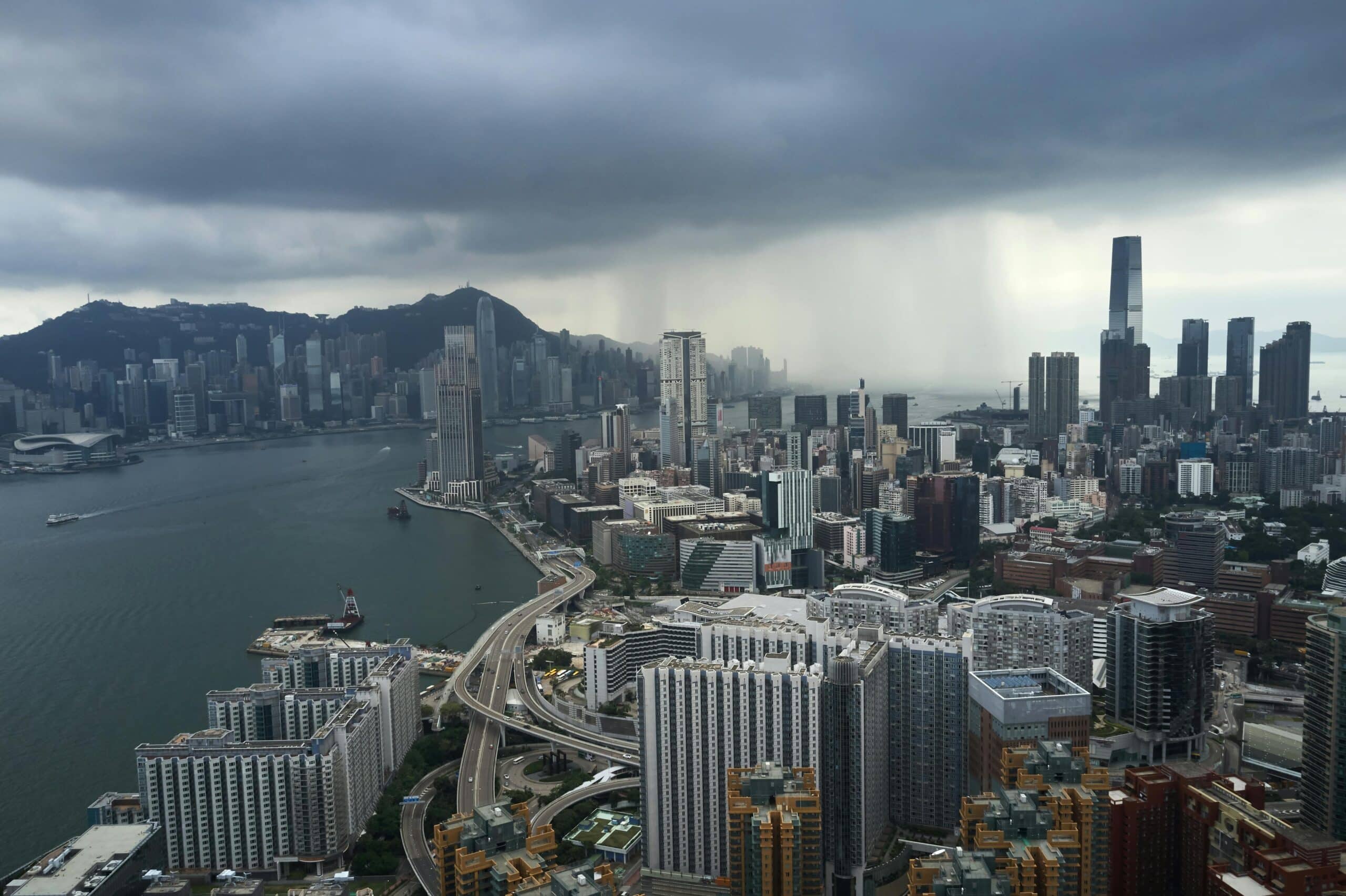
The typhoon season in Hong Kong officially spans May to November, but the peak risk window is June through October. In 2025, 14 tropical cyclones required the issuance of warning signals in Hong Kong — more than double the long-term average and the highest annual count since 1946. The Hurricane Signal No. 10 was raised twice, for Typhoon Wipha in July and Super Typhoon Ragasa in September, matching a record last set in 1964.
Ragasa struck on 24 September, coinciding with astronomical high tide and producing the near-record 3.4 m Chart Datum sea level at Quarry Bay. Economists estimated total losses between HK$2 billion and HK$3 billion. A single unprotected basement ramp during that event could have resulted in multi-million HKD damage from water ingress alone.
The Compound Flood Threat: Rain + Surge + Sea-Level Rise
The most important flood control concept for Hong Kong in 2026 is compound flooding — where multiple flood drivers interact and produce consequences larger than any single driver alone. A compound event typically unfolds in this sequence:
- A typhoon approaching from the Pearl River Estuary or from the south drives wind-based storm surge into the harbour, pushing levels up by 1–3+ metres.
- Astronomical high tide coincides with the surge, adding another 1–2 metres of tidal elevation.
- Extreme rainfall from the outer rainbands overwhelms stormwater drainage, which is already backing up because outfall levels are elevated.
- Hill runoff accelerates across steep terrain and funnels toward low-lying urban basements and openings.
- The baseline mean sea level — now roughly 25 mm per decade higher than in the 1980s — means every event starts from a higher floor.
Each factor alone might not breach a threshold. Together, they produce events like Ragasa and Mangkhut. This compound risk picture is what should drive every flood barrier investment decision in Hong Kong today.
Why Traditional Flood Control Measures Are No Longer Enough
For decades, sandbags were the default response to typhoon flood risk in Hong Kong. Temporary flood barriers can be constructed using sandbags, but recent innovations have led to more efficient mobile flood protection systems. Modular self-supporting barriers, water-filled or ballast-based systems, and prefabricated panel barriers are modern alternatives to traditional sandbagging for flood protection. Flood protection systems can be designed for rapid deployment and reuse in locations where permanent flood defences are not practical — enhancing their versatility in emergency situations.
However, temporary systems require consistent maintenance and enough warning to deploy before floods occur. Flash floods can hit a basement ramp within 20–30 minutes of a Black Rainstorm Warning. If the signal is issued at 3 a.m. and no staff are on site, manual flood control is simply not available. Rapid deployment is not the same as automatic deployment. If no one is there to install the system, the building remains exposed.
Types of Flood Barriers: What Exists and What Works in Hong Kong
Flood barriers can be classified into temporary and permanent types, with temporary barriers including sandbags and modular self-supporting systems designed for rapid deployment. Different types of flood barriers include demountable and panel barriers, inflatable and water-filled tubes, automatic and passive barriers, permanent flood walls and levees, expandable barriers, and glass flood walls.
| Flood barrier type | How it activates | Works without staff | Key limitation for Hong Kong |
|---|---|---|---|
| Automatic / passive barrier (Spillbarrier) | Water-activated float — no power needed | Yes | Higher upfront cost |
| Demountable and panel barriers | Manual installation | No | Needs warning time and trained staff |
| Sandbags | Manual | No | Slow, poor seal on uneven surfaces |
| Motorised flood gates | Sensor or button — power required | Risk during blackout | Fails without electricity |
| Inflatable and water-filled tubes | Manual or semi-auto; weight of fill provides anchorage | No | Not permanently installed |
| Expandable barriers | Manual — expand and compress to seal openings | No | Staff-dependent |
| Glass flood walls | Manual or fixed; hold water while maintaining visibility | Partial | Best for visible frontage only |
Perimeter flood barriers are often placed around buildings to prevent floodwaters from entering, with examples including sandbag walls as temporary solutions and reinforced concrete walls as permanent structures. For most Hong Kong commercial buildings, a full perimeter barrier is not practical because of site density, access requirements, and fire safety rules. Flood protection systems can be designed for rapid deployment and reuse where permanent defences are not practical, but for mission-critical openings, the automatic option remains the gold standard.
The Levee Effect: A Hidden Engineering Risk
Flood barriers require careful design to avoid redirecting hazards. They can present significant challenges such as the “Levee Effect” and downstream risks. A barrier that protects one doorway can divert water pressure toward an adjacent unprotected opening, a neighbouring building’s ramp, or a shared drainage channel. In Hong Kong’s high-density environment — where buildings share podium levels, underground connections, and drainage infrastructure — this risk is particularly pronounced.
A well-specified automatic flood barrier seals the protected opening while allowing drainage to function normally during moderate events, avoiding the displacement of risk elsewhere. Flood barriers can provide physical and psychological security for residents in high-risk flood zones, and the same applies to building operators: visible, engineered protection gives teams confidence during severe weather.
What Is an Automatic Flood Barrier and How Does It Work?
An automatic flood barrier — also called a self-rising or passive flood barrier — is an engineered gate installed flush with a driveway, floor threshold, or access opening. Automatic and passive barriers deploy automatically when water levels rise, sealing off an area without human intervention. The system requires no electricity, no sensor array, no control room command, and no manual lifting.
- The barrier lies completely flat in normal conditions. Vehicles, pedestrians, forklifts, and pallet trucks pass over it without obstruction.
- When floodwater begins to enter the collection sump, a float mechanism rises.
- The rising float activates a pivot, causing a stainless-steel gate to rise and seal against the frame or threshold.
- The gate holds back incoming water through hydrostatic pressure resistance.
- Once water recedes, the float lowers and the barrier resets — ready for the next event.
The full sequence happens within seconds of water contact. Because water itself is the driving force, the system remains operational during complete power blackouts — which typhoons in Hong Kong routinely cause.
Spillbarrier: The Automatic Flood Barrier Built for Coastal Cities
Spillbarrier by Anhamm is a specialist manufacturer with over 30 years of experience in automatic, self-activating flood protection solutions. The flood barrier is designed specifically for industrial gates, driveways, and access ramps — exactly the openings most vulnerable to typhoon-season flash floods in Hong Kong.
When water enters the barrier’s built-in sump, a float rises and mechanically actuates a stainless-steel gate to seal the opening — completely without external power, hydraulics, pneumatics, or human intervention. Once water recedes, the system resets automatically.
Technical Specifications — Flood Barrier
| Specification | Detail |
|---|---|
| Activation | 100% mechanical — float-based, no power required |
| Material | AISI 304 stainless steel, PTFE seals |
| Installation | Flush floor — invisible during normal operation |
| Width range | Custom sizing from standard doorways to wide ramp openings |
| Rolling load | Certified for vehicle and forklift traffic in daily operation |
| Corrosion resistance | Suitable for marine, coastal, and salt-air environments |
| Manufacturing standard | Made in Germany with full compliance documentation |
| Maintenance | Passive design — no active service cycles required |
Consultancy services in flood prevention often include site visits and surveys to assess specific risks and recommend tailored solutions — and this is precisely how Spillbarrier engages. Expert advice in flood prevention can help identify the most effective strategies and technologies for different environments. Consultants in the flood protection industry often have access to a range of products and solutions, allowing them to provide comprehensive recommendations based on client needs. Spillbarrier’s team brings this breadth to every project.
Local Weather Forecast Integration: Building a Flood-Ready Operation
A strong local weather forecast routine is the operational layer that sits alongside permanent flood protection — it tells you when the barrier is most likely to be tested. For Hong Kong facility managers, the following weather information sources should be integrated into daily operations during the typhoon season:
- Hong Kong Observatory (hko.gov.hk) — official typhoon forecast track updates, rainstorm bulletins, and storm surge alerts. The authoritative source for all signal decisions.
- MyObservatory app — provides district-level location weather data and real-time hourly rainfall readings from nearby weather stations across Hong Kong.
- Weather radar — available on HKO’s website, showing rain band positions. During a developing typhoon, this gives 30–60 minutes of additional warning before intense rain reaches a specific district.
- Rainstorm warning signals — Amber, Red, and Black, each with defined thresholds. The rainstorm warning signal system is independent of the tropical cyclone system and can be issued any time during the wet season.
The Critical Signal Timeline for Flood Barrier Readiness
| Signal / Warning | Condition | Facility Action |
|---|---|---|
| Typhoon Signal No. 1 | Storm within 800 km | Monitor weather forecast; no operational change needed |
| Typhoon Signal No. 3 | Strong winds expected | Inspect Spillbarrier sump for debris; brief all staff |
| Amber Rainstorm Warning | Heavy rain developing | Review location weather at nearby weather stations |
| Red Rainstorm Warning | Over 50 mm/hour | Confirm all barriers are clear and unobstructed |
| Black Rainstorm Warning | Over 70 mm/hour; serious flooding likely | All manual protocols activated; automatic barriers already live |
| Typhoon Signal No. 8 | Gale-force winds | Cease all outdoor work; buildings sealed |
| Typhoon Signal No. 10 | Hurricane-force winds | Full lockdown; Spillbarrier protecting openings autonomously |
The critical insight is in the lower rows of this table. When a heart rainstorm warning bulletin or Signal No. 8 is raised, it may be unsafe for staff to carry panels through wind and rain. The automatic flood barrier has already activated — requiring nothing from anyone.
Seasonal Preparation: The Jan–Apr Window
Fall generally brings lower rainfall in Hong Kong, and the Jan, Feb, Mar, and Apr months represent the driest part of the year. This is the ideal window for flood barrier installation, maintenance inspections, and drainage assessments. Climatological distribution data from the Observatory confirms that the transition from dry to wet season typically begins in late April or May — making March the practical deadline for completing any flood protection upgrades.
During this period, temperature values are at their lowest, temperature variation between day and night is greatest, and persistently hot weather advisories are absent. The maximum UV index readings characteristic of summer are months away, making outdoor civil work more comfortable and safer for installation teams.
Use Cases: Flood Barriers for Hong Kong Facilities
Basement Car Parks in Commercial Towers

In Central, Admiralty, Wan Chai, Kowloon, and Quarry Bay, a ramp may fall below street level within just a few metres. During intense rain events, surface runoff collects at the ramp crest and cascades into the basement. During the August 2025 flooding events, at least one Tseung Kwan O carpark flooded overnight with no staff available to respond. An automatic flood barrier at the ramp entrance creates a sealed line of defence before water enters — without any interference to daily vehicle movements.
Logistics and Industrial Facilities in the New Territories
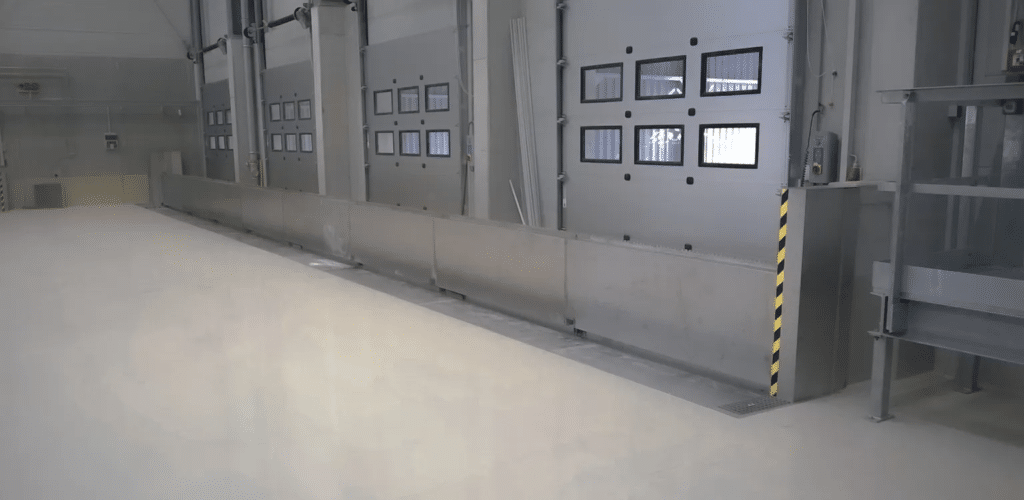
Wide loading docks facing open yards are among the most difficult openings to seal manually during a typhoon. Modular self-supporting barriers, water-filled systems, and prefabricated panel barriers are modern alternatives to traditional sandbagging for flood protection in these environments — but for 24/7 resilience without staff dependency, a permanently installed automatic barrier is the stronger solution. A Spillbarrier installation across the dock threshold protects inventory, machinery, forklifts, and switchgear without requiring any interruption to truck and logistics operations.
Data Centres and Critical Infrastructure
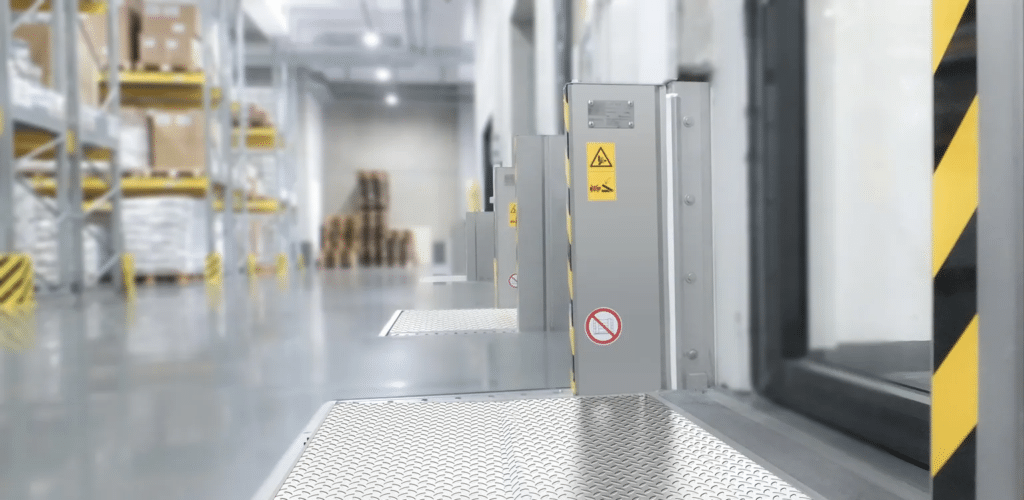
Hong Kong is Asia’s premier digital infrastructure hub, and data centres have near-zero tolerance for water ingress. Even a few centimetres of water can trigger emergency shutdowns and downtime costs in the tens of millions of HKD. Spillbarrier’s energy-independent activation means that even during a complete mains failure — which typhoons routinely cause — the barrier remains fully operational. This is a fundamental advantage over sensor-triggered, powered flood gate systems that fail at exactly the moment they are most needed.
Waterfront Commercial and Residential Towers
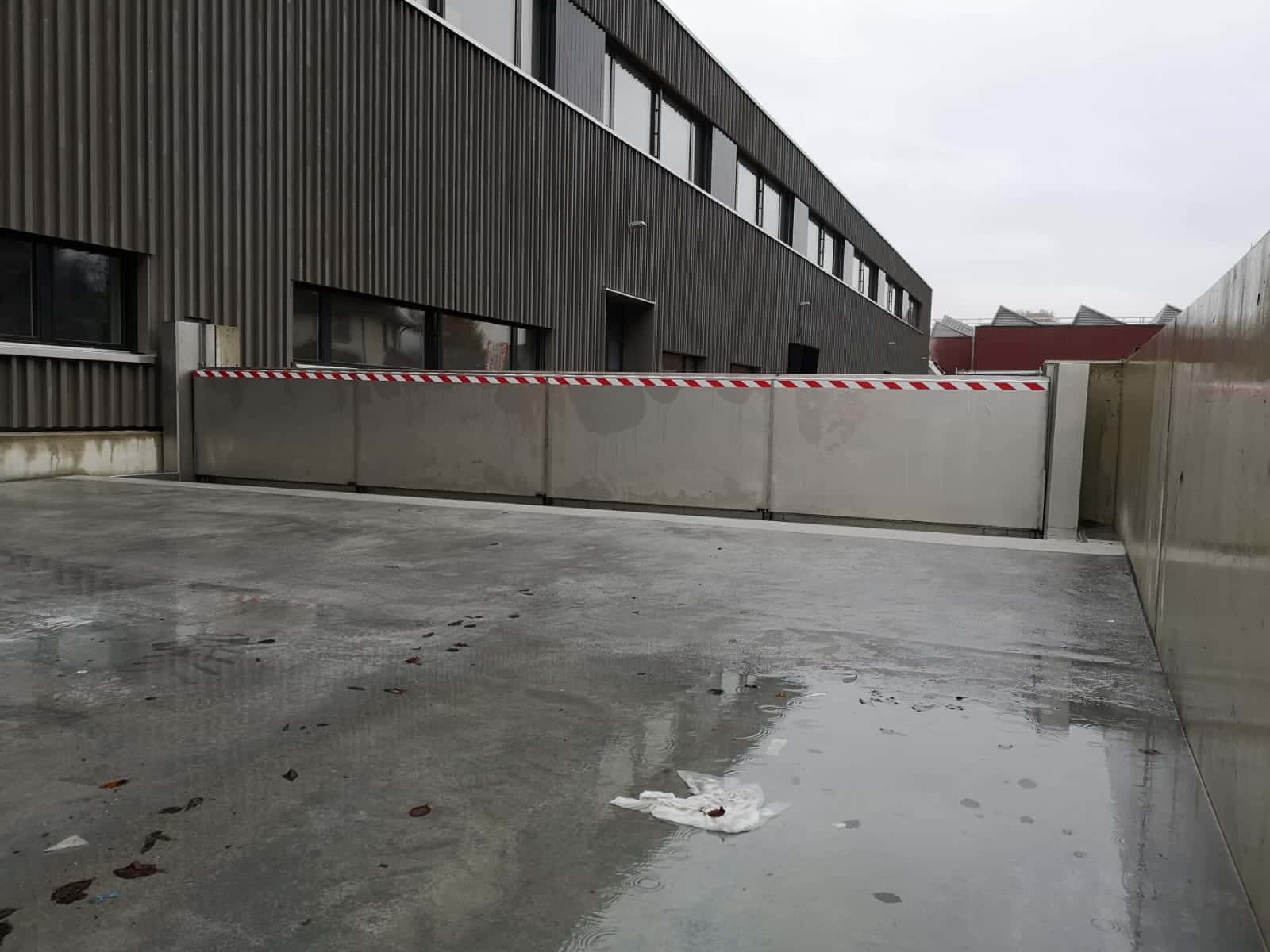
Towers in Wan Chai, North Point, Quarry Bay, and New Territories waterfront districts sit within the direct storm surge envelope. The 3.4 m Chart Datum sea level recorded during Ragasa in 2025 is a design benchmark every waterfront asset manager should compare against their ground-floor threshold elevation. Glass flood walls — designed to hold back water while maintaining visibility in urban or scenic areas — are one option for premium waterfront lobbies. For service ramps and loading areas at the same properties, the Spillbarrier automatic gate provides industrial-grade reliability.
MTR-Connected Retail Podiums and Underground Passages
The MTR network creates an interconnected underground layer beneath large parts of Hong Kong. Flash floods can propagate quickly through these linked spaces, and any single unprotected threshold becomes a pathway for a much larger volume of water. Automatic barriers can be installed at selected thresholds without disrupting pedestrian movement, accessibility, or the visual character of premium retail environments — the flush-floor design ensures the barrier is invisible until activated.
The Economic Case for Automatic Flood Protection
Flood damage to a commercial building in Hong Kong compounds rapidly across multiple cost categories:
- Direct repair: dehumidification, structural drying, switchgear replacement, lift systems, floor finishes, ceiling reinstatement.
- Tenant disruption: if tenants suffer losses due to inadequate flood protection, landlords may face lease-related claims.
- Business interruption: downtime in a data centre or logistics hub can cost millions of HKD per day.
- Insurance complications: claims may be challenged if flood protection measures were inadequate or undocumented.
- Regulatory exposure: critical infrastructure operators face escalating compliance requirements for resilience documentation.
Research from PolyU modelling typhoon-induced coastal flooding found that worst-case compound events could multiply economic losses by a factor of 2.0–2.3 compared to current baseline — with the Yuen Long District identified as the most economically vulnerable.
Over a 10–20 year asset horizon, the lifecycle economics of a permanent, automatic system become increasingly favourable compared with annual deployment of sandbags, demountable panels, and manual teams. Corporate insurers and property underwriters are now actively reviewing flood resilience measures during underwriting. A documented, engineered, third-party-tested flood barrier at a vulnerable opening is materially different from a note in the risk register that says “sandbags available.”
The Government’s Four-Layer Coastal Flood Defence Framework
The Civil Engineering and Development Department (CEDD) has formally adopted a Progressive Adaptive Approach to coastal flood risk in Hong Kong, structured around four layers. Understanding where your building sits within this framework clarifies the role of on-site flood control measures:
- Layer 1 – Coastal adaptation: raising wave walls and sea defences (government-funded, decades-long programme).
- Layer 2 – Resilience buffer: demountable flood barriers behind the coastline (government and private cooperation).
- Layer 3 – Building-level contingency: demountable flood boards and sandbags at important buildings (building owner responsibility).
- Layer 4 – Management measures: early warning systems, pumps, and emergency plans (building owner responsibility).
The CEDD explicitly acknowledges that public infrastructure cannot protect every individual building. Layers 3 and 4 are the full responsibility of building owners and facility managers. By replacing the manual, fallible elements of those layers with an engineered, passive, always-ready automatic flood barrier, you close the gap between government protection and building-level resilience.
Spillbarrier for Hong Kong: Getting Started with Flood Protection
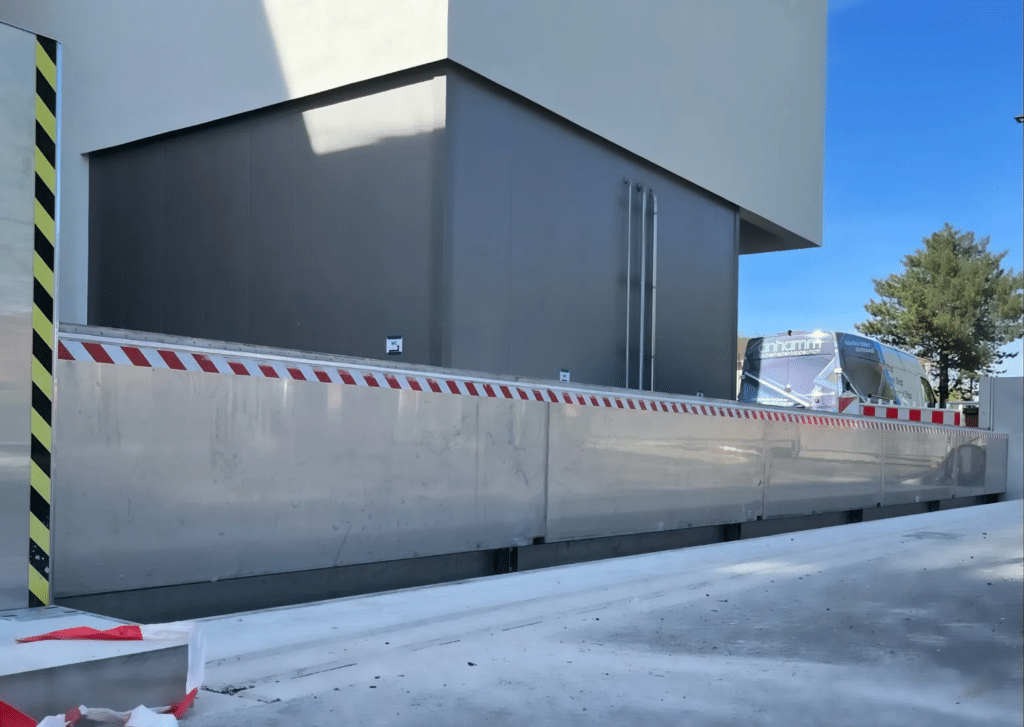
If your site has experienced ponding, near-miss flooding, or sits in a district with a documented flood history, a professional site assessment is the most productive first step before the 2026 typhoon season reaches its peak. Spillbarrier works with facility managers, property owners, engineers, and consultants to assess flood protection requirements at specific openings and propose engineered solutions sized for actual hydraulic conditions.
- Site assessment: identify all below-grade or threshold openings at flood risk. Document sill levels relative to local ground and tidal benchmarks.
- Flood risk review: cross-reference opening elevations against known flood levels and storm surge records, including Ragasa’s 3.4 m Chart Datum reading at Quarry Bay in 2025.
- Hydraulic sizing: Spillbarrier engineers size the gate, sump, and seal for the expected water head, traffic loads, opening geometry, and corrosion environment.
- Installation: the barrier is installed flush with the driveway or floor, integrated into the structural slab. No above-floor structure is visible during normal operations.
- Commissioning and documentation: the installed system is performance-verified and fully documented for insurance and compliance purposes.
You can request a consultation or site-specific proposal from Anhamm/Spillbarrier. The Spillbarrier gallery shows real installations in similar environments worldwide.
Frequently Asked Questions About Flood Barriers in Hong Kong
Does an automatic flood barrier need maintenance?
Spillbarrier’s passive design does not rely on an active service cycle. The main ongoing requirement is a periodic visual inspection to confirm the collection sump is clear of debris. This is a significant advantage over motorised gate systems, which require regular electrical and mechanical maintenance.
What height of water can the Spillbarrier flood barrier handle?
The barrier is hydraulically sized for the specific site during the engineering phase. For Hong Kong applications, relevant design heights include storm surge levels up to 2–3.5 metres above Chart Datum based on recent events, plus surface runoff accumulation depths at the protected opening.
Can it be retrofitted into an existing building?
Yes. Spillbarrier systems are designed for retrofits. An installer cuts a recess into the existing slab at the doorway or ramp, sets the barrier housing in place, and commissions the float mechanism. Work is limited to the immediate threshold area and does not require structural modification to the wider building.
What happens during a total power blackout?
Because the system is entirely passive and water-activated, a complete mains failure has no effect on operation. The barrier activates when water rises, regardless of whether power is available. This makes it fundamentally more reliable than any electrically dependent flood gate system during typhoon conditions.
How does the Spillbarrier system compare to glass flood walls for a premium lobby?
Glass flood walls are designed to hold back water while maintaining visibility in urban or scenic areas — the right choice for prestigious ground-floor lobbies where aesthetics must be preserved. For service ramps, loading docks, and utility entrances at the same property, the Spillbarrier stainless-steel automatic gate provides industrial-grade reliability without visual compromise.
When is the best time to install a flood barrier in Hong Kong?
The Jan-Feb-Mar-Apr period represents the driest part of the year and the lowest-risk window for outdoor civil work. Making March the practical deadline for installation ensures your barrier is commissioned and tested before the June–October peak typhoon season begins.
Anhamm Liquid Barrier Products GmbH — Franz-Haniel-Strasse 47, D-47443 Moers, Germany. All technical details in this article are based on Anhamm documentation and public data from the Hong Kong Observatory and CEDD as of May 2026. Spillbarrier is the international brand at spillbarrier.com.

