

Effective warehouse fire protection is essential to protect lives and preserve assets. In today’s global supply chain, where logistics centers serve as the critical hubs of commerce, a fire can have catastrophic consequences — not only loss of goods, but operational shutdowns, environmental damage, and serious legal liability. This comprehensive guide covers the most important measures to prevent fires in warehouses and logistics facilities and to respond effectively when they occur. From structural and technical solutions to regular monitoring, maintenance, and the integration of modern systems like the Spillbarrier Fire Protection Barrier — learn how to best secure your warehouse and distribution center.
Key Takeaways
Warehouse Fire Protection: Core Facts
- Effective warehouse fire protection requires structural, technical, and organizational measures that must work in close coordination.
- Compliance with US regulatory requirements such as NFPA 1, NFPA 72, NFPA 13, and OSHA 1910 standards is mandatory for safe and legally compliant warehouse operations.
- Regular maintenance, employee training, and evacuation drills are non-negotiable to protect personnel and enable rapid emergency response.
- Modern systems like the Spillbarrier Fire Protection Barrier provide low-maintenance, energy-free solutions for firefighting water containment and flammable liquid control.
What Is Warehouse Fire Protection?
Warehouse fire protection encompasses all preventive and reactive measures designed to prevent the ignition and spread of fires while protecting people, property, and the environment. The primary purpose of fire protection in industrial construction is the protection of human life and assets, as codified in NFPA 1: Fire Code and state-level fire codes across the US. A properly implemented fire safety plan forms the foundation of safe facility operations. For a broader overview of preventive measures, see our guide on fire protection strategies for businesses. Effective warehouse fire protection covers three core pillars: structural (e.g., fire compartments, fire-resistance ratings per ASTM E119/UL 263), technical (e.g., fire alarm systems, sprinklers, automatic barriers like Spillbarrier Fire Protection Barriers), and organizational (e.g., fire safety plans, training programs). All three pillars must interlock seamlessly to achieve maximum safety.

The construction of warehouses requires fire protection considerations that must be addressed in the early planning phase. Particular challenges arise with high-rack storage systems, which due to their material density and restricted accessibility require specialized fire protection solutions as addressed by NFPA 13: Standard for the Installation of Sprinkler Systems. Another critical element is egress design and fire alarm systems compliant with NFPA 72: National Fire Alarm and Signaling Code. The fire alarm control panel (FACP) is the central hub of a fire detection system, receiving signals from detectors and initiating automatic emergency alerts.
To improve overall safety and regulatory compliance, fire protection measures should be integrated into the design of logistics facilities from the outset. Regular updates are necessary because fire safety requirements and code editions evolve continuously — particularly as high-density automated storage and e-commerce fulfillment facilities introduce new risk profiles.
What Are the Legal Requirements for Warehouse Fire Protection in the US?
In the United States, warehouses and logistics centers must comply with a layered framework of federal, state, and local fire codes. The NFPA 1: Fire Code establishes minimum requirements for fire prevention and suppression. The International Building Code (IBC), adopted in most US jurisdictions, sets structural fire requirements by occupancy classification — including Group S (storage) occupancies that cover warehouses and distribution centers. Companies must also comply with OSHA 29 CFR 1910 for general industry fire safety, including egress requirements, extinguisher placement, and employee training obligations.
| Standard / Code | Application | Key Requirements |
|---|---|---|
| NFPA 1 | Industrial buildings, logistics centers | Fire compartments, egress routes, general fire code compliance |
| NFPA 13 | High-rack storage (>12 ft / 3.7 m) | Sprinkler system design for high-piled storage and rack storage warehouses |
| NFPA 72 | Fire alarm and signaling systems | Detection, alarm notification, FACP requirements, inspection intervals |
| NFPA 30 | Flammable and combustible liquids storage | Secondary containment, spill control, tank storage requirements |
| OSHA 29 CFR 1910 | All industrial facilities | Employee fire safety, egress, extinguisher programs, emergency action plans |
In addition, the International Fire Code (IFC) and individual state fire codes impose facility-specific requirements. For high-rack storage exceeding 12 feet in height, NFPA 13 mandates in-rack sprinkler systems. Requirements for firefighting water supply are critical to the operational readiness of fire suppression systems in warehouses. Modern solutions like the Spillbarrier Fire Protection Barrier play a key role here, automatically containing firefighting water runoff to prevent environmental contamination and cross-contamination of adjacent areas.
Fire protection engineers (FPEs) play a central role in communicating with building departments, fire marshals, and the Authority Having Jurisdiction (AHJ). Monitoring of fire protection measures must account for both regulatory requirements and day-to-day operational conditions. Regular compliance reviews are necessary to ensure all measures continue to meet applicable code editions, particularly when occupancy or storage configurations change.
Typical Fire Risks in Warehouses and Logistics Centers
The 6 Most Common Fire Risks in Warehouses
Warehouses and logistics centers contain numerous fire risks arising from materials, equipment, and building systems. These are the most frequent hazards:
- Electrical and lighting fires: Overloaded circuits, faulty wiring, and improper use of extension cords are leading causes of warehouse fires according to NFPA data.
- Trash and waste fires: Accumulations of paper, cardboard, or other combustible packaging materials significantly increase ignition risk in receiving and shipping areas.
- Heating equipment: Improperly used or inadequately maintained space heaters and HVAC equipment can ignite nearby combustibles.
- Flammable liquids and chemicals: Storage of flammable or combustible liquids requires specialized chemical spill protection barriers and liquid containment systems for aggressive chemicals.
- Packaging materials: Paper, cardboard, and plastic shrink wrap serve as primary fuel and accelerate fire spread throughout storage aisles.
- Forklift and equipment collisions: Impacts between forklifts, racking, and stored materials can produce sparks or puncture flammable liquid containers, triggering fires.
Common warehouse fire risks include high fire loads and combustible stored goods. Characteristic vulnerabilities include inadequately maintained systems, obstructed egress routes, and gaps in employee training. Thorough risk assessments enable facilities to identify potential fire hazards and implement preventive measures proactively — a requirement under both OSHA 1910 and FM Global property protection standards.
Fire risks in logistics centers are growing due to increasing operational complexity, larger fire loads, and diverse ignition sources. According to FM Global research, over one-third of all major industrial fire losses occur in warehousing and logistics operations. Warehouse automation increases the risk of electrical failures and makes fire detection more challenging in unmanned areas operating overnight or on weekends.
In cold storage warehouses, the dry air accelerates fire development and insulation materials contribute additional fuel load. Fires in hazardous materials storage can have severe environmental consequences under EPA SPCC regulations (40 CFR Part 112), as fire hazards vary significantly by substance stored. Comprehensive safety measures for chemical and fire hazards are therefore indispensable. Tailored fire protection solutions must be developed for each storage type — from automatic chemical spill protection barriers to specialized water containment barriers.
Modern Fire Protection Solutions for Warehouses
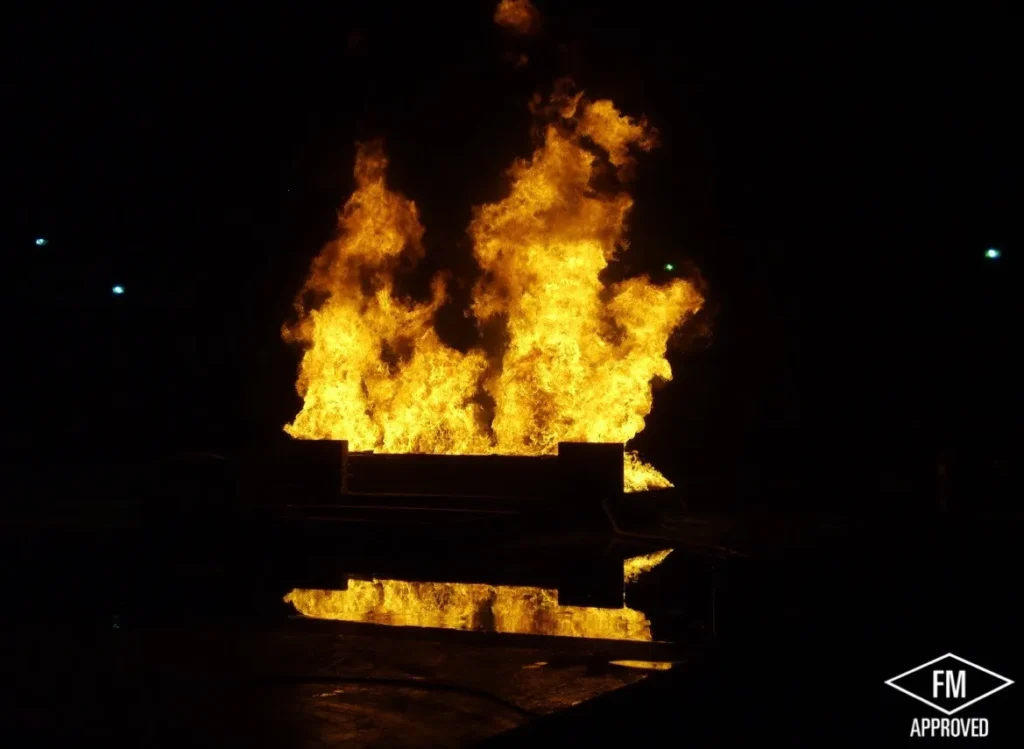
Modern warehouse fire protection solutions encompass advanced fire detection and suppression systems that comply with current US standards. Fire alarm systems must meet the requirements of NFPA 72 to ensure reliable detection, notification, and alarm transmission. Sprinkler systems must comply with NFPA 13, which sets design criteria for both standard and high-piled storage configurations common in modern distribution centers.
Intelligent fire alarm control panels (FACPs) improve alarm routing through precise communication via cloud-connected monitoring platforms. Modern suppression systems — including clean agent, gaseous, and foam systems — are particularly suited for sensitive areas such as server rooms, battery storage, and flammable liquid warehouses. Oxygen reduction systems prevent fires by maintaining oxygen levels below the combustion threshold in continuously occupied high-risk zones. The development of automatic protection systems has advanced enormously in recent years. Similar to innovative flood protection technologies, modern fire containment barriers leverage automation, energy independence, and low-maintenance construction principles.
Energy-Independent
Mechanical systems like the Spillbarrier Fire Protection Barrier operate without electricity, hydraulics, or compressed air — similar to water-activated flood barriers.
Low Maintenance
Minimal maintenance costs through robust, long-lasting construction with no electronic components — a significant lifecycle cost advantage for warehouse operators.
FM Approved
Meets all relevant US fire protection standards and FM Global certification requirements — enabling simplified insurance compliance documentation.
How Does the Spillbarrier Fire Protection Barrier Work?
The Spillbarrier Fire Protection Barrier is a purpose-built barrier for containing flammable liquids, controlling liquid-phase fires, and retaining contaminated firefighting water runoff. It operates entirely mechanically, requiring no electrical or hydraulic power sources — guaranteeing the highest level of reliability precisely when power outages coincide with fire events. The system activates automatically via a float mechanism the moment liquids reach a defined threshold level.
How It Works — 3 Steps:
- Liquid reaches threshold: Firefighting water or flammable liquid accumulates and reaches the installed barrier housing.
- Float mechanism activates: The integrated stainless steel float responds to the liquid level and mechanically raises the sealing plate — the same operating principle used in water-activated flood barrier systems.
- Barrier seals automatically: The plate closes the opening completely, preventing contaminated firefighting water or flammable liquids from escaping into drainage systems, waterways, or adjacent areas — meeting EPA SPCC requirements.
These modern fire protection technologies can significantly reduce operating costs while simultaneously raising safety levels. Combined with traditional systems such as sprinkler systems and fire alarm control panels, they create a comprehensive safety net for warehouse operations. Similar automatic systems — such as flood barriers for doors and garage openings — also use float mechanisms for maximum reliability in unattended facilities.
How to Plan and Implement a Warehouse Fire Safety Plan
Define Protection Objectives
- Prioritize life safety as the primary objective
- Define asset protection and business continuity goals
- Address environmental protection requirements (EPA SPCC)
Conduct a Risk Assessment
- Identify fire loads (materials, stored goods, packaging)
- Identify ignition sources (electrical, mechanical, hot work)
- Analyze egress routes and occupant load
Plan Structural Fire Protection Measures
- Establish fire-resistance ratings (1-hour, 2-hour, 3-hour per ASTM E119/UL 263)
- Define fire compartments and fire walls per IBC Chapter 7
- Dimension egress routes per IBC Chapter 10 / NFPA 101
Integrate Technical Systems
- Design fire alarm systems per NFPA 72
- Size sprinkler systems per NFPA 13
- Plan smoke and heat ventilation systems
- Install Spillbarrier firefighting water containment barriers at all critical drainage points and door openings
Establish Organizational Measures
- Develop a written Emergency Action Plan (EAP) per OSHA 1910.38
- Create fire prevention and response procedures
- Define maintenance intervals for all fire protection systems
Authority Coordination (AHJ)
- Submit fire protection narrative and drawings to the Authority Having Jurisdiction (AHJ)
- Coordinate fire department access and pre-incident plans
- Obtain inspection and acceptance documentation
Monitor Implementation
- Conduct construction phase fire protection inspections
- Train fire brigade and emergency response teams
- Document all system tests and commissioning results
Ongoing Maintenance and Updates
- Conduct annual inspections per NFPA 25 (sprinklers) and NFPA 72 (alarms)
- Account for occupancy changes and storage configuration updates
- Incorporate technical updates and new code editions as adopted by your AHJ
Implementing a warehouse fire safety plan requires close collaboration between the building owner, fire protection engineers (FPEs), and general contractors to achieve protection objectives efficiently. Early involvement of the FPE in the design process facilitates the identification of appropriate fire protection measures. The fire protection plan is typically developed from the building permit documents and the current operational profile.
Planning should also address changes in applicable codes and their impact on existing building systems and products. Achieving cost-effective solutions requires coordination between the various engineering disciplines and the FPE. Embedding the FPE within the project team from the outset streamlines implementation of an effective fire protection strategy for any industrial facility.
Case Study: Fire Protection in a New Logistics Center
A leading example of a comprehensive warehouse fire safety plan in the US context is the FM Global-guided approach for large-scale distribution centers. FM Global Loss Prevention Data Sheet 8-9, covering storage of flammable and combustible liquids in warehouses, provides the definitive framework for US logistics operators seeking both code compliance and insurance optimization. A key structural element is the use of fire walls in substantial construction to separate hazardous storage areas from general logistics operations.
Installation of a complete NFPA 13-compliant sprinkler system, including in-rack sprinklers for high-piled storage exceeding 12 feet, is a non-negotiable element of any modern US warehouse fire safety plan. Large-scale distribution centers — those exceeding 300,000 sq ft — are increasingly divided into multiple distinct fire compartments with different sprinkler design densities based on occupancy hazard classification. These facilities typically qualify as special occupancies under the IBC, which triggers additional code requirements including enhanced fire detection, suppression, and firefighting water supply.
Large US logistics investments — Amazon, Walmart, and third-party logistics (3PL) operators routinely building facilities at $100M+ — are typically designed to FM Global property protection standards, which exceed minimum code requirements and result in measurable insurance premium reductions. These facilities require wastewater containment systems for firefighting runoff per EPA SPCC — precisely the application for which Spillbarrier’s automatic firefighting water retention barriers are designed.
Why Interdisciplinary Collaboration Is Critical
Close cooperation between architects, fire protection engineers, mechanical engineers, and operations teams is essential for developing effective warehouse fire protection strategies. Interdisciplinary teams drive innovative approaches tailored to the specific hazards and use cases of each facility. Coordination across engineering disciplines is required to address all safety-relevant aspects throughout design and construction.
Team collaboration enables a holistic view of fire protection measures across the entire project lifecycle. Cross-disciplinary coordination saves time and improves planning efficiency. Only through this integrated approach can a truly fire-safe industrial facility be designed, built, and operated.
Maintenance and Inspection of Warehouse Fire Protection Systems
Safety Notice
Installation and maintenance of fire protection systems must be performed by licensed and certified contractors. Regular inspections per NFPA 25 (Inspection, Testing, and Maintenance of Water-Based Fire Protection Systems) and NFPA 72 are legally required in all US jurisdictions.
Water-based suppression systems must be maintained regularly because they operate under continuous pressure and are susceptible to material fatigue, corrosion, and biological fouling. Administrative and employee support areas also require dedicated maintenance protocols to ensure safety system integrity. Gaseous suppression systems store agent in pressurized cylinders and require periodic hydrostatic pressure testing per manufacturer specifications and applicable NFPA standards.
Establishing a fixed maintenance schedule and engaging certified inspection contractors is therefore non-negotiable for any warehouse operator. Regular maintenance and updates to current code standards are critical to long-term building safety. Integration of smart monitoring technologies — including remote FACP supervision and IoT-connected sprinkler system monitors — contributes to long-term system reliability.
In automated storage and retrieval systems (AS/RS), restricted human access can compromise the effectiveness of fire detectors. Inadequate fire detection in unmanned areas means fires may go undetected until they have grown significantly. Smoke and heat ventilation systems — smoke control systems per IBC Section 909 — are essential to managing toxic combustion gases during a fire event in large-volume warehouse spaces.
Modern solutions like the Spillbarrier Fire Protection Barrier are distinguished by minimal maintenance requirements, operating entirely mechanically with no electrical or hydraulic components. This significantly reduces long-term operating costs — an important factor in the total cost of ownership calculation for large distribution centers.
Planning and Conducting Fire Drills and Evacuation Exercises
An effective evacuation plan encompasses the design of egress routes, assembly points, and emergency notification procedures. Evacuation drill design should be tailored to the specific hazards and operational risks of each facility. The primary objective of evacuation drills is the rapid and orderly evacuation of all employees in an emergency — the standard set by OSHA 1910.38 (Emergency Action Plans).
The legal framework for fire safety and evacuation exercises in the US is established in OSHA 29 CFR 1910.38 and NFPA 101: Life Safety Code. It is recommended that evacuation drills be conducted at minimum annually, with higher-frequency drills for facilities with high employee turnover or complex egress scenarios. Regular training and drills in fire response protocols are critical to ensuring all employees know how to respond effectively when a fire occurs.
Evacuation training covers legal obligations, first aid organization, and site-specific hazard awareness. OSHA requires employers to conduct drills at a frequency appropriate to the hazard level of the facility. Regular fire drills enhance response confidence and have the proven potential to save lives. Well-trained employees conserve critical time during an emergency and reduce panic-driven injuries.
Frequently Asked Questions
Conclusion: Comprehensive Warehouse Fire Protection Saves Lives and Assets
A well-designed warehouse fire safety plan is non-negotiable for the protection of people, assets, and the environment in warehouses and logistics centers. The integration of structural, technical, and organizational measures provides comprehensive protection against fires and their consequences. Modern fire protection solutions — including the Spillbarrier Fire Protection Barrier, chemical spill protection barriers, and flood and water protection systems — combined with regular maintenance, ensure effective fire suppression capability and protect both employees and the environment.
Close collaboration across engineering disciplines and continuous employee training are essential for the successful implementation and long-term maintenance of a fire protection program. Invest in regular drills, current technologies, and low-maintenance systems to operate your warehouse and logistics center safely and efficiently — and to meet your obligations under NFPA, OSHA, and FM Global standards.
Spillbarrier Fire Safety Editorial Team
The Spillbarrier Fire Safety Editorial Team consists of fire protection engineers, technical writers, and industrial safety specialists. Anhamm has been developing innovative automatic containment systems for industrial and commercial facilities for over 30 years. Our focus:
- Development of low-maintenance, standards-compliant fire containment barriers engineered and manufactured in Germany
- Clear, practical guidance on US fire protection codes and their real-world application in warehouses and logistics facilities
- Honest technical information without exaggerated claims — just engineering that works
Disclaimer: This article does not replace a formal fire protection engineering assessment. For facility-specific guidance, please consult a licensed fire protection engineer or contact us at spillbarrier.com/contact/.

