

Nearly 40% of facility incidents involving chemical spills lack adequate containment measures, according to UNECE industrial accident prevention research. For this reason, chemical barriers and spill containment systems are no longer luxury items—they’re critical risk-control infrastructure that separates a contained incident from an environmental and personnel crisis.
This comprehensive guide explains how chemical barriers work and which materials protect against hazardous liquids. It also covers regulatory requirements that demand secondary containment and real-world case studies showing ROI and risk reduction. Ultimately, you’ll learn how to build a site-specific chemical protection strategy aligned with EPA compliance, industry standards, and operational readiness.
Key Takeaways
- Chemical barriers reduce incident scope by 70–90%: Early containment prevents escalation from a small leak into a major environmental release and personnel exposure event.
- Secondary containment is mandatory under EPA SPCC (40 CFR 112.7(c)): Most facilities storing hazardous liquids must demonstrate containment or diversionary structures to prevent discharges to navigable waters.
- Material performance varies by exposure scenario: ISO 6530:2005 standards define penetration, absorption, and repellency indices for protective materials—concepts that directly apply to barrier selection for chemical protection.
- Pre-positioned mobile barriers cut response time from 30+ minutes to under 5 minutes: Notably, deployment speed is a life-saving variable in early-stage spill management.
- Warehouses see 79% of all chemical accidents but often lack adequate emergency planning: In many cases, design shortcomings and inadequate response procedures escalate accidents in warehouse and storage facilities.
What Are Chemical Protection Barriers?
Chemical protection barriers are engineered systems and materials designed to isolate, block, and contain hazardous liquids to prevent migration, exposure, and environmental release. Fundamentally, they function as a physical control layer that stops or redirects spill pathways before contamination spreads to sensitive zones (drainage systems, personnel areas, soil, and groundwater).
Types of Chemical Barriers (Overview)
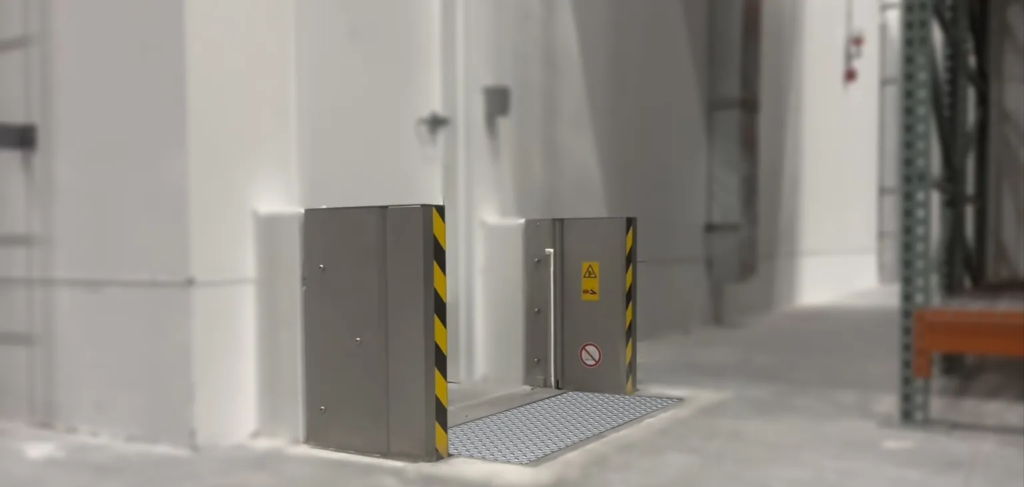
- Door threshold barriers: These prevent spill migration into adjacent corridors and offices; they’re typically made from foam, rubber, or hybrid materials rated for specific chemicals.
- Drain covers & sealing plugs: By blocking entry to storm and sanitary systems, these keep chemicals out of municipal treatment and surface waters.
- Temporary bunds & spill trays: Essentially, foldable or modular containment structures positioned near storage, transfer, or processing areas; they can contain 25–500+ liters depending on design.
- Secondary containment flooring & coatings: These impermeable surfaces (stainless steel, coated concrete, HDPE-lined) prevent liquid penetration and enable safe cleanup.
- Mobile chemical containment systems: Moreover, deployable barriers combine isolation, diversion, and decontamination—ready to use in under 30 minutes (see case study below).
Related reading: Understanding Spill Barriers: Types, Materials & Installation covers material comparison and deployment workflows in detail.
Why Chemical Barriers Are Critical: Regulatory Compliance & Risk Reduction
EPA SPCC Secondary Containment Requirements (40 CFR 112.7–112.8)
Facilities subject to the Spill Prevention, Control, and Countermeasure (SPCC) rule must demonstrate secondary containment or diversionary structures to prevent discharges of oil and other hazardous materials to U.S. navigable waters or adjoining shorelines.
- Containment sizing: Specifically, the system must hold 100% of the largest single container plus 10% of total stored volume, with sufficient freeboard to account for rainfall.
- Facility drainage design: EPA guidance explicitly addresses combined collection areas, drain protection, and spill response infrastructure as integral to compliance.
- Inspection & maintenance: Additionally, secondary containment systems must be free of cracks, gaps, and accumulated waste; they must be inspected regularly and cleaned promptly to prevent overflow.
- Diversionary structures & curbing: In practice, physical barriers (curbs, dikes, berms, portable chemical barriers) are recognized as equivalent controls in many scenarios.
Key fact: Facilities without formal secondary containment face federal civil penalties of $25,000+ per day of violation. They also face cleanup, remediation, and third-party liability costs.
Beyond SPCC: RCRA, State Regulations & Industry Standards
The EPA’s Resource Conservation and Recovery Act (RCRA, 40 CFR Part 264) imposes similar secondary containment requirements for hazardous waste storage. Additionally, state environmental agencies often adopt stricter rules. Industry standards (ISO 6530, ASTM F903) define material performance expectations for protective equipment and spill-response textiles.
| Regulation / Standard | Scope | Key Requirement |
|---|---|---|
| EPA SPCC (40 CFR 112) | Oil & hazardous liquid storage; facilities ?1,320 gal total capacity | Secondary containment or diversionary structures; 100% of largest container + 10% total |
| EPA RCRA (40 CFR 264) | Hazardous waste storage; generators & treatment/storage/disposal facilities | Impermeable secondary containment; free of cracks/gaps; weekly inspections |
| ISO 6530:2005 | Protective clothing materials; penetration/repellency against liquid chemicals | Classification indices for low-volatility chemical splash scenarios |
| ASTM F903 | Protective clothing liquid penetration resistance | Controlled drop-impact test; measures barrier integrity under dynamic exposure |
How Chemical Barriers Work: Principles & Multi-Layer Defense
An effective chemical protection strategy combines three operational layers: isolation at source, containment at the pathway, and safe recovery and decontamination. Consequently, this layered approach (defense-in-depth) ensures that if one layer fails, others prevent escalation.
Layer 1: Isolate (Source Control)
For source control, stop or reduce the release at the point of origin with these actions:
- Closing isolation valves on leaking pipes or containers
- Using temporary sealing plugs, clamps, or epoxy patches
- Transferring liquid to alternative intact containers
- Deploying specialized chemical protection solutions to prevent re-release
Layer 2: Contain (Pathway Control)
To stop lateral spread and prevent migration into sensitive areas, apply these techniques:
- Deploying door threshold barriers to block corridor entry
- Covering drains with sealing devices or absorbent plugs
- Positioning temporary bunds or trays at low points
- Creating diversionary channels using absorbent socks or berms
Layer 3: Recover & Decontaminate
To safely remove liquid and restore safe working conditions, follow these steps:
- Collecting spilled material into designated waste containers
- Wiping & decontaminating affected surfaces (minimum 20 minutes contact time with appropriate disinfectant)
- Protecting responders with appropriate PPE (gloves, face shields, respiratory protection if needed)
- Disposing of contaminated materials per regulatory and waste classification standards
Case Study 1: Warehouse Chemical Spill Response (Real-World Impact)
The Incident: Sulfuric Acid / Sodium Hypochlorite Mixing at MGPI Processing
On October 21, 2016, an MGPI processing facility near Atchison, Kansas experienced an unplanned chemical reaction when a delivery truck connected to the wrong fill line, inadvertently mixing 4,000 gallons of sulfuric acid with 5,850 gallons of sodium hypochlorite. Consequently, the reaction released a toxic chlorine gas plume affecting the nearby community: over 140 people sought medical attention, with 6 hospitalized.
Root Causes
- Design failure: Fill line identification and locking mechanisms were not fail-safe; operators manually directed drivers to the correct line without redundant verification.
- Inadequate emergency procedures: Notably, no automated or remote emergency shut-off system existed for cargo tank connections.
- Communication breakdown: Furthermore, pipe markings were unclear; operators did not visually verify driver connections before liquid transfer began.
Lessons for Chemical Barriers & Containment
This accident highlights why pre-positioned secondary containment and mobile chemical barriers at unloading areas are critical. Had the facility deployed temporary barrier systems to isolate the unloading zone and prevent chemical spread, and if drain covers had been pre-staged, the toxic plume release could have been significantly reduced, protecting the surrounding community.
Fire Protection & Chemical Safety in Warehouses explores similar scenarios and practical containment strategies for storage facilities.
Chemical Barrier Material Performance: ISO 6530 & ASTM Standards
Not all materials labeled “chemical resistant” perform the same way. Clearly, performance depends on chemical type, concentration, temperature, contact time, and exposure scenario (splash vs. spray vs. pooling immersion). Importantly, industry standards define how materials are tested and classified.
ISO 6530:2005 – Protective Clothing: Classification of Penetration Resistance
ISO 6530 specifies a standardized test method to measure three key indices for protective materials exposed to liquid chemicals (primarily low-volatility substances):
- Penetration resistance: Time elapsed before a liquid chemical passes through a material sample (measured in minutes; higher = better). Additionally, there are two types: spray/splash penetration (EN 6531) and pooling penetration (EN 6532).
- Repellency: Material’s ability to shed or bead liquid on the surface rather than absorb it. Furthermore, it’s classified on a scale (0–6): scale 6 = excellent repellency, scale 0 = no repellency.
- Absorption resistance: In essence, a material’s capacity to resist liquid uptake, which affects durability and user comfort during extended exposure.
| Material Type | ISO 6530 Repellency Scale (0–6) | Best For (Exposure Type) | Durability Notes |
|---|---|---|---|
| Untreated woven fabric | 0–2 | Dry powder, minimal splash risk | Quick saturation; short-term use only |
| Water-repellent coated fabric (polyester laminate) | 3–5 | Splash & spray scenarios; non-oil chemicals | Good durability for 8–12 hour shifts |
| Multi-layer polymer film (HDPE laminate) | 5–6 | Oil-based & aggressive chemical splash | Excellent; resistant to most industrial chemicals |
| Stainless steel mesh / micro-pore membrane | 6 (complete resistance) | Immersion, high-pressure jets, extreme chemicals | Indefinite durability; reusable & washable |
Application to barrier selection: When choosing site-level chemical protection barriers, the same logic applies. Essentially, a door threshold designed for water-based spills (repellency scale 3) will fail against aggressive solvents; conversely, over-specifying multi-layer HDPE for mild detergent spills wastes budget. Therefore, match material to exposure.
ASTM F903 – Protective Clothing Liquid Penetration Resistance Testing
ASTM F903 uses a controlled drop-impact test to measure how long a material resists penetration when struck by a falling droplet of the target chemical. In effect, this dynamic exposure scenario (versus the static pooling test in ISO 6530) better represents splash and aerosol exposure in real industrial settings.
- Test method: Specifically, the test releases a 0.05 mL droplet from 10 cm height onto the material; the lab records penetration time when the first droplet reaches the back surface.
- Classification: Labs report results in minutes and rate systems by chemical and exposure level.
- Relevance to barriers: Particularly, splash-impact resistance is important for floor-level and drain-protection barriers, where turbulent flow creates dynamic pressure.
Stainless Steel vs. HDPE: Material Comparison for Chemical Barriers
Stainless Steel Containment Systems
Stainless steel (grades 1.4301 / V2A or 1.4571 / V4A) is the preferred choice for long-term, high-durability secondary containment and chemical barrier infrastructure in demanding environments.
- Corrosion resistance: Essentially, it does not rust even under aggressive chemical exposure (acids, bases, oxidizers); it maintains structural integrity over decades.
- Hygienic & cleanable: Its non-porous surface allows thorough decontamination without residual absorption; it’s ideal for food, pharmaceutical, & biotech facilities.
- Durability: With a lifespan of 20+ years and routine maintenance, no replacement cycles are required for material degradation.
- Cost: Though requiring a higher upfront investment (~2–3× HDPE), it’s justified by zero replacement costs and long service life.
- Customization: Modular designs allow exact fit for complex facility layouts; grated flooring and drainage channels can be engineered to specification.
Best for: Permanent chemical storage areas, transfer stations, pump skids, secondary containment floors, high-value facility protection.
HDPE (High-Density Polyethylene) Containment
HDPE (polyethylene) is a cost-effective alternative for short-to-medium term storage and temporary chemical barriers, particularly for non-aggressive chemicals.
- Chemical resistance: It’s highly resistant to acids, bases, and many organic solvents; however, it degrades under extreme heat (>60°C) and prolonged UV exposure.
- Lightweight & portable: Because it’s easy to move and reconfigure, it’s ideal for mobile spill trays and temporary barriers.
- Cost: At 50–70% lower than stainless steel, it’s budget-friendly for temporary deployments.
- Durability: With a 5–10 year lifespan before replacement, it’s susceptible to UV and temperature-induced brittleness.
- Decontamination: Since its porous surface can absorb some contaminants, it requires more aggressive cleaning.
Best for: Temporary mobile barriers, portable spill trays, drain covers for low-corrosive chemicals, short-term unloading operations, cost-constrained facilities.
| Factor | Stainless Steel | HDPE | Choose Based On |
|---|---|---|---|
| Durability | 20+ years (permanent) | 5–10 years (temporary) | Is this a permanent installation or temporary deployment? |
| Chemical resistance | Excellent (all aggressive chemicals) | Good (acids/bases; poor for solvents at high heat) | What chemicals will be stored, and at what temperature? |
| Upfront cost | $$ (higher) | $ (lower) | What is the facility’s capex budget? |
| Portability | Fixed (heavy) | Highly portable | Will the barrier need to move between sites? |
| Cleanliness & hygiene | Superior (non-porous) | Moderate (porous surface) | Is the facility subject to food/pharma regulations? |
Mobile Chemical Containment Systems: Fast Deployment & Incident Control
Mobile chemical containment barriers are engineered for rapid deployment in response to active or suspected leaks. Pre-staging these systems near high-risk operations (storage tanks, transfer points, loading docks, battery rooms) reduces response time from 30+ minutes to under 5 minutes—a critical variable in preventing escalation.
Key Features of Effective Mobile Barriers
- Ready-to-use design: With no assembly required, they can be deployed by one trained operator in under 5 minutes.
- Integrated multi-layer sealing: They combine isolation (source blocking), containment (floor spreading prevention), and decontamination (washdown/rinse capability).
- Chemical compatibility testing: Being pre-tested against common facility chemicals, they include a compatibility chart with the system.
- Modular sizing: Available in configurations from 5–50+ liters, they accommodate small leaks through major spills.
- Reinforced positioning: Through weight, anchoring, or adhesive strips, they prevent shifting during cleanup operations or emergency spray-down.
- HEPA filtration (optional): Some systems include cartridge-based or positive-pressure decontamination units to capture airborne vapors and prevent inhalation exposure.
Case Study 2: Mobile Barrier Deployment in a Manufacturing Facility
A chemical manufacturing plant in the EU stored phenolic compounds in a bulk tank with aging flanges prone to micro-leaks. Routine inspections detected seepage, but traditional fixed containment was under maintenance. To address this, the facility deployed a pre-positioned mobile chemical containment system rated for phenolic exposure around the flange in under 10 minutes. Consequently, the barrier isolated the seeping liquid, preventing drainage migration and protecting nearby employees. After controlled cleanup, the team replaced the flange safely—all without unplanned downtime or environmental release. Estimated cost of mobile barrier: €2,500. Estimated cost of environmental remediation if uncontained: €250,000+.
Related context: Advanced Fire & Chemical Safety Strategies in Warehouse Design discusses infrastructure planning that integrates mobile systems with fixed barriers.
Warehouse Chemical Storage: Accident Statistics & Prevention Priorities
Warehouses and independent storage facilities account for 79% of all reported chemical accidents in Europe, according to the European Commission’s Technical & Biological Hazard Preparedness database. Why is this the case? Typically, warehouses often store chemicals from multiple suppliers in a single facility, lack purpose-built design features, and frequently suffer from inadequate emergency planning and poor inventory management.

Key Statistics on Warehouse Chemical Incidents
- Emergency response failures: According to the European Commission’s Major Accident Hazards Bureau (MAHB) Bulletin 16 on warehouse chemical accidents, investigators found that in more than 50% of warehouse incidents, emergency arrangements and response planning were inadequate; furthermore, in nearly half of those cases, emergency responders were among the fatalities and injuries.
- Design shortcomings: The same MAHB warehouse safety research reveals that in little over half of the events studied, warehouses were not appropriately designed to accommodate hazardous substances, leading to containment failures and escalation. Design issues included lack of segregation elements, improper structural materials, and insufficient ventilation systems.
- Property damage: Data from the U.S. Chemical Safety Board’s incident reports demonstrate that industrial chemical accidents result in catastrophic property losses, with documented incidents exceeding $1.8 billion in damages across 30 major events. Individual warehouse destruction and stock loss frequently result in facility losses exceeding €5 million.
- Spill response delays: The European Commission’s analysis of emergency response failures in chemical accidents indicates that facilities without a structured spill response plan experience significantly higher rates of exposure-related injuries to both personnel and emergency responders. In cases where emergency plans were inadequate, response times exceeded safe intervention windows by hours.
- Domino effect risk: Research from MAHB warehouse incident analyses documents that chemical reactions between incompatible substances (e.g., sulfuric acid + sodium hypochlorite, or sodium chlorite stored near combustible materials) frequently transform localized spills into widespread toxic gas releases or explosions. The JRC study of warehouse incidents found that accidents collectively resulted in 495 fatalities and at least 8,500 injuries, with escalation effects amplifying initial release impacts.
Prevention Checklist: Reducing Warehouse Chemical Risk
- Design & layout: First, install permanent secondary containment (stainless steel or coated concrete), segregate incompatible chemicals, ensure clear floor space and accessible drain covers.
- Inventory management: Next, maintain an up-to-date chemical register with compatibility matrix; enforce “like with like” storage protocols.
- Equipment & maintenance: Furthermore, inspect container integrity, flanges, and seals quarterly; replace worn gaskets and clamps before failure.
- Mobile barriers & PPE: Additionally, pre-stage chemical barrier systems near high-risk zones; ensure emergency responders have access to drain covers, threshold barriers, and spill absorbents.
- Emergency planning: Moreover, document response roles, equipment locations, decontamination procedures, and notification contacts; conduct quarterly drills and update after each incident.
- Training & competence: Finally, ensure staff understand chemical hazards, incompatibilities, and correct use of barrier systems; certify emergency responders and document ongoing refresher training.
How to Evaluate Chemical Resistance: Selection Matrix for Your Facility
Choosing the right material for a chemical barrier requires a structured evaluation of exposure scenario, chemical compatibility, durability requirements, and regulatory context. Consequently, this matrix helps you match barrier type to your facility’s needs.
Step 1: Define Your Exposure Scenario
- Splash (momentary contact, 0–30 sec): This is typical of tank car unloading, pump failure, valve breakage. High velocity but brief exposure; material needs excellent impact resistance.
- Spray (continuous aerosol, 1–10 min): Conversely, this includes hose leaks, nozzle mis-directs, high-pressure cleaning. Requires material with sustained repellency and low absorption.
- Pooling (immersion, >10 min): In contrast, this involves tank base leaks, drain backup, containment overflow. Material must resist chemical penetration over extended time; temperature matters.
- Vapor / aerosol inhalation: Notably, this includes volatile solvents, chlorine releases, acid mists. Requires HEPA filtration or air-supply respiratory protection; passive barriers are insufficient.
Step 2: Verify Chemical Compatibility
Check the chemical against known compatibility matrices (ISO 6530, ASTM F903, manufacturer data sheets). Key factors include the following:
- Chemical family: Essentially, aqueous acids/bases are compatible with most polymers, organics/solvents often degrade HDPE (stainless steel preferred), and oxidizers are corrosive to metals (require coatings or specialty polymers).
- Concentration: For instance, 10% sulfuric acid and 98% sulfuric acid have very different penetration rates; always specify concentration in compatibility requests.
- Temperature: Clearly, high-temperature chemicals degrade polymers rapidly; stainless steel is the only reliable choice above 60°C sustained exposure.
- Duration of storage: In general, short-term (hours–days) allows lower-rated materials; long-term (months–years) requires full-rated systems.
Step 3: Calculate Containment Volume & Select System Size
Under EPA SPCC and RCRA guidelines, you should follow these calculations:
- Minimum containment volume: Specifically, it’s 100% of the largest single container + 10% of total stored volume + freeboard for rainfall.
- Example: For instance, 4 × 200-liter drums (800 liters total) = 200-liter largest container + 80-liter (10% of 800) + 20-liter freeboard = 300-liter minimum containment required.
- Mobile barriers: Therefore, choose modular systems that can be combined to meet your calculated volume.
Step 4: Assess Durability & Maintenance Requirements
| Barrier Type | Durability | Maintenance | Cost per Year (5-year lifecycle) |
|---|---|---|---|
| Stainless steel permanent containment | 20+ years | Annual inspection, corrosion check, drain flushing | ~5% of capital cost |
| HDPE portable containment | 5–10 years | Quarterly inspection, surface wiping, UV protection cover storage | ~15% of capital cost + replacement at EOL |
| Mobile chemical barrier (foam/hybrid) | 3–5 years (active use); 10+ years (standby) | Monthly function test, annual replacement of consumable seals/absorbent cores | ~20% of capital cost + consumables |
| Drain covers / threshold barriers | 5–15 years (varies by material) | Annual removal & cleaning; replace if cracks/gaps appear | ~8% of capital cost |
Frequently Asked Questions (FAQ)
Building Your Chemical Protection Plan: Step-by-Step Framework
Phase 1: Risk Assessment & Inventory (Weeks 1–2)
- Chemical inventory: Begin by listing all hazardous liquids stored, transferred, or processed; include chemical names, CAS numbers, quantities, storage locations, and container types.
- Hazard identification: Next, consult Safety Data Sheets (SDS) for each chemical; note hazard classes (acute tox, corrosive, environmental hazard) and physical state (liquid, vapor pressure).
- Spill risk mapping: Then, identify leak points (pump flanges, valve seals, container seams, transfer hoses) and potential pathways (floor slopes, drain locations, adjacent areas).
- Regulatory scope: Finally, determine if your facility is subject to EPA SPCC (oils) or RCRA (hazardous waste), state environmental rules, or industry-specific standards (pharma, food, semiconductor manufacturing).
Phase 2: Barrier Selection & Procurement (Weeks 3–4)
- Material selection: Using the compatibility matrix above, first choose stainless steel for permanent/high-risk installations and HDPE or hybrid systems for portable/temporary use.
- Volume calculation: Next, calculate required containment volume (100% largest container + 10% total + freeboard) and choose barrier configurations (single large tray vs. modular multi-piece system).
- RFQ & supplier evaluation: Then, request quotes from 2–3 manufacturers; ask for compatibility certificates, material testing data, and references from similar facilities.
- Positioning & procurement: Finally, work with facility management to stage barriers near identified risk zones (loading dock, pump room, storage area) for rapid access.
Phase 3: Training & Procedures (Weeks 5–6)
- Deployment drills: First, train staff on barrier setup, positioning, and use; simulate a spill scenario and time response (target: under 5 minutes to isolate a leak).
- Decontamination procedures: Next, document step-by-step cleanup protocol; include disinfectant contact times (minimum 20 minutes), waste disposal routes, and respiratory protection requirements.
- Emergency contact & escalation: Then, define who calls 911 and environmental authorities if spill exceeds containment capacity; specify pre-positioned phone numbers and facility access codes for responders.
- Documentation & certification: Lastly, record all training attendance; maintain certificates of chemical compatibility; document barrier inspection logs and maintenance history for regulatory audits.
Phase 4: Implementation & Ongoing Management (Months 2+)
- Quarterly inspections: Establish a schedule for systematic checks of all barriers; look for cracks, permeation, corrosion, drain blockages, and hardware degradation.
- Annual drills: Moreover, conduct at least one full-scale spill simulation per year; involve all relevant departments and document performance metrics (response time, containment integrity, cleanup speed).
- Update & refresh: Additionally, after each incident or near-miss, review and update the plan; replace damaged barrier components immediately; conduct additional training if deficiencies emerge.
- Regulatory compliance documentation: Furthermore, maintain SPCC Plan updates, RCRA permits, training records, and incident reports in a centralized system accessible to auditors and emergency responders.
Conclusion: Chemical Barriers as a Core Risk Management Strategy
Chemical protection barriers are not optional add-ons; they are essential infrastructure that bridges the gap between regulatory compliance and operational resilience. Clearly, the data is conclusive: facilities without pre-positioned barriers suffer longer response times, higher escalation rates, and far greater costs when incidents occur. Notably, warehouses, which account for 79% of industrial chemical accidents, are particularly vulnerable when design and emergency planning are inadequate.
By implementing a layered chemical protection strategy—combining permanent stainless steel containment for high-risk storage, mobile chemical barrier systems for work areas, regular training, and documented emergency procedures—you reduce incident frequency, minimize escalation when leaks occur, protect personnel and the environment, and demonstrate strong regulatory compliance.
Next steps: Review your facility’s current hazardous liquid storage, conduct a gap analysis against EPA SPCC and RCRA requirements, and contact a barrier supplier to assess your needs. Ultimately, the upfront investment in chemical protection systems—typically €5,000–€50,000 depending on facility scale—is infinitesimal compared to the cost of a single uncontained spill.
Related Resources & Further Reading
- Chemical Spill Protection Systems & Products – Explore Spillbarrier’s full range of portable and fixed barriers, with compatibility data and case studies.
- Fire Protection & Chemical Safety in Warehouses: Design & Response Strategies – Deep dive into warehouse-specific hazards and integrated protection approaches.
- Advanced Fire & Chemical Safety: Infrastructure Planning for High-Risk Facilities – Technical guide to permanent secondary containment, drainage design, and automation.
- Understanding Spill Barriers: Types, Materials & Installation Best Practices – Comprehensive material comparison and deployment workflows.
- EPA SPCC Rule (40 CFR Part 112): EPA Secondary Containment for Each Container Under SPCC – Official regulatory guidance on sizing, inspection, and maintenance.
- ISO 6530:2005 Standard: Protection Against Liquid Chemicals – Penetration and Repellency Indices – Standardized material performance metrics (available from ISO directly).
Contact & Support
Unsure which chemical barrier system is right for your facility? Our experts can conduct a free risk assessment and recommend solutions tailored to your chemical inventory, regulatory obligations, and operational constraints.

